Imagine a vehicle that advances by sinking into snow, mud or water using two cylinder-shaped helices rotating in opposite directions. It has no wheels. It has no tracks. It is entirely at the mercy of the terrain — and precisely because of that, it can go where everything else fails.
The Siberia problem
A capsule that could not choose where to land
The re-entry capsule of the Soviet Soyuz programme had a geometry problem. Its spherical shape was perfect for maximising interior volume and withstanding the heat of re-entry. But that same sphere, once in the atmosphere, was practically impossible to steer. The cosmonaut could do very little to direct the descent. The capsule fell where it fell — and in the Soviet Union, that could mean in the middle of the Siberian taiga, on a frozen swamp, inside a lake, on a snow-covered hillside hundreds of kilometres from the nearest road.
Temperatures in Siberia can drop below –60 °C. The terrain, depending on the season, can range from permafrost covered in deep snow to a muddy bog that gives no traction to any conventional track or wheel. And the cosmonauts who had just spent weeks in microgravity arrived weakened, disoriented, unable to survive long without assistance.
The Soviet military needed to reach them. No matter where they landed.
¿Cómo se ve en la
vida real?Ver en TikTok▶❤️💬🔗TV@LlantaPinchadaTVThe ZIL-2906: the Soviet vehicle that used Archimedes screws to rescue cosmonauts in Siberia ☭🚀❄️ #ZIL2906 #USSR #Engineering #Space
Disponible en nuestra comunidad vertical
"The vehicle could go practically anywhere — deep snow, swamps, rivers, mud. The only condition was that there be no hard surface. On hard surface, the screws could find nothing to grip."
The 2,200-year-old solution
The Archimedes screw as a wheel
In the third century BC, the Greek mathematician Archimedes described a mechanism as simple as it was brilliant: a helical spiral inside a cylinder that, when turned, raised water from lower levels. Two millennia after the Egyptians and Greeks used it to irrigate fields and drain mines, a group of engineers in Moscow applied the same principle to create a vehicle.
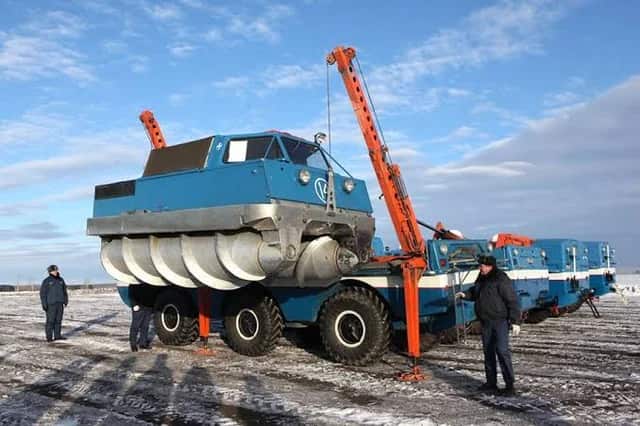
The ZIL-2906 was a шнекоход — shnekojod in transliteration, literally "screw vehicle". Instead of wheels or tracks, it mounted two large aluminium cylinders with a helix carved in a spiral on their outer surface. Placed longitudinally on either side of the chassis, parallel to the direction of travel, these cylinders rotated continuously. As they did so, their spirals "rested" on the snow, mud or water and pushed the vehicle forward — exactly as the Archimedes screw moves water, but in reverse: instead of the screw advancing while the fluid stays still, here the fluid stays still and the screw advances.
The steering principle was also the simplest possible: each screw had its own completely independent motor. To turn right, the left screw was accelerated or the right one braked. To turn on the spot, the two screws were rotated in opposite directions. To move forward, both rotated in the same sense but in opposite directions relative to each other — their lateral forces cancelled each other out and the result was pure forward traction.
The two engines were MeMZ-967A air-cooled units, derived from the Zaporozhets, the small Soviet utility car. Each produced 37 hp. In total: 74 hp to move 1,280 kg of vehicle through Siberian snow, swamp and water.
The system
The Blue Bird and its impossible passenger
The ZIL-2906 never operated alone. It was the final piece of a complete rescue system called PEK-490, developed by the Special Design Department (SKB) of the ZIL plant from 1972 onwards. The package included multiple specialised vehicles, all of them painted in that vivid blue that would give them their collective nickname: Синяя птица — Blue Bird.
The heart of the system was the ZIL-4906, a large six-wheel-drive vehicle capable of travelling across difficult terrain at 80 km/h, equipped with amphibious propulsion and a rear cargo bed. Its role was to get as close as possible to the capsule's landing zone. When the terrain became too soft, too flooded or too snow-covered for the ZIL-4906's wheels, the solution was to unload what it was carrying: the ZIL-2906.
The screw vehicle travelled on the ZIL-4906's cargo bed, secured in a special cradle. Unloading was carried out with a crane built into the carrier vehicle. The complete unloading process took approximately half an hour under normal conditions. If the temperature was below –40 °C — commonplace in Siberia in winter — another half hour was needed for the ZIL-2906's engines to reach operating temperature before it could be driven.
The ZIL-2906 carried in its rear section space for two stretchers for weakened cosmonauts, additional seats for medical personnel, heating for the front seats, a location transponder and communications radio.
The limitations
What a screw cannot do
The ZIL-2906 was extraordinarily capable on the terrain it was designed for. In deep snow, swamp, mud, water, frozen mud, peat bogs, it comfortably outperformed anything with tracks or wheels. But it had three blind spots that made it entirely dependent on its operating conditions.
The first was hard ground. On asphalt, concrete, rock or smooth ice, the screws could find no traction. They spun in place without advancing, and also destroyed the surface beneath them. The ZIL-2906 could not travel on any conventional road without damaging it.
The second was speed. Even in its best conditions — soft snow, water — the vehicle did not exceed 15–16 km/h. It was fundamentally slow.
The third was fuel consumption. In snow and swamp conditions, the ZIL-2906 consumed over 50 litres of fuel per 100 km — more than double that of a conventional truck on the road. For extended operations in remote areas, fuel logistics were a genuine challenge.
And there was a fourth aspect, less technical but equally relevant: the helical screws were prone to becoming entangled with vegetation, branches and roots in boggy forest zones, requiring frequent intervention to clear the rotors.
The legacy
Never used in a real emergency
Of the five ZIL-2906 units built between July 1975 and 1979, and of the fourteen ZIL-29061 vehicles manufactured between 1980 and 1991 — its improved successor — none was ever used in a real space emergency. Advances in the re-entry guidance systems of the Soyuz capsules, and the improvement in landing accuracy, always kept landings within zones accessible to conventional rescue teams using helicopters and the ZIL-4906s themselves.
The ZIL-2906 was, in that sense, the life insurance policy that never had to be used. The vehicles were assigned to the Baikonur Cosmodrome and to alternative landing zones, ready to be activated. They never were.
With the dissolution of the Soviet Union in 1991, production stopped and funding disappeared. The surviving vehicles were left at military and factory facilities. Today, the units that survive are preserved in museums or private collections. In the yard of the MZKT plant in Minsk, alongside the MAZ-7907 — another Soviet giant that also never fulfilled its operational mission — some of the last metal witnesses to the extreme ingenuity of the Soviet space age can still be found.
The шнекоход was not merely a curiosity. Helical propulsion in land and amphibious vehicles continues to be studied today for applications in wetland areas, soft-ground mining operations and rescue operations in extreme environments. The ZIL-2906 demonstrated in practice, on the snows of Siberia and the swamps of Uzbekistan, that the Archimedes screw still had more than one surprise in store — 2,200 years after its invention.