Imagine driving a 1970 Ford Galaxie — a car that weighed nearly 2,300 kilograms and had a 460 cubic inch V8 — 205 miles through the New Mexico desert on exactly two gallons of petrol. No hidden cameras. With journalists and engineers inspecting the car before departure.
The context
The summer when everyone was looking for the 100 mpg miracle
To understand why Tom Ogle's story found such an audience in 1977, one must remember what it was like to live in the United States four years after the 1973 oil crisis. Petrol prices had quadrupled. Queues at petrol stations had been a daily reality. Congress had imposed the national 55 mph speed limit. President Carter appeared on television from the White House in a woollen cardigan asking Americans to turn down their thermostats.
In that climate, anyone who claimed to have an engine capable of doing ten times more on the same petrol was not a fringe lunatic — they were the protagonist of the story everyone wanted to be true.
Thomas Ogle was a self-taught inventor from El Paso, Texas, who claimed to have designed a vapour carburettor system that vaporised petrol for direct injection into the engine's combustion chamber, supposedly achieving exceptional fuel economy without a conventional fuel pump or carburettor.
He was not an engineer. He was a mechanic. He was around 22 years old. And he said he had discovered the principle by accident.
¿Cómo se ve en la
vida real?Ver en TikTok▶❤️💬🔗TV@LlantaPinchadaTVTom Ogle: the Texas mechanic who claimed 100 mpg, got a patent, and died at 26 without anyone replicating his invention ⛽🇺🇸 #TomOgle #Oglemobile #Invention #Mystery
Disponible en nuestra comunidad vertical
"I did it, it works, and it is not a fraud." — Tom Ogle, El Paso Times, 1 May 1977
The lawnmower accident
How the idea was born: 96 hours on a small tank
Ogle said he discovered his system by accident while working on a petrol lawnmower: "I was tinkering with a lawnmower when I accidentally made a hole in the fuel tank. I put a vacuum line that went directly from the tank to the carburettor intake. The mower kept running. I let it run and it kept running, but the fuel stayed the same. I got excited."
According to the published account, Ogle removed the mower's carburettor out of curiosity and placed a hose connecting the fuel tank to the carburettor intake injector, allowing the machine to run on petrol vapours. He claimed the mower ran for 96 hours.
From the lawnmower he moved to the car. Ogle eventually managed to convert one of his own cars, a 1972 Thunderbird, and accumulated 60,000 miles on the system, obtaining over 100 miles per gallon. Without independent verification of that figure.
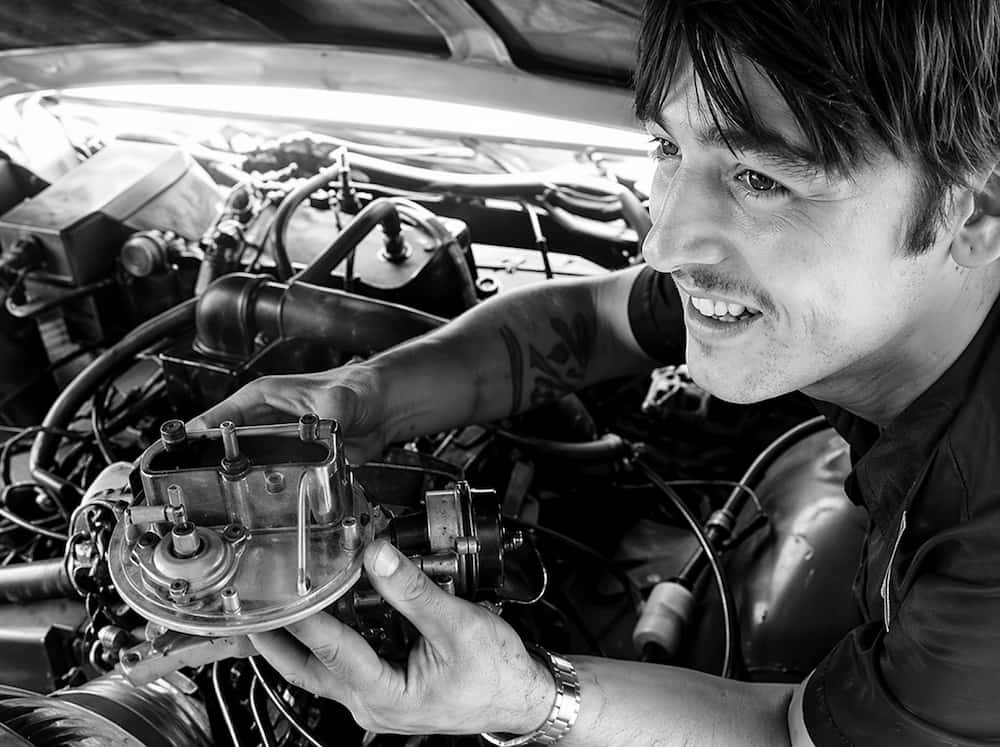
The system he developed eliminated the conventional carburettor and fuel pump. It used engine vacuum to draw fuel vapours from a vapour tank through a duct to a vaporiser placed directly on the engine's intake manifold. The vapour tank was built from high-strength steel to withstand the high vacuum pressure and included an air intake valve coupled to the accelerator pedal. Hot water from the engine's cooling system caused the fuel in the tank to vaporise readily.
The test of 30 April 1977
205 miles. 2 gallons. Journalists and engineers present.
On 30 April 1977, Tom Ogle summoned the press and technical observers to Peck's Automotive Service workshop in northeast El Paso. The car was a 1970 Ford Galaxie with a 460 cubic inch V8 — one of the largest displacement engines ever mass-produced in the United States, in a car weighing nearly 2,300 kilograms. A post-war muscle car in every sense of the term, designed to devour petrol.
Before the test drive, "journalists and onlookers watched as a mechanic emptied the special pressurised petrol tank, and poured two gallons of fuel into the tank once it was empty." The car was also inspected for any hidden tank, but none was found.
The car set off for Deming, New Mexico — a journey of around 80 km in one direction, all motorway, all flat desert. It maintained constant speeds of between 55 and 60 miles per hour. It returned to El Paso with a pint and two ounces of fuel remaining in the tank. It had covered 205 miles on fewer than two gallons.
The only setback was that the return to El Paso from Deming was interrupted a few miles from completing the full journey when a stone damaged a filter, causing a vapour leak and stalling the engine.
Two engineers from the Mechanical Engineering Department of the University of Texas at El Paso — Dr Garry Hawkins and John Whitacre — inspected the system. Hawkins said Ogle's system was "sound and feasible" and that the engineers had made sure there were no hidden fuel compartments. Hawkins added that Ogle's fuel system "has accomplished what was intended for the internal combustion engine... to run on vapours." Whitacre noted in response to the question of why the system had not been developed before: "Everyone has been trying to improve the carburettor."
The sceptics and the physics
Why engineers say it cannot work as claimed
Ogle's claims have a problem that does not go away no matter how much the demonstration impressed those present: the physicists who analysed vapour carburettor systems, including Ogle's patent US 4,177,779, found no novel mechanisms that would allow circumventing Boyle's law restrictions on manifold vacuum or Le Chatelier's principle for the stability of explosive mixtures.
El Paso physicist Robert Levy pointed out that the laws of thermodynamics would make it impossible to move a 5,000-pound car 200 miles on two gallons of petrol. The argument is straightforward: the energy contained in a gallon of petrol is a physical constant — approximately 132 megajoules. Moving a 2,300 kg vehicle at 90 km/h for 160 km requires a calculable amount of energy. Even with a hypothetically 100% efficient engine — impossible in practice — the figures do not add up to what was claimed.
Without independently verified dynamometer data or emissions spectra validating complete combustion, the demonstrations are considered anecdotal and potentially confounded by undetected modifications.
The patent was granted — but patents do not validate the physics of a claim. The USPTO grants patents if the invention is sufficiently novel and well described, not on whether or not it violates the laws of thermodynamics. The invention lacked independent empirical validation through controlled testing and never reached commercial production, remaining unadopted by car manufacturers or fuel suppliers.
The final years
Investors, gunshots, and a death at 26
After the 1977 demonstration, Tom Ogle's world changed rapidly. Investors arrived in El Paso. Local businessman Tom Ramsay reportedly contributed $30,000. It was rumoured that major corporations sent representatives to the city to try to buy the patent rights. Ogle rejected them, according to those who knew him.
At some point during these years, someone shot Tom Ogle outside a bar — an incident that was never fully resolved. Ogle had begun frequenting pool halls and was losing large amounts of money. He told his lawyer Bobby Perel that he believed someone was spiking his drinks. Perel was sceptical.
On 19 August 1981, Ogle died. At Eastwood Hospital in El Paso, he was declared dead. An overdose of alcohol and the prescription painkiller Darvon caused his death. He was 26.
Claims that major oil companies or car manufacturers deliberately suppressed Ogle's vapour fuel system arose primarily among conspiracy theorists and supporters of alternative energy narratives. Ogle's death on 19 August 1981 at the age of 26 from an alcohol and Darvon overdose is presented by advocates as suspiciously timely following his alleged rejection of purchase offers that would have buried the technology.
What is certain, without any need for conspiracy: the invention lacked independent empirical validation through controlled testing and never reached commercial production. The patent expired. It is in the public domain. Anyone can manufacture the system described in it. Nobody has done so producing verifiable results.
The legacy
The story that time never quite closes
The story of Tom Ogle is uncomfortable precisely because it has no clean resolution. It is not a story of proven fraud — nobody found the hidden tank. It is not a story of suppressed genius — nobody has replicated the results. It is something more complicated: a young man with real mechanical intuition, a demonstration that impressed engineers and journalists, and numbers that physicists say cannot be correct.
The story has become more or less academic: modern electric vehicles achieve the equivalent of over 100 miles per gallon, and petrol-electric hybrids achieve 50 mpg or more. If the goal was to demonstrate that it was possible to go further on less energy, the industry got there by another route — without vaporisers, without vacuum tanks, without mystery.
What remained of Tom Ogle was an expired patent, a nickname — the Oglemobile — and a story that every few years circulates again on the internet as an example of suppressed technology. The truth is probably simpler and sadder: a young mechanic with an interesting idea, a demonstration that physics does not entirely explain satisfactorily, and a life that unravelled too quickly before anyone could know with certainty whether the idea was brilliant, mistaken, or something in between that was never fully understood.