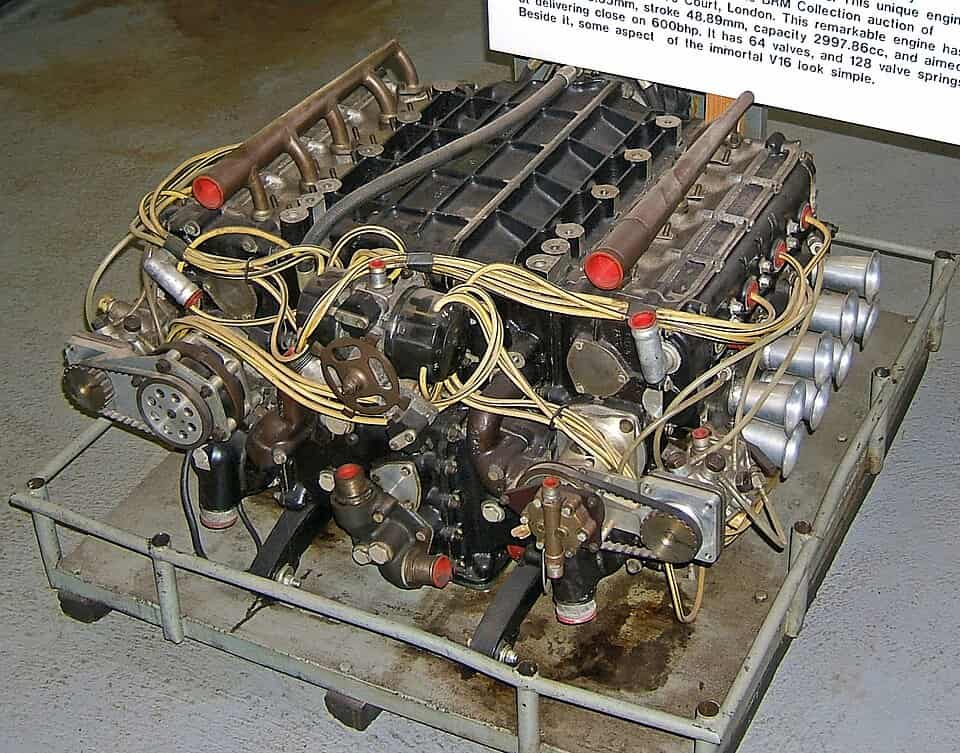
Imagine a Formula 1 engine so heavy and so complex that it took six men to unload it from the truck. With 16 cylinders arranged in an H configuration, eight camshafts, four crankshafts, 64 valves and an irresistible tendency to break down mid-race.
The regulation problem
From 1.5 to 3 litres: the chaos nobody anticipated well
During the years leading up to 1966, Formula 1 ran on 1.5-litre engines. BRM had built a V8 of that displacement that was brilliant: compact, reliable, with a good power-to-weight ratio. Graham Hill had won the drivers' world championship with it in 1962 and the constructors' title too. Aubrey Woods, the chief engine engineer, knew perfectly well what worked.
When the FIA announced that from 1966 the limit would move to 3 litres, Woods proposed the logical solution: a 3-litre V12, designed from scratch. It was the route Ferrari, Cooper-Maserati and, later, Lotus with the Cosworth DFV would follow. It was more complex than the V8, but manageable. It was the right option.
In May 1965, Sir Alfred Owen — owner of the business group that financed BRM — rejected that proposal. The stated reason: the H16 would share components with the existing V8, which seemed more economical and faster to develop. Owen chose the H16 and also ordered a parallel partnership with Harry Weslake to explore the V12, but with lower priority.
It was the decision that defined BRM's decline.
¿Cómo se ve en la
vida real?Ver en TikTok▶❤️💬🔗TV@LlantaPinchadaTVThe BRM H16: the most complex engine in F1 history that only won ONE race 🏎️🔩 #F1 #BRM #MotorH16
Disponible en nuestra comunidad vertical
"It was unnecessarily large, used more fuel, carried more oil and needed more water — all of which added weight and reduced the car's agility." — Jackie Stewart, BRM driver 1966–67
The architecture
Two flat engines, one on top of the other
The conceptual logic of the H16 was, in a certain way, seductive. If they already had a 1.5-litre flat-8 — essentially a V8 laid completely horizontal — all it took was placing two of them one above the other, connecting them via a central gear and obtaining a 3-litre 16-cylinder. The internal components were partly the same. The block would be compact in length.
The result on paper gave a configuration that, seen from the front, resembled the letter H: two flat cylinder banks, one above the other, with the crankshafts running in parallel and connected to each other by an intermediate gear. The lower crankshaft was the one that transmitted power to the gearbox.
The declared power output was around 400 hp at 10,000 rpm, with the best documented figure of 420 hp at the 1967 Italian Grand Prix. It was competitive in raw numbers — comparable to the Ferrari V12 and the Honda of the era. The problem was not the power. It was everything else.
The engine weighed around 252 kilograms. The Brabham BT19-Repco, constructors' champion that same year, weighed 555 kg complete. The BRM P83 with its H16 reached 695 kg in race trim — 140 kilograms more than the Ferrari, 75 more than the Brabham. That extra weight translated into a high centre of gravity, a problematic mass distribution and handling characteristics that drivers described as clumsy and hard to trust.
The vibrations from the two blocks never fully synchronised. The crankshafts would fall out of balance. An engine might last 300 miles at best before requiring a complete overhaul.
In competition
A debut that explained everything
The H16 appeared for the first time in practice at the 1966 Monaco Grand Prix, in Jackie Stewart's hands. After testing it, Stewart decided to race with the 2-litre P261 V8 from the previous season. Graham Hill did the same. Neither wanted to take it into competition.
The situation repeated itself at Spa. The engine practiced, the drivers preferred the old V8.
It was not until Monza, the seventh round of nine, that the H16 competed in a Grand Prix for the first time. Both BRM drivers — Hill and Stewart — retired. The Lotus 43, the second car with which Colin Chapman had gambled on the engine by buying it from BRM while waiting for the Cosworth DFV, also retired with a gearbox problem in Jim Clark's hands.
When the United States Grand Prix arrived at Watkins Glen on October 2, 1966, something happened that nobody had planned for.
Clark qualified the Lotus 43 in second on the grid. During practice, his H16 engine had failed and the BRM team lent him a used spare engine — which was also leaking oil on the starting grid before the mechanics sorted it out. Clark started behind Bandini and Brabham. On lap 34, Bandini's Ferrari threw its engine. On lap 55, Jack Brabham's Brabham did the same. Jim Clark found himself in the lead. The H16 — that day, in that car, with that crew — made it to the chequered flag.
Clark finished a full lap ahead of Jochen Rindt in the Cooper, recording the only victory of the BRM H16 engine in the entire history of Formula 1. It was not a BRM victory. It was a Lotus victory, with a BRM engine, in a car designed by Maurice Philippe under Colin Chapman's instructions.
In the official BRM, Hill retired on lap 52 with a broken differential. Stewart retired a lap later.
The end
1967: More of the same, then abandonment
BRM entered 1967 with the improved P83 and a new lighter chassis, the P115. The engineers had managed to reduce the engine's weight to around 180 kg through packaging redesigns. Stewart achieved a second place at Spa and a third at the French Grand Prix. These were the best results the H16 would ever deliver in BRM's hands.
But reliability remained the central problem. Jackie Stewart, years later, was blunt in his assessment: "I have no good memories of the whole H16 dilemma. Tony wanted to prove the concept was right and Tony was a good man, but it was very clear that it wasn't going to work, and that's why in the end I left BRM."
At the end of the 1967 season, BRM abandoned the H16 and accelerated development of its own V12 — the engine that, paradoxically, Aubrey Woods had proposed from the very beginning. Stewart left to join Ken Tyrrell's team. Mike Spence, who had been the most consistent driver with the P83, died in the Indianapolis accident in May 1968 during testing of the Lotus 56 turbine car. Chris Irwin suffered serious injuries at the Nürburgring weeks later.
The BRM V12 continued competing until the team's definitive closure in 1977. It was the engine they should have built in 1966.