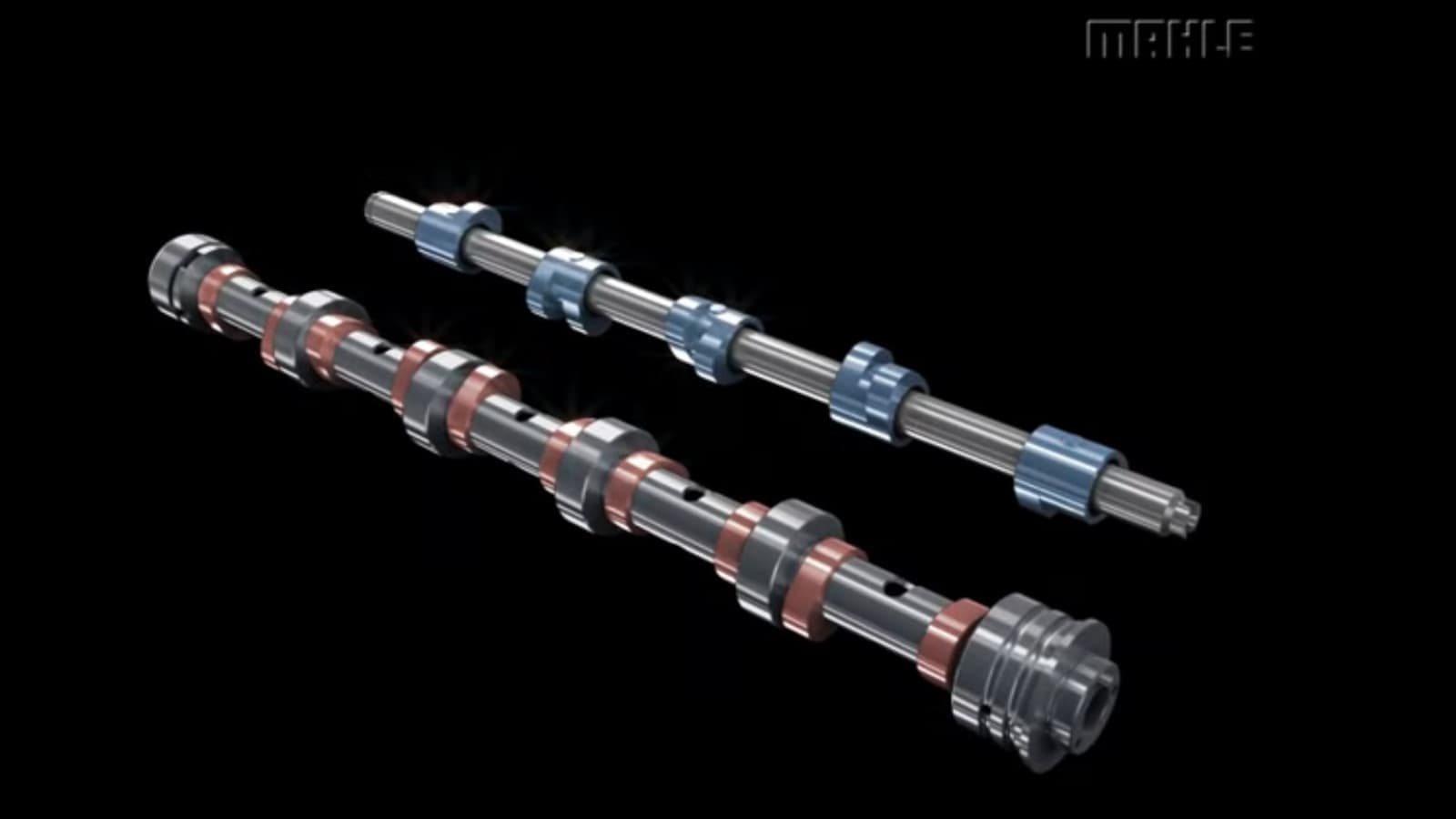
Imagine a camshaft that has another camshaft inside it. The outer one controls the exhaust valves. The inner one controls the intake valves. The two can move independently of each other. All within the space of a single conventional camshaft. And the system had not existed in production since it was first patented in 1908.
```label The problem that created it ```
An 8.3-litre engine that failed EPA standards — and could not have DOHC
In 2004, Chrysler's SRT team had a serious problem. Chrysler's Street and Racing Technology team faced a challenge with the Dodge Viper. Like many big, high-performance engines, this one displayed combustion instability at light loads due to aggressive valve timing designed for high-speed power, and did not meet EPA standards.
The diagnosis was clear: the engine needed variable valve timing. At low loads and idle, the cam profile designed to extract 500 horsepower at high speed was creating a poorly controlled mixture that burned incompletely and generated more emissions than permitted. With variable timing, the camshaft could use a softer profile at low loads and the aggressive one only when needed.
The problem was the engine's architecture. The Viper's V10 was an overhead-valve engine actuated by pushrods — OHV — with a single camshaft in the block, between the two cylinder banks. This layout, inherited from American engine tradition and shared with Chrysler's Hemis and GM's small-blocks, has the advantage of being extremely compact in height: without overhead camshafts, the engine sits lower. But it has one drawback for VVT: variable valve timing would mean a new, taller, overhead cam engine, hence investment, delay, and styling changes.
Redesigning the V10 as a DOHC engine would have required changing the Viper's bonnet — the engine already had barely any vertical clearance —, years of development and hundreds of millions of dollars. It was not an option. They needed another solution.
```tiktok https://vm.tiktok.com/ZGdHBy8EP/ @LlantaPinchadaTV The Dodge Viper's Cam-in-Cam system: a camshaft inside another camshaft, 99 years of waiting since the patent, and nobody else has copied it 🐍🔧 #DodgeViper #CamInCam #V10 #Engineering https://res.cloudinary.com/db3veuotr/image/upload/v1777641403/image_27_yaazh1.jpg ```
"Working together, MAHLE, INA and Chrysler accomplished what had not been done in the century since the first Cam-in-Cam patent in 1908: independent timing of exhaust and intake valves in one camshaft." — Automotive News, upon awarding the 2007 PACE Award
```label The 1908 solution ```
A forgotten patent for ninety-nine years
A never-implemented 1908 patent described an intake camshaft mounted inside the exhaust camshaft, so intake and exhaust timing could be advanced or retarded independently.
The idea was conceptually simple: if the intake camshaft goes inside the exhaust camshaft — one hollow on the outside, one solid on the inside —, they can be moved independently. The outer shaft can rotate slightly ahead or behind the inner one. The result: the opening and closing phase of the exhaust valves changes relative to the intake valves without either shaft having to move relative to the crankshaft.
The 1908 patent described this precisely. Nobody had implemented it in production in nearly a century. The UK engineering firm Mechadyne had introduced the concept to Chrysler and built a prototype, which was too complex.
Mechadyne's prototype worked in principle, but was too complex for mass production. Too many parts. Too demanding machining tolerances. Too much risk of failure. Chrysler needed someone to simplify the system without losing the functionality.
```callout MAHLE was already a Chrysler supplier with expertise in precision camshafts. INA had the camshaft phasers. Mechadyne had proven the concept. Chrysler's SRT team put all three to work together redesigning the system from scratch with one clear premise: it had to fit in the space of a conventional camshaft, without modifying the engine block or changing the dimensions of the valve train assembly. ```
```label How it works ```
The hollow tube, the solid shaft and the five pins
The CamInCam® system that reached production in 2008 had a specific and elegant architecture. The cam-within-a-cam consists of a solid intake camshaft within a hollow exhaust camshaft. The solid shaft has holes for cylindrical pins, located at five points that align with axial slots in the hollow outer shaft.
The outer shaft was a hollow aluminium tube with exhaust lobes machined on its surface. The inner shaft was a solid steel spindle with intake lobes. The two were concentric — one inside the other — and connected by five cylindrical pins running in axial slots in the outer tube.
This pin-and-slot connection was the key to the system: the hollow outer tube holds the exhaust lobes while an inner shaft drives the intake lobes. This allows continual adjustment of valve operation according to the needs of the engine at different speeds.
The pins transmitted torque from the inner shaft to the outer — both had to rotate together to move the valves. But the axial slots in which the pins ran allowed the outer tube to rotate slightly relative to the inner shaft. When the hydraulic system pushed the outer shaft a few degrees forward or backward, the exhaust lobes moved relative to the intake lobes. Exhaust timing changed. Intake timing remained fixed.
Actuation was electrohydraulic: using a phaser on the camshaft-within-a-camshaft design, the V10 can change exhaust valve timing up to 45° versus intake valve timing, although only 36° are actually used.
An oil control valve, governed by the engine control unit, sent oil pressure to the outer shaft's phaser. The phaser — the same type of device that conventional DOHC engines use to move a camshaft relative to the crankshaft, simply applied here between two concentric shafts — rotated the outer tube within its 36-degree range. Response was in milliseconds.
```label Why exhaust only ```
The decision to engineer only one side — and why it made sense
The Viper's system applied variable timing only to the exhaust, not the intake. The reason was technical and practical. Intake valve control was not chosen because its prime benefit would be improved low-end torque, something the 8.4-litre V10 has plenty of, although the 560 lb-ft peak is at 5,000 rpm. Intake control would simply "translate to more tyre smoke on a Viper," explained Chrysler SRT engineer Kraig Courtney.
With 560 lb-ft of torque at 5,000 rpm, the V10 did not need more torque at low speeds. What it needed was clean, controlled combustion under those conditions — and that was delivered by varying the exhaust phase. By retarding exhaust valve closure at cruise and light loads, the engine reintroduced a small quantity of burnt gases into the combustion chamber — internal exhaust gas recirculation — which stabilised the flame in lean mixtures and reduced emissions without sacrificing peak power.
The results of the changes to Dodge's V10 engine were increases in combustion stability, better fuel economy, better exhaust gas recirculation performance, and more power.
Although technology exists for both intake and exhaust VVT with the pushrod cam-in-block, it would require new designs both for the camshaft and phaser, deemed an unnecessary complexity and cost at this time. Applying the system to the intake as well was theoretically possible but would have required redesigning both the shaft and the phaser far more substantially. For the project's objective — solving the emissions and combustion instability without radically changing the engine — exhaust-only VVT was sufficient.
```label The results ```
90 more horsepower, 300 more rpm of rev limit, idle like a German limousine
Thanks to the novel camshaft design combined with a slight displacement bump from 8.3 to 8.4 litres, the fourth-generation Viper V10 picked up 90 horsepower over the third-generation motor and made peak power 500 rpm higher in the rev range.
The engine went from 510 hp at 6,100 rpm to 600 hp at 6,100 rpm — a jump of 90 horsepower that the team attributed partly to the Cam-in-Cam and partly to the redesigned heads with larger valves and the slight displacement increase from 8.3 to 8.4 litres.
The rev limit was able to be increased by 300 rpm due to improved valve-train stability from both the new camshaft profiles and valve springs.
The most surprising effect was not the peak power. It was the idle. An 8.4-litre engine with an aggressive cam profile designed for over 600 horsepower should have a rough, uneven idle, with that characteristic rhythmic lope that Americans love and regulators hate. The fourth-generation Viper did not. The idle in a fourth-generation Viper is remarkably smooth, with none of the rowdy chop you would normally expect in a peaky pushrod engine.
It was the Cam-in-Cam at work: at idle, the system retarded the exhaust to smooth combustion. At full throttle, it advanced to the most aggressive profile. The same engine, two personalities, imperceptible transition.
```label The recognition ```
The PACE Award: the Nobel Prize of American automotive engineering
Working together, MAHLE, INA and Chrysler accomplished what had not been done in the century since the first Cam-in-Cam patent in 1908: independent timing of exhaust and intake valves in one camshaft.
The system won the Automotive News PACE Award in 2007 — the most important innovation honour in the North American automotive industry, awarded each year to the technologies representing the most significant advances in mass production. It shared the podium with technologies from companies such as Bosch, Continental and Denso.
Nobody expected that year's winner to be the camshaft of an American 8.4-litre pushrod engine.
```label The legacy ```
The technology that won an award, solved a problem — and nobody else ever adopted
Weirdly, the overhead valve cam-in-cam system found in the Viper seems to largely be a technological dead end for now. Ford's Godzilla V8, GM's small-block engine family and Stellantis' Hemi V8 all use simple cam phasing with fixed overlap, just like the pushrod 3.5-litre V6 found in mid-2000s Chevrolet Malibus.
The paradox of the Cam-in-Cam is complete: it was so specific to the unique circumstances of the Viper's V10 — a giant OHV engine that could not grow in height, that needed to pass emissions without sacrificing character, and that had an SRT team with budget and ambition behind it — that no other manufacturer found justification to replicate it. GM's, Ford's and Stellantis's conventional OHV engines use simple phasers on a solid shaft. Modern high-performance engines use DOHC with VVT on both camshafts. The Cam-in-Cam solved the problem of an engine from another era with a solution from another era.
It was the first application of independently variable exhaust valve timing on a pushrod engine, an impressive feat that is wonderfully anachronistic considering the Viper's reputation for being fast but somewhat crude.
The last Dodge Viper left the Conner Avenue plant in Detroit in August 2017. With it went the only production engine in the world carrying two concentric camshafts working in parallel inside the block. A patent from 1908, ninety-nine years of waiting, four years of development between Chrysler, MAHLE, INA and Mechadyne, and a PACE Award at the end. For a system nobody has ever used again.