Imagine a wheel where air does not exist. Where punctures are impossible because there is nothing to puncture. Where high-strength plastic spokes absorb bumps instead of compressed air. The idea has over 20 years of development, over a decade on the industrial market, and has been promising to reach the family car for seven years. It is still promising.
```label The idea ```
A lunch in South Carolina — and twenty years waiting for the result
It was during a lunch in the late 1990s in Greenville, South Carolina, that Dr Tim Rhyne, along with fellow Michelin engineer and co-inventor Steve Cron, had the idea of challenging conventional tyre technology and exploring new and revolutionary concepts for this essential component of mobility.
The idea was simple in concept and incredibly difficult in execution: eliminate the air. Not improve it, not manage it better, not make it more puncture-resistant. Eliminate it. Replace the compressed air cushion with a structure of polyurethane spokes that absorbed bumps the same way air does — but with no possibility of puncturing because there was nothing to puncture.
The Tweel received patents between 1999 and 2003, with an early prototype presented in 2005. The name was a combination of the English words tire and wheel. The reason for the name: the Tweel was not just a tyre mounted on a rim. It was both at once, fused into a single unit.
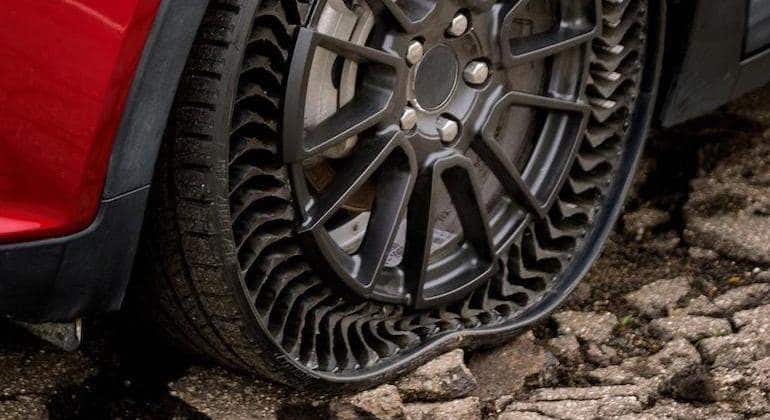
A solid inner hub mounts on the axle and is surrounded by polyurethane spokes arranged in a wedge pattern. A shear band extends across the spokes, forming the outer edge of the wheel. The tread band rests on top of it — the part that makes contact with the road surface. The cushioning provided by the trapped air in a conventional tyre is replaced by the resistance of the spokes, which take the tension from the shear band.
```tiktok https://youtu.be/KyeQo-zNvSg @LlantaPinchadaTV The airless tyre that has been arriving for 20 years: Michelin's Tweel and UPTIS — why they are not on your car yet 🚗🔧 #Michelin #UPTIS #Tweel #Airless #Engineering https://res.cloudinary.com/db3veuotr/image/upload/v1777845528/image_29_aay0ch.jpg ```
"Airless technology is completely new in terms of design, production and homologation. We have to learn everything from scratch." — Cyrille Roget, Michelin Director of Scientific and Technical Communication, 2023
```label What exists today ```
The Tweel works. Just not on your car.
The X Tweel SSL was commercially launched for skid-steer loaders in October 2012. Thirteen years later, it is still there. On landscaping skid-steers, on construction equipment, on John Deere ride-on mowers, on military vehicles. Michelin is the only manufacturer of airless radial tyres and has been offering solutions since 2012 for commercial applications.
In November 2014, Michelin opened its plant in Piedmont, South Carolina — the world's first factory dedicated to airless tyre production. A $50 million investment.
The Tweel performs extraordinarily well in its current applications. Its tread band is designed to last two to three times longer than a conventional tyre at the same tread depth, and can be retreaded. On a skid-steer working on a site full of nails, screws and broken glass, a Tweel that never punctures pays for itself in avoided lost working days within days.
```callout The Tweel's problem at high speeds is physical. Above around 80 km/h, the polyurethane spokes that deform with each revolution generate heat and vibrations that accumulate in a non-linear fashion. At 100 km/h it is uncomfortable. At 130 km/h it is dangerous. The design that makes the Tweel perfect at 30 km/h on a construction site makes it unacceptable at motorway speeds. The UPTIS attempts to solve exactly that problem with different materials — fibreglass instead of polyurethane — but the solution has still not been approved for any public road. ```
```label The 2024 promise ```
GM signed the deal. Michelin made the announcement. And 2024 came and went.
In 2019, Michelin presented the UPTIS — Unique Puncture-proof Tire System — as the evolution of the Tweel specifically designed for passenger cars and light vans. GM signed a joint research agreement as co-development partner, with the ambitious goal of making UPTIS a reality in passenger vehicles as early as 2024. GM began real-world testing and prototype validation of UPTIS with a fleet of Chevrolet Bolts in Michigan.
The difference between the Tweel and the UPTIS was the material: UPTIS features fibreglass hoops beneath the tread band and, instead of air, elastic spokes also reinforced with fibreglass. Fibreglass is lighter and dissipates heat better than polyurethane. The complete structure mounts on a specific Michelin rim — it cannot be fitted to conventional rims.
The tyres themselves are designed not to be mounted on pre-existing wheels, but on those supplied by Michelin, on which they are balanced at the factory. In theory, they can arrive ready to fit to a car without special tools or labour.
2024 arrived. GM went through a crisis with its Cruise autonomous vehicle division. The UPTIS appeared in no catalogue.
```label Where it stands today ```
40 postal vans. 50 per country. And an estimate of 12 to 36 months.
In 2023, Michelin announced real-world UPTIS trials with both DHL Express in Singapore and La Poste, the French postal service. They are equipping around 50 vehicles in each of those fleets, with the aim of capturing as much data as possible.
By the end of 2024, UPTIS had been selected for a pilot with La Poste, with 40 of its vans equipped with these tyres. They are not 40 cars for consumers. They are 40 postal delivery vans in the hands of technicians recording data on temperature, wear, noise and dynamic behaviour under real-world usage conditions.
Michelin itself admits that UPTIS is not yet ready for the mass market, that no international standards for airless tyres exist and that homologation remains a key step. Other technical challenges are also present: heat dissipation management, debris accumulation in the spoke structure, noise, and achieving rolling resistance and service life equivalent to conventional tyres. The current estimate for the market: 12 to 36 more months.
The competition is no closer. Goodyear has published test videos of its non-pneumatic iterations on cars such as the BMW 3 Series and Tesla Model 3, but continues to acknowledge that its airless tyres probably will not be road-ready until 2030. Bridgestone conducted public road tests in Tokyo in 2023 but acknowledges that the arrival on passenger cars could be a decade away.
```label The real problems ```
Why it still has not arrived
There are four concrete, verified obstacles that no manufacturer has fully resolved for road use.
The first is heat. The spokes that absorb bumps generate heat with each deformation. At sustained high speed, that heat accumulates. The Tweel's polyurethane manages it poorly. The UPTIS's fibreglass manages it better but not yet well enough to guarantee service life equivalent to a conventional tyre.
The second is debris. The open spokes trap stones, branches, mud and screws. On a skid-steer on a building site doing 20 km/h it is a minor inconvenience. On a car at 120 km/h it is a problem of imbalance, vibration and potential structural damage.
The third is noise. The spoke deformation pattern generates a specific sound that conventional tyres do not produce. It is sharper, more mechanical. In current tests it remains perceptible at motorway speeds.
The fourth — and the slowest to resolve — is homologation. No international standards for airless tyres exist. Current safety regulations assume that a tyre has an air chamber, a specific pressure and predictable puncture behaviour. A regulator evaluating UPTIS has no regulatory framework to place it in. Each country would need to develop its own test standard from scratch.
```label The legacy ```
The technology that already changed an industry — just not the one we expected
The story of the airless tyre is not the story of a technology that failed. It is the story of a technology that solved the problems it could solve and got stuck exactly where the physics gets complicated.
As of October 2025, recent improvements include an improved shear band construction for greater core life and a new polyester resin material for the spokes that offers up to ten times greater spoke durability compared to earlier versions.
The Tweel exists, is sold, lasts three times longer than a conventional tyre and has eliminated punctures on thousands of construction sites, farms and golf courses. Military tests have shown that the Tweel deflects mine blasts better than conventional tyres and does not lose mobility if some spokes are damaged or missing.
What does not yet exist is the airless tyre you buy in a shop and fit to your car. The UPTIS is still in real-world fleet testing. Michelin estimates 12 to 36 more months. That is what they said in 2022. And in 2023. And in late 2024.
At its core, the airless tyre remains the oldest story in modern engineering: a correct idea waiting for materials, regulators and manufacturing processes to catch up with it. Air has been in wheels since 1888 — when John Boyd Dunlop invented it for his son's bicycle. Getting it out of there has turned out to be considerably harder than it seemed over that lunch in Greenville, South Carolina, in 1999.