Imagine designing the most innovative car in Europe, patenting it, presenting it to the world — and watching the regime that has just invaded you mass-produce a copy for decades. And when a judge finally rules in your favour, the inventor is already dead.
The engineer nobody remembers
Hans Ledwinka: the man who invented the modern car and ended up in prison
Hans Ledwinka was born in 1878 in Austria and spent almost his entire professional life at Tatra, the Czech company from Kopřivnice — one of the oldest in the automotive world, founded in 1850 as a carriage manufacturer. Ledwinka was not a surface designer or a stylist: he was a systems engineer, the kind who thinks from the physics outwards.
The three ideas that define his legacy are so fundamental that today it is hard to recognise them as innovations: the tubular central chassis — a steel backbone that replaced the heavy perimeter frame and drastically reduced weight —, the swing-arm rear suspension with a split axle that gave genuine independence to the rear wheels, and the air-cooled boxer engine mounted at the rear — no radiator, no water-cooling system, none of the complexity of transmitting power from the front to the rear drive wheels via a long propshaft.
¿Cómo se ve en la
vida real?Ver en TikTok▶❤️💬🔗TV@LlantaPinchadaTVThe story Volkswagen would rather forget: the Tatra that inspired the Beetle ☭🚗🇩🇪 #Tatra #Volkswagen #Beetle #History
Disponible en nuestra comunidad vertical
"Sometimes I would look over his shoulder, and sometimes he would look over mine." — Ferdinand Porsche, on his working relationship with Hans Ledwinka
Ledwinka and Porsche knew each other. They had crossed paths during the First World War years when both worked at the Austrian firm Steyr. They were contemporaries, they respected each other, and in the 1930s they met periodically to discuss their respective projects. Porsche's remark about shoulders is the closest thing to an acknowledgement of debt that he left on record.
The prototype that came first
V570: the people's car that never belonged to the people
In 1931, the Tatra team under Ledwinka's direction — with key contributions from his son Erich Ledwinka and engineer Erich Übelacker — built the V570 prototype. The goal was a car for the masses: affordable, economical, small. The engine was an air-cooled twin-cylinder boxer of around 800 cc, mounted at the rear. The chassis was the usual central tube. Rear-wheel drive.
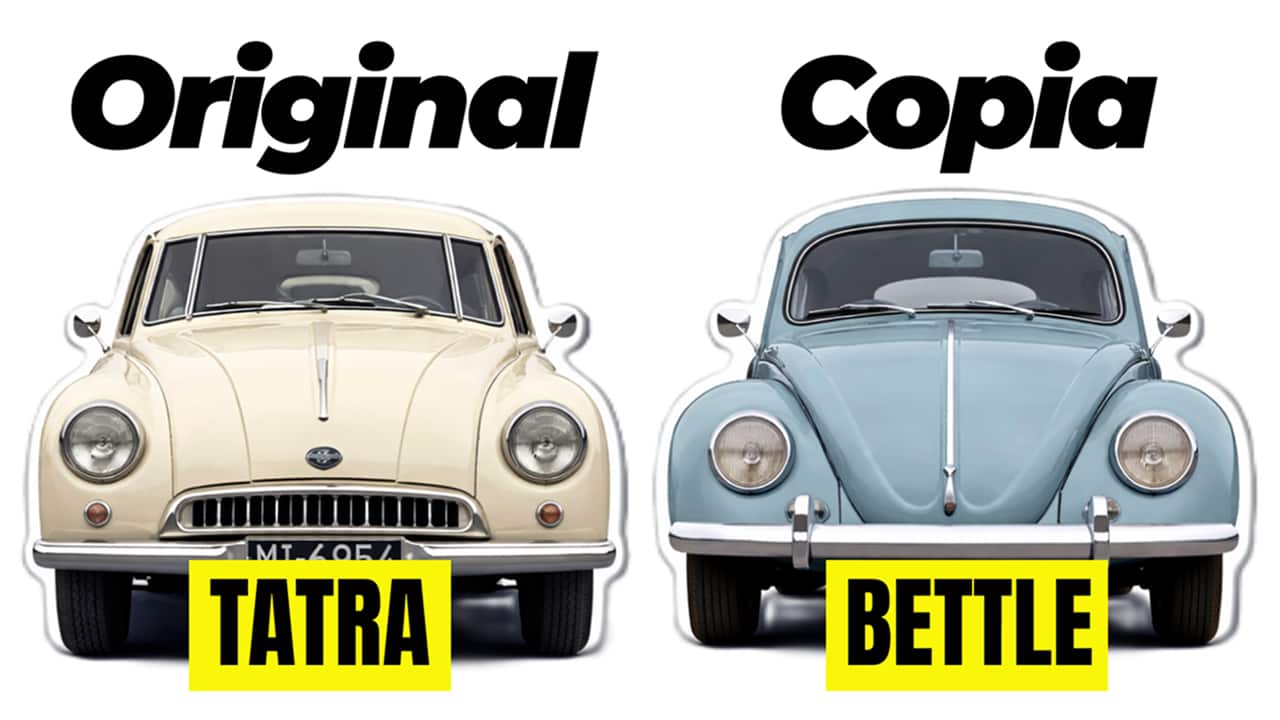
The first prototype had cooling problems — the engine suffocated inside the rear boot of the conventional T57 body used as a base. But two years later, in 1933, the second V570 arrived with an aerodynamic body designed with the help of Paul Jaray, the Swiss engineer who had calculated the aerodynamics of zeppelins and held patents on low-drag body shapes. The result was a four-seat saloon with a teardrop silhouette, a rear engine and a look that, seen today, makes it hard to say whether you are looking at a Tatra or a Volkswagen Beetle.
The small-car project was put on hold. But Tatra registered the patents. Dozens of them, covering everything: the forced air-cooling system, the tubular chassis, the swing-arm suspension, the aerodynamic approaches. Because at that moment, in the automotive world of the 1930s, registering patents was the only way to protect an idea from the engineers who visited you, admired you — and then went back to their offices to start designing.
Hitler enters the scene
'This is the car for my motorways'
Adolf Hitler was a car enthusiast. He was fascinated by Tatras. He had travelled in them during his political tours of Czechoslovakia before coming to power, and had dined several times with Ledwinka. According to accounts gathered in Jonathan Mantle's book Car Wars, after one of those dinners Hitler pointed to the Tatra and told Ferdinand Porsche: "This is the car for my motorways."
Porsche, at that point, had been tasked by Hitler with creating the Volkswagen — literally, the people's car. A vehicle any German citizen could buy for 990 marks, that could travel at 100 km/h on the new motorways, that used little petrol and was easy to maintain. In 1934 he presented the Type 32, a prototype commissioned by motorcycle company Zündapp. In 1936 he presented the VW 38. In 1938 the world saw the KdF-Wagen — Kraft durch Freude, Strength through Joy — at the Berlin Motor Show.
The KdF-Wagen had: an air-cooled four-cylinder boxer engine at the rear, rear-wheel drive, central chassis, aerodynamic body with a teardrop line. Exactly the combination of technologies that Tatra had been developing, refining and patenting since 1931.
That same year of 1936, Tatra had launched the T97 — the production version of the V570 concept, with a 1,759 cc four-cylinder boxer producing 40 hp, five seats and a top speed of 130 km/h. It was the car most similar to the KdF-Wagen in existence. And it cost 5,600 marks — five times more than the promised Volkswagen — which made it an image competitor but not a market one.
The lawsuit the war killed
Ten patent claims. One invasion. One million marks thirty years later.
In 1938, just before the war began, Tatra formally filed ten patent claims against Volkswagen and Ferdinand Porsche. The claims did not cover the entire car — they covered specific aspects of the forced air-cooling system, which Tatra had patented extensively since 1933 and which the KdF-Wagen used without a licence.
Porsche was willing to reach a settlement. It was Hitler who prevented it. He said he would handle the matter himself. Weeks later, Germany occupied the Czech Sudetenland. The Tatra factory came under Nazi administration. T97 production was stopped immediately. The claims were frozen. Hitler also ordered that Tatra's T97 and T57 models be removed from Tatra's display at the 1939 Berlin Motor Show. Tatra was redirected towards heavy trucks and diesel engines for the war effort.
The T97 never went back into production. Of the 508 units built between 1936 and 1939, few survive.
When the war ended, Ledwinka was arrested as a Nazi collaborator — a charge that reflected his work under German administration during the occupation, though the debate about his actual degree of responsibility remains a matter of historical discussion. He was convicted and spent six years in prison. Tatra offered him his position back upon his release, but he declined. He moved to Munich, where he worked as a consultant and received honorary doctorates from several German and Austrian universities. He died in 1967.
The Ringhoffer family — who had owned the Tatra facilities in the 1930s and held the patents — reopened the litigation after the war. It was a long process, complicated by the time elapsed, changes in ownership and Volkswagen's reluctance to disturb its history. Finally, in 1965, Volkswagen reached an out-of-court settlement: one million German marks paid to the Ringhoffer family.
Neither Hans Ledwinka — the engineer who had designed those patents — nor the company Tatra itself received a single mark of that money.
The legacy
What the Beetle owed to the Tatra
The story between Tatra and Volkswagen is not a story of simple, brazen copying. It is more complicated and, for that reason, more interesting. The 1930s were a period of technical ferment in the European automobile: Mercedes-Benz had built in 1931 its own prototype of a small rear-engined, rear-wheel-drive car (the 120H), which nobody remembers today. The Austro-French firm Steyr did too. Designer Tom Tjaarda had published in 1931 in Modern Mechanics a rear-engined car project with independent suspension and an aerodynamic body that visually anticipated what Tatra and Porsche would do later.
What Ledwinka had that others did not was the specific combination of tubular chassis, swing-arm suspension, air-cooled rear boxer engine and Paul Jaray's aerodynamic expertise — all together, resolved in a production car. And it was all patented.
What the court recognised — and what the million marks of 1965 implicitly ratified — was that Volkswagen had used specific technical solutions from those patents without paying for them.
Had the war not interrupted the process, a settlement would have been reached in 1938 or 1939. With Porsche in favour of paying, with Tatra legally in the right. Instead, the war turned it into the most bitter and protracted case in the history of automotive patent law.
The Volkswagen Beetle was manufactured until 2003 — 65 years after Tatra filed its first patent claim. In that time more than 21 million units were produced. The family whose technical principles had underpinned its construction received, in total, one million marks. In 1965.