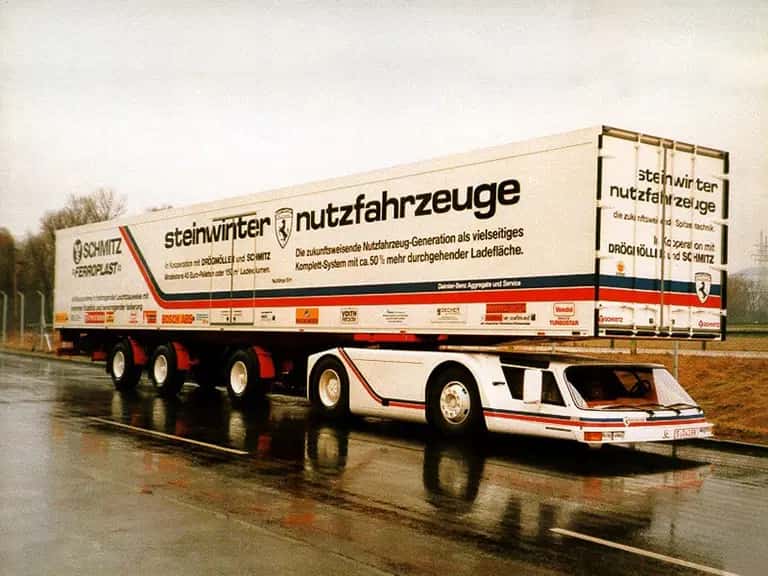
Imagine driving a 26-tonne truck from a cab positioned entirely below the level of the semi-trailer. No bonnet, no engine in front, nothing between you and the tarmac but a few centimetres of chassis.
The radical concept
Europe has length limits. Physics does not.
In the 1980s, European regulations limited the total length of a truck-and-trailer combination. Every centimetre of cab was a centimetre less of payload. Hartmut Ütescher asked himself a question: what if the cab took up no longitudinal space at all?
The solution was to sink it beneath the semi-trailer. The driver sat just 55 cm from the ground, with the engine behind him and the trailer passing literally over his head. Cargo length was maximised to 100%.
¿Cómo se ve en la
vida real?Ver en TikTok▶❤️💬🔗TV@LlantaPinchadaTVThe Steinwinter Supercargo in action. Would you dare to drive like this? 🚛 #Engineering #Trucks #Steinwinter
Disponible en nuestra comunidad vertical
"The driver was not at the front of the truck. He was beneath the load."
Pure Efficiency
Aerodynamics of a supercar
Without a square cab protruding at the front, the Supercargo presented a clean wedge profile. The drag coefficient of 0.35 was extraordinary; conventional trucks of the era hovered around 0.7. Less drag meant a 20% saving in fuel.
The Legacy
Why did the future fail?
Driving at ground level with tonnes of load above the cab was psychologically difficult for hauliers to accept. Furthermore, crash safety regulations did not know how to classify this design. The project ran out of funding in 1989.