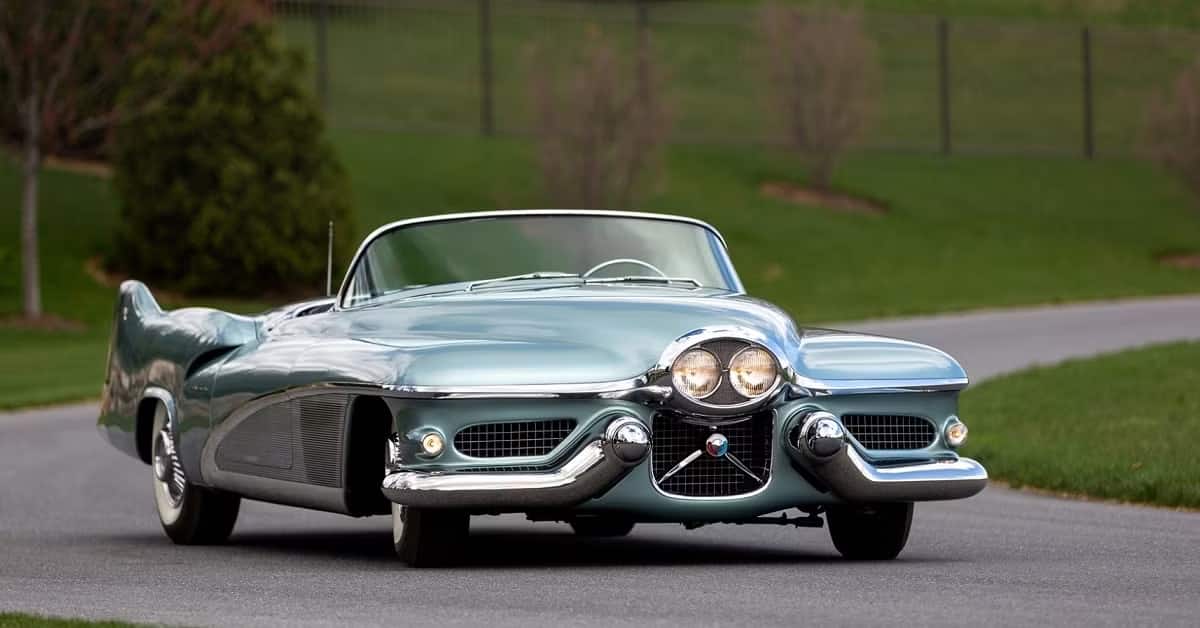
Imagine the head of design at the world's largest company taking the most advanced concept car of the year and using it to drive to work every day. Because he could. Because it was built to drive on the road. Because it had 335 horsepower, closed itself when it rained, and had an altimeter in the dashboard. In 1951.
```label The man who invented automotive design
## Harley Earl: the industry's first designer — and its tallest

With the establishment of Harley Earl's Art & Color section in 1927, General Motors practically invented automotive design as it is practised today. That leadership played a fundamental role in the corporation's rise to market dominance in the years that followed.

Harley Earl was a large bear of a man: nearly two metres tall and built like a linebacker. When he designed cars, he designed them to his own measure — literally. The Le Sabre was as long and wide as Earl was tall. It was not a light, nimble roadster for Alpine roads. It was a boulevard cruiser built to be seen advancing along Woodward Avenue in Detroit.

Earl had created the Y-Job in 1938 — the world's first concept car in automotive industry history. A low, flowing roadster that he used as his personal car for more than a decade. By 1947, the Y-Job was starting to look dated even to its creator. Earl proposed that Buick's chief engineer, Charles Chayne, create a pair of convertible roadsters built on identical chassis but with two different futuristic bodies. The reason was to demonstrate GM's leadership in style and engineering.

Development began in 1947 under the codenames XP-8 and XP-9. Both saw the light in 1951. However, while the XP-9 (renamed XP-300 at its presentation) soon faded from public memory, the XP-8 became an all-time icon: Earl's legendary Le Sabre.

```tiktok
https://vm.tiktok.com/ZGdHm2kcw/
@LlantaPinchadaTV
The 1951 GM Le Sabre: the concept car Harley Earl used as his daily driver for 2 years — and that invented tail fins and the panoramic windscreen 🚗✈️ #GMleSabre #HarleyEarl #ConceptCar #Engineering
https://res.cloudinary.com/db3veuotr/image/upload/v1778436691/image_36_n9dn4y.jpg
"People ask: 'isn't your exaggerated design just for effect?' The answer is definitely no. The Le Sabre's twin fins serve the functional purpose of housing aircraft-type 20-gallon fuel tanks." — Harley Earl, December 1951
The F-86 Sabre on wheels
The fighter jet that inspired every line — and whose ideas reached millions of cars
The name was a nod to the military aircraft that inspired the car's design, the North American F-86 Sabre. The first prototype of this jet fighter flew in 1947, and it is easy to see why it captured Harley Earl's imagination. With its smooth, elegant fuselage and dramatically swept-back wings to reduce drag while flying near the sound barrier, the F-86 Sabre was a direct product of the enormous advances made by aviation technology during the war years.
The oval air intake in the centre of the front was not decorative. The oval air intake in the centre was designed to resemble the jet design and functioned as the Le Sabre's engine air intake. Behind it were the headlights — which swung out when the driver activated the corresponding switch. It was the same retractable headlight concept the Le Sabre introduced and that Italian sports cars of the 1960s and 1970s would popularise two decades later.
The tail fin was another of Earl's inventions, as he admired the beautiful Lockheed P-38 Lightning with its twin booms, which was so devastatingly effective in the Second World War. Earl had seen the P-38 on a visit to Selfridge Air Base in 1943 and the aircraft's stabilising fins had obsessed him ever since. The Le Sabre translates them into metal: two twin rear fins that served the functional purpose of housing rubber-lined aircraft-type 20-gallon fuel tanks.
The wraparound panoramic windscreen, inspired by the teardrop-shaped transparent canopies of fighter jets, was another innovation. Earl had played with the idea for decades, but only in the early 1950s was the technology to make glass with that pronounced curvature finally available. Panoramic windscreens entered mass production at GM in 1953, and within a couple of years Ford and Chrysler had them too.
The technology
12 volts, a rain sensor, hydraulic jacks and methanol — in 1951
The Le Sabre was not just a styling exercise. It was a rolling laboratory with technologies the industry would take a decade to adopt — and some that are still unusual today.
The Le Sabre presented a series of advanced features, including a 12-volt electrical system — when the industry standard was 6 volts —, heated seats, electric headlights hidden behind the central jet air intake, Dagmar bumper extensions on the front, a moisture sensor to automatically activate the convertible roof, and electric lifting jacks integrated into the chassis to assist with tyre changes.
The convertible roof's rain sensor allowed it to close automatically on detecting moisture. It was not a whim — it was the solution to the problem every convertible of the era had: rain falling while the driver was away from the car. The Le Sabre detected the rain and closed the roof without human intervention. The first automatic rain systems for production cars did not arrive until the 1980s. The Le Sabre had them in 1951.
The hydraulic jacks integrated into the chassis and operated from the driver's seat — a concept that later became common in Formula 1 cars. To change a tyre, the driver needed no emergency jack. From inside the car, they actuated the system that raised the vehicle at any point on the chassis.
The dashboard was a more explicit nod to aviation: it included an altimeter, tachometer and compass. The altimeter measured nothing useful on the ground — it was pure aesthetic declaration. The tachometer was a rarity in 1951, when most cars had none. And the compass was Earl's answer to the question of what a jet fighter pilot would put in his automobile instrument panel.
The engine
A supercharged aluminium V8 with two tanks and two fuels
Both cars — Le Sabre and XP-300 — shared many mechanical components, including 335 hp supercharged V8 engines that burned methanol and petrol fuel.
The engine used an aluminium HEMI V8 block with dual carburettors, aluminium heads and a supercharger producing 29.5 psi of boost. All of this made the engine good for 335 hp at 5,500 rpm.
The two fuels had distinct purposes: petrol for ordinary use, methanol for maximum power. The two fuel tanks were independent because one was for methanol and the other for petrol. Methanol, like ethanol, can produce more power than petrol but contains less energy per gallon — exactly the same trade-off that Formula 1 engines of the era used to extract extra power from their competition units.
The 215 ci (3.5L) aluminium V8 of this concept car is not the same as the production "oversquare" aluminium V8 of the Buick 215 introduced in GM's Y-platform compact cars in 1961. The 1961 production engine that would eventually find its way into Land Rovers was a different architecture — although the coincidence of two 215 ci aluminium V8s existing at GM, ten years apart, has confused many historians.
The daily driver
50,000 miles in a concept car — then to the museum
The Le Sabre was built to be road-legal, so that after its auto show tour it could become Earl's personal car — and so it did, for two years.
Earl adopted the 1951 Le Sabre as his own and drove it until it had around 50,000 miles before handing it over to GM's museum in the 1960s.
It was not the first time Earl had used a concept car as a daily driver — he had done the same with the Y-Job for more than a decade. It was his way of proving that his creations were not impractical showpieces: they were cars that could be driven, that could be filled with petrol, that could be driven in the rain and heat and cold of a Michigan winter. And that, if GM's chief of design chose to drive them above all the other options available to him, they must be doing something right.
The Le Sabre was updated for the 1953 Motorama with new sheet metal. It continued appearing at auto shows for years. And in 1959, when Buick needed a name for its new entry-level production model, it chose LeSabre — the name of Earl's concept car, with the small modification of writing it as one word.
The legacy
The panoramic windscreen, the tail fins and the rain sensor — all came out of the Le Sabre
With GM controlling close to 50% of the American car market in the 1950s, its design decisions had ripple effects across the entire industry. The trends Earl established at GM's Motorama appeared in Ford and Chrysler cars a few years later.
Although the Le Sabre never entered production, it played a significant role in shaping future Buick and Cadillac designs, influencing the tail fin style and other design cues seen in later models.
The panoramic windscreen reached GM production cars in 1953 — two years after the Le Sabre. The tail fins grew on Cadillacs and Chevrolets throughout the 1950s and reached their peak in 1959. Heated seats became a standard luxury item. The 12-volt electrical system universally replaced 6 volts in the American industry during the 1960s.
Earl retired from GM in 1958, the year before the tail fins he had invented with the Le Sabre reached their maximum expression on his company's production models. The Le Sabre is today in the GM Heritage Collection and still appears occasionally at concours events. It is the only concept car in history whose creator used it as a daily driver, accumulated 50,000 miles, and then saw it go to a museum as a foundational piece of twentieth-century industrial design history.