Imagine founding a design company in February. Discovering that the first major motor show is in October. Buying from your financially struggling friend the tubular chassis he raced at Le Mans two years earlier. And building on top of it, in 45 days, a car that would simultaneously anticipate the McLaren F1, the Lotus Esprit, the VW Golf and the Maserati Bora.
The two men behind the myth
One left Ferrari. The other was head of design at 22.
To understand the Manta you need to understand its two protagonists and why, in 1968, each needed something only the other could provide.
Giotto Bizzarrini was the engineer who had developed the Ferrari 250 GTO engine — the most valuable car in the world today. Bizzarrini worked at Alfa Romeo and then for Ferrari, where he was responsible for the development of the 250 GTO. In late 1961, following a dispute, he left Ferrari and became a consultant driven by a desire to build cars that would surpass his former employer. The dispute was the episode known as the "Maranello palace purge": Enzo Ferrari dismissed virtually his entire technical team in a single day, including Carlo Chiti, Giotto Bizzarrini and other engineers who had built his sporting dominance. The official reason was a management conflict. The consequences included the founding of ATS, the arrival of some of those engineers at Lamborghini, and the creation of the Bizzarrini company.
Giorgetto Giugiaro was the child prodigy of Italian design. After several successful years at Fiat, Bertone and Ghia, he was in the process of forming Italdesign. He had joined Bertone at 22 as head of design — succeeding Nuccio Bertone himself — and had signed the Gordon-Keeble, the Alfa Romeo Sprint Speciale and the Testudo there. At Ghia he had designed the Maserati Ghibli and the De Tomaso Mangusta. It was 1967 and he was 28 years old.
Giugiaro needed a platform for his first independent project, and Bizzarrini needed money, so the redundant P538 chassis changed hands quickly, Corvette engine included.
¿Cómo se ve en la
vida real?Ver en TikTok▶❤️💬🔗TV@LlantaPinchadaTVThe Bizzarrini Manta: 40 days, a Le Mans chassis and a 28-year-old designer who changed the car forever 🇮🇹🏎️ #Bizzarrini #Manta #Italdesign #Giugiaro
Disponible en nuestra comunidad vertical
"We began working on a chassis that engineer Bizzarrini obtained by modifying a Grifo Competizione model that had a tubular structure. We took it as a starting point for our research, with a view to building a vehicle for the 1968 Turin Motor Show." — Giorgetto Giugiaro, in 2008 statements
The chassis that came from Le Mans
The P538 that lasted half an hour at La Sarthe — and decades in design history
The origins of the Manta concept go back to the mid-1960s, when legendary engineer Giotto Bizzarrini began developing the P538 competition prototype to race against the Ford GT40, the Ferrari 250 P and the Porsche 906. Against that calibre of competition, Bizzarrini poured maximum resources into the project, envisioning a Le Mans victory that would not only bring professional recognition but also serve as a personal triumph over Ferrari.
Although it started the 1966 Le Mans race, the P538 lasted barely half an hour on the circuit before being put out by a broken radiator pipe — though not before recording one of the highest speeds on the Mulsanne Straight.
The P538-003 was therefore a car that had been Bizzarrini's biggest gamble — and had lasted thirty minutes. In 1967, the prototype class for closed vehicles was announced. Bizzarrini fitted the open P538 with a plastic roof and gullwing doors, but permission was not granted for this version to race at Le Mans. In 1968, the International Sporting Commission unexpectedly limited prototype displacement to 3.0 litres. With a 5.3-litre V8, the P538 was automatically out of competition. It was a chassis with no sporting future.
Unfortunately, neither Giotto Bizzarrini nor Giorgetto Giugiaro can recall exactly which chassis was the origin of the Manta. The memories of two key protagonists do not agree on the details. What is confirmed by Giugiaro himself in 2008 statements: it was a P538 chassis, modified, with a tubular steel structure designed to withstand the rigours of Le Mans and the 400 hp of the Chevrolet V8.
The 40 days
How you build a car in six weeks — without it being driveable at the end
On 13 February 1968, Italdesign was formally created and a deadline was set for the inaugural project at the Turin Motor Show — giving just 40 days for the forgotten chassis to be transformed into a show attraction.
Specialist Autocostruzioni S.D. built the show car in 45 days — which was not driveable at the moment of its debut. It was an exhibition model, not a functional vehicle. The engine was there, the chassis was real, the body was hand-formed aluminium. But the driving systems — pedals, power steering, complete hydraulic circuits — were not operational for the show.
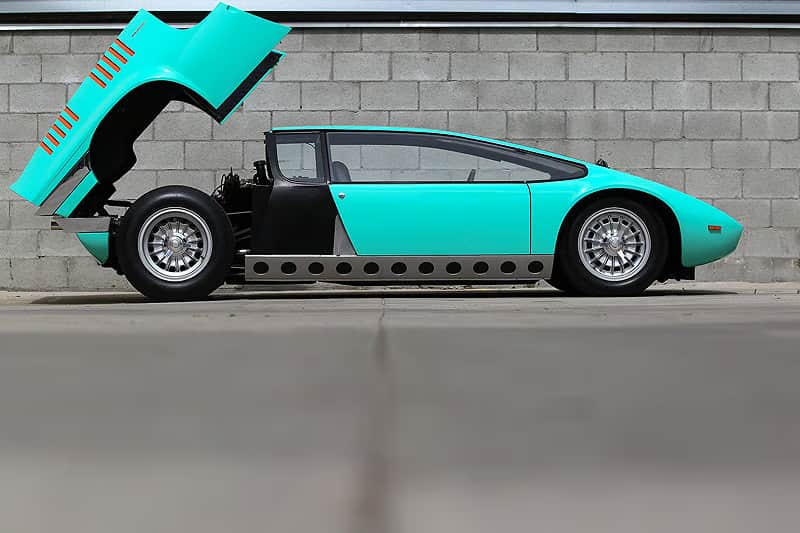
The visual result was explosive. The Manta's original colour was acid green with orange accents, and it was painted metallic grey for Italdesign's 30th anniversary, returning to green at the end of the celebrations.
The design that changed everything
A 15-degree windscreen, no bonnet and the driver in the centre
The continuous connection between the bonnet and the roof allows a windscreen inclined at 15° to be drawn — truly extreme for the era. This solution necessitates the use of a venetian blind immediately beneath the windscreen, operable from inside, which allows the driver to increase visibility in urban driving.
It was the solution to a problem that Road & Track itself articulated in its show coverage: Giugiaro has done away with the bonnet altogether, fusing the letterbox nose with the windscreen and the roof in a firm, rising line. The so-called "one-box style" — bodywork with no distinction between bonnet, cabin and boot, everything integrated into a continuous form — was a philosophy Giugiaro would take to production cars: the 1974 Volkswagen Golf, the Alfasud, the Maserati Bora. The Manta was the conceptual demonstration of that principle in its purest form.
The Manta's design introduced new aerodynamic and architectural concepts that would define sports car design for decades. The one-box body was characterised by a steeply inclined 15° windscreen and a continuous wedge profile, eliminating the traditional distinction between bonnet, cabin and boot.
The central driver's seat was the most radical interior decision. The driver sits in the centre with a passenger seat on each side, which may not be ideal or even necessary, though it certainly makes the car too wide. It was a critical reading — but the concept was correct. The idea was copied from a Ferrari 365 prototype built in 1965 and was subsequently more popularly revived with the powerful McLaren F1.
Gordon Murray's McLaren F1 would arrive in 1992. The Manta had done it in 1968. Twenty-four years earlier.
The loss
The car that was lost crossing the Atlantic
The public had its first glimpse of the car at the 1968 Turin Motor Show. It was painted lime green and was without doubt one of the highlights of the show. The car was subsequently shipped to the United States; in transit, it was lost and was not seen again until the late 1970s.
The period of its disappearance — the 1970s — remains the darkest chapter of the Manta's history. There is no documentation of where it was, who had it, how it was treated. When it was found, it received a new paint job, this time in silver. It was exhibited again at the Italdesign 20th anniversary celebration in 1988 as one of the highlights of the events.
Originally finished in acid green, the Manta was subsequently repainted in metallic grey before being restored to its original colour. The Manta's colours are, in themselves, a historical archive of its different lives: the original acid green of Turin 1968, the silver of the late-1970s California reappearance, the metallic grey of the 1988 20th anniversary, and the restored acid green of its current state.
The legacy
The cars that would not exist without the Manta
The body designed by Giorgetto Giugiaro in the so-called one-box style is considered revolutionary for the design of subsequent mid-engine sports cars.
The list of cars that owe something to the Manta is long enough to be difficult to trace with precision. The 1972 Lotus Esprit — designed by Giugiaro at Italdesign — has the same no-bonnet wedge philosophy. The 1972 Maserati Bora, also from Italdesign, applies the same one-box language to a production Grand Tourer. The 1974 VW Golf takes the same principle to a utility car made in millions of units. All of them signed by the same studio, in its first year of existence.
In 2008, Italdesign revisited its design principles with the Quaranta concept — a modern tribute to the Manta's pioneering integration of engineering and form. The Quaranta — forty in Italian, for the 40th anniversary — had the same wedge, the same inclined windscreen, the same absence of a differentiated bonnet. It was proof that forty years later, the Manta's language was still radical.
Although it was a "rush job", the Manta not only catapulted Italdesign into the automotive stratosphere and inspired countless other designs (signed by Giugiaro or not), but is also remembered as one of the most representative concept cars of the 1970s, if not of the twentieth century. Its existence can easily be explained as "one man's trash is another's treasure", but the truth is that there are few designers on the planet as talented as Giugiaro. And to prove it, one need only remember that he was just 28 years old when he created one of the most memorable concept cars in history.
The only existing Bizzarrini Manta was auctioned by Gooding & Company at Pebble Beach in August 2012 — one of the most anticipated auction events of that year in the collector car world. The hammer price was not publicly disclosed. What is documented is that it still exists, that it is still unique, and that the tubular steel chassis Giotto Bizzarrini took to Le Mans in 1966 and that Giugiaro transformed in 40 days in 1968 remains, nearly sixty years later, one of the most influential design objects the twentieth century produced.