Imagine an engine where the cylinder head is not fixed to the block. Where the entire cylinder assembly tilts by millimetres on a hinge while the engine is running, altering in real time the very physics of combustion.
The radical concept
The problem nobody had solved in a century
Every internal combustion engine has a fixed compression ratio. It is one of its most fundamental parameters: how much the air-fuel mixture is compressed before ignition. A high ratio means greater efficiency and lower fuel consumption, but also a higher risk of premature detonation under load. A low ratio allows the engine to be supercharged without pre-igniting, but wastes energy at cruising speed.
For over a hundred years, engineers chose a middle ground and lived with it. Saab decided not to choose.
The solution they developed in Trollhättan during the 1990s was conceptually so simple that it is surprising nobody had taken it this far before: if the volume of the combustion chamber determines the compression ratio, why not make that volume variable? Not with special pistons, not with complex connecting rod mechanisms — but by making the engine block literally tilt on a hinge.
¿Cómo se ve en la
vida real?Ver en TikTok▶❤️💬🔗TV@LlantaPinchadaTVThe Saab SVC in action — the engine that folded while it ran 🇸🇪🔧 #Engineering #Saab #Engine
Disponible en nuestra comunidad vertical
"It was not just another engine. It was an engine that transformed itself according to what you needed from it."
The Monohead
The block that folded in two
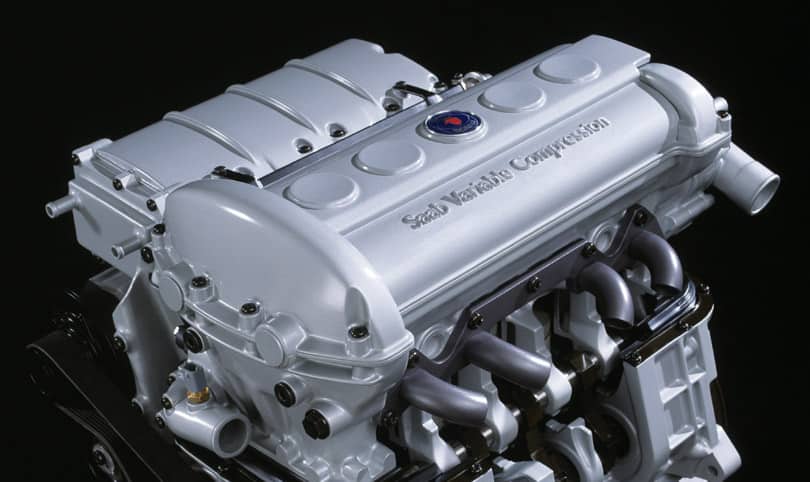
The heart of the solution was what Saab's engineers called the monohead: an integrated cylinder head that not only housed the valves and combustion chamber, but the cylinders themselves. The entire cylinder assembly formed a single rigid unit — separate from the lower block where the crankshaft lived.
The two blocks were joined by a hinge on one side. A hydraulic actuator controlled the angle between both halves, with a range of movement of up to four degrees. Four degrees that changed everything: by tilting the monohead towards the lower block, the space between the piston crown and the cylinder head was reduced, increasing compression. When they separated, that dead volume increased and compression dropped.
The result was an engine that at gentle cruising behaved like a high-compression, maximum-efficiency unit — approaching diesel proportions. And that when pushed hard would lower its compression while the supercharger pushed up to 2.8 bar of boost, without any risk of detonation. The same engine, two modes of existence, with a transition imperceptible to the driver.
The seal between the two blocks was achieved with a rigid rubber bellows. The supercharger, intercooler and intake system were integrated into the monohead, moving with it as a single unit. From the outside, it was a completely conventional-looking five-cylinder 1.6-litre engine.
The performance
225 hp from 1.6 litres. No tricks.
The figures Saab presented at the 2000 Geneva Motor Show were hard to believe: a 1,598 cc, inline five-cylinder engine capable of producing 225 horsepower and 305 Nm of torque, with fuel consumption up to 30% lower than a naturally aspirated engine of equivalent performance.
The reference comparison was direct: the SVC consumed like a conventional 1.6-litre engine under normal conditions, but delivered the power of a 3.0-litre engine when pushed. The efficiency of a city car, the muscle of a sports saloon, in the same block.
Popular Science named it best technology of 2001 in the automotive category. AutoZine awarded it the same recognition that same year. The prototype ran installed in a first-generation Saab 9-5, where engineers conducted the documented performance tests. Some of those engines went on to run in the Saab museum in Trollhättan.
What Saab had not entirely solved — and which the engineers themselves later acknowledged — was the structural noise generated by the hinge under load. The movement of the monohead introduced vibrations that proved difficult to isolate from the cabin, and whose solution would have required further development cycles.
The legacy
GM switched it off
In 2000, General Motors completed the full acquisition of Saab Automobile. The Swedish brand became one more subsidiary within the world's largest car manufacturer. One of the new management's first acts was to cancel the SVC programme for budgetary reasons.
The engineers who had worked on the project acknowledged years later that the decision was coherent from GM's corporate perspective: the SVC required additional development investment, was difficult to produce at scale, and the company had other plans for Saab that did not include proprietary engine technology. Installing shared group engines and rebadging vehicles from other brands was cheaper.
The variable compression problem went unsolved in production for nearly two more decades. In 2019, Infiniti launched the QX50 with Nissan's VC-T engine — the first variable compression engine to reach mass production — the result of twenty years of development and over three hundred patents. Its compression range: 8:1 to 14:1. Identical to that of the Saab SVC, presented nineteen years earlier in Geneva.
Saab went bankrupt definitively in 2011. What could have been its technological ticket to the future had been sitting in a drawer for ten years.