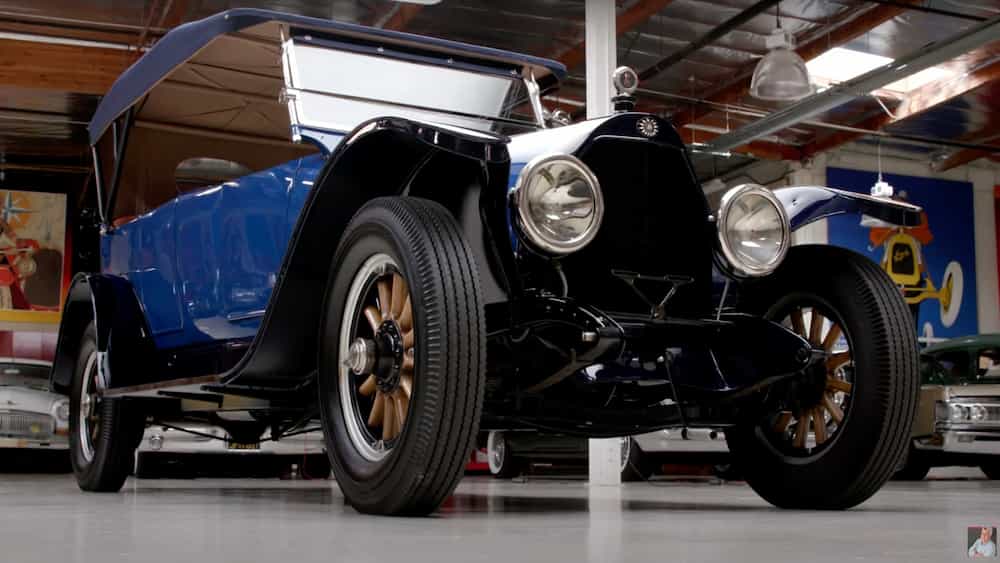
Imagine a 1915 car with no clutch pedal, no gear lever, where speed is regulated with a small lever beside the steering wheel, where there is no mechanical connection between the engine and the wheels, and where the same electromagnetic principle that propelled the battleship USS New Mexico moves a luxury saloon through the streets of Manhattan. And Enrico Caruso bought one.
The problem it solved — in 1916
Manual transmissions of 1915 were a nightmare — and the Owen Magnetic eliminated them
The Owen Magnetic was the perfect vehicle for the first decade of mass-produced automobiles, as it has no clutch or gear lever. In 1916 hybrids made more sense than today because early manual transmissions were a genuine nightmare to operate. Most cars of the era had straight-cut gears and heavy clutches. If you were a man or woman with a bad leg, or simply unable to drive, shift and double-declutch at the same time.
Early petrol automobiles required considerable physical skill to drive. Straight-cut gear transmissions needed manual synchronisation — the driver had to coordinate the clutch, throttle and lever with a precision that took weeks to learn. A timing error produced a metallic screech, a violent jolt or even mechanical damage. For a society that had come from driving horses, it was an enormous demand.
The Owen Magnetic had no mechanical connection between its engine and the drive axle. Power was sent from the petrol engine to the wheels through a magnetic clutch and an electric motor. The result was, in effect, an automatic transmission with no clutch pedal to press and no gears to change.
It was exactly what someone like Enrico Caruso — the world's most famous tenor, with the most valuable fingers on the planet — needed to get around New York without risking his hands on an aggressive manual transmission.
¿Cómo se ve en la
vida real?Ver en TikTok▶❤️💬🔗TV@LlantaPinchadaTVThe 1915 Owen Magnetic: the series hybrid that anticipated the Toyota Prius by 80 years — bought by the world's most famous opera tenors 🎵🚗⚡ #OwenMagnetic #Hybrid #History #Engineering
Disponible en nuestra comunidad vertical
"R.M. Owen & Company has leased the large new three-storey fireproof building on the corner of Fifth Avenue and 142nd Street in New York, where they will build the new Owen Magnetic automobiles." — New York Times, announcing the start of production, 1915
The Entz transmission
No gears, no clutch, no mechanical connection — just magnetism
The transmission mechanism had no direct connection between the engine and the rear wheels. Instead of a flywheel, a generator and a horseshoe magnet were attached to the rear end of the engine's crankshaft.
The principle of the Entz system was that of a series hybrid avant la lettre: the petrol engine did not drive the wheels directly — it generated a magnetic field which in turn generated electricity, and that electricity drove the electric motors that actually actuated the wheels. The generator and electric motor were mounted on the same shaft, so they always rotated at the same speed, and critically the coupling between the generator and the motor was both mechanical and electrical.
At the forward end of the car's drive shaft, there was an electric motor with an armature fitted in an air gap inside the rotating magnet. Electrical current, transmitted by the engine generator and the magnet attached to the electric motor armature, provided the energy to rotate the drive shaft and propel the rear wheels of the motor. The car's speed was controlled by a small lever adjacent to the steering wheel.
Speed was regulated by pulling a lever at the centre of the steering wheel to control the five different speed ranges. They were not five gears in the conventional mechanical sense — they were five ranges of continuously variable electromagnetic field variation. That is why the car was advertised as "The Car of a Thousand Speeds": speed was actually infinitely variable within each range, not stepped.
It is sometimes called an early hybrid car, but it is not really a hybrid — it has no peak energy storage source. It has no storage battery. The only energy source is the petrol engine, which feeds the wheel electric motors in real time. It is more precisely a series hybrid without storage — what engineers today would call an extended-range electric vehicle without the storage part. The petrol engine runs constantly as a generator; the electric motors deliver the power with the smoothness and modulation that no mechanical transmission of the era could match.
The other advantage of the car was its electric brake. On releasing the speed lever, the electromagnetic field acted as a regenerative brake — the same technology that modern electric cars use as regenerative braking. In 1916.
The customers and the price
Ten times more expensive than a Ford — and with a waiting list at the New York opera
The car became as famous as its clientele, which included Enrico Caruso and John McCormack.
Caruso was the most celebrated tenor in the world at that moment — his 78 rpm disc recordings were the best-selling records in history up to that date, and his performance fees were the highest in any artistic discipline. McCormack was the world's second most famous tenor and the only one who rivalled Caruso in disc sales. Both bought Owen Magnetics.
It was the car of the cultural and financial elite of New York, Boston and Philadelphia. Prices were in the range of $3,000 to $6,000. A 1917 Ford Model T cost $360; Cadillacs hovered around two thousand dollars. An Owen Magnetic started at $3,700 and went up from there.
The price difference was justifiable from the buyer's perspective: the Owen Magnetic offered a driving experience that no other car in the world could provide. No clutch, no gear changing, no physical coordination that conventional cars demanded. For a pianist, a tenor or an industrial magnate who travelled with a chauffeur, it was the only car that allowed the accompanying passenger to drive as well without weeks of prior training.
The technology and its limitations
Why the most elegant system of its era was also too expensive to survive
The Entz transmission was genuinely brilliant in its operation. It was a manual-shift transmission that made driving easy because it shifted without declutching or synchronising gears. But its brilliance had a price — literally and figuratively.
The system required a high-precision generator, a high-power electric motor and all the electromagnetic engineering needed to make both work in a coordinated fashion. Every component was significantly more expensive to manufacture than the mechanical equivalents of the same period. And every component was also harder to repair for the mechanics of the era, who had no electrical training.
The complex system was expensive, and the company filed for bankruptcy in 1920. In five years of production, Owen Magnetic had built fewer than a thousand cars. It was not enough to amortise the investment in the Entz system or to build a service network capable of maintaining the technology.
The Ford Model T, at $360 and with its two-speed planetary transmission — equally without a conventional clutch, but for completely different and far simpler reasons — was winning the market battle with an opposing philosophy: maximum simplicity, maximum accessibility. The Owen Magnetic lost that battle before it started.
The legacy
The USS New Mexico, the Toyota Prius — and Jay Leno driving one on YouTube
The Fountainhead Antique Auto Museum in Fairbanks, Alaska, owns an Owen Magnetic. Their website states that 974 were manufactured from 1915 to 1921 and that approximately a dozen are known to exist today.
Only 12 are said to still exist — one at the Nethercutt, one in Jay Leno's collection, one at the Cleveland Car Museum, one at the Fountainhead.
Jay Leno — also the owner of one of the two Japanese Cosmo Sports exported to the United States — filmed an episode of his series "Jay Leno's Garage" driving the Owen Magnetic from his collection. What impressed him most was the smoothness of power delivery: no jerk, no jolt, no vibration. Just linear, silent acceleration, exactly like a modern electric car.
The difference between the 1915 Owen Magnetic and the 1997 Toyota Prius is not conceptual — it is materials and electronics. The Prius uses a petrol engine as a generator that feeds electric motors with a battery bank as a buffer. The Owen Magnetic used a petrol engine as a generator that fed an electric motor without a storage battery. The fundamental concept — using the combustion engine as an energy source for an electric transmission — is identical.
Owen Magnetic was a pioneering American company in luxury hybrid and electric automobiles manufactured between 1915 and 1922. The company's car models were notable for their use of an electromagnetic transmission and constitute early examples of a series electric hybrid.
Eight decades after the last Owen Magnetic left Wilkes-Barre, Pennsylvania, Toyota received the Engineering Award for the Prius. The principle they were rewarded for was already eighty years old. It was just that in 1997 the materials were cheap enough for the car to cost the same as a Camry, and not ten times more than a Model T.