Imagine a car with a production-derived engine from what would power the Oldsmobile Cutlass Calais — enlarged with a turbo to 1,000 horsepower, mounted in an IndyCar chassis, with a carbon fibre body, weighing 726 kilograms, capable of 278 mph in a single pass. Eighteen years before the Bugatti Veyron reached 253 mph.
The engine that started it all
The Quad 4: the first American production engine with DOHC and four valves
In late 1984, Oldsmobile was finishing development of the Quad 4, a new inline four-cylinder engine with double overhead camshafts and four valves per cylinder. It was innovative for a four-cylinder. Oldsmobile promoted the engine as the perfect blend of fuel economy and power.
The Oldsmobile Quad 4 was the first high-volume production engine designed entirely in the US to have these features. What BMW and Mercedes had been exploring in Europe for years, and what Honda and Toyota engineers had been refining since the 1970s, was an absolute novelty in the American domestic industry. In its initial configuration, the factory Quad 4 produced 150 horsepower and 160 lb-ft of torque, eclipsing other domestic four-cylinders and rivalling the competition's V6s: Honda's 2.5-litre V6 was rated at 151 hp in 1986.
The engineers behind the Quad 4 engine development were eager to demonstrate the engine's capabilities. Under the leadership of Ted Louckes, Quad 4 engine programme chief, they convinced General Motors senior management to develop a research vehicle that would showcase the engine's potential.
The proposal was radical: not a showroom concept car, not a styling exercise for motor shows. A vehicle capable of breaking the world closed-circuit speed record.
¿Cómo se ve en la
vida real?Ver en TikTok▶❤️💬🔗TV@LlantaPinchadaTVThe Oldsmobile Aerotech: the car nobody remembers that beat the Bugatti Veyron 18 years early with a four-cylinder engine 🏎️💨 #Oldsmobile #Aerotech #SpeedRecord #Engineering
Disponible en nuestra comunidad vertical
"Olds never talked about specific figures, but the twin-turbo Quad 4 was supposedly good for over 1,000 horsepower." — Story-Cars, on the Feuling engine in the Aerotech Long Tail
The design
An IndyCar chassis, one centimetre from the ground and sketches inspired by the Porsche 917
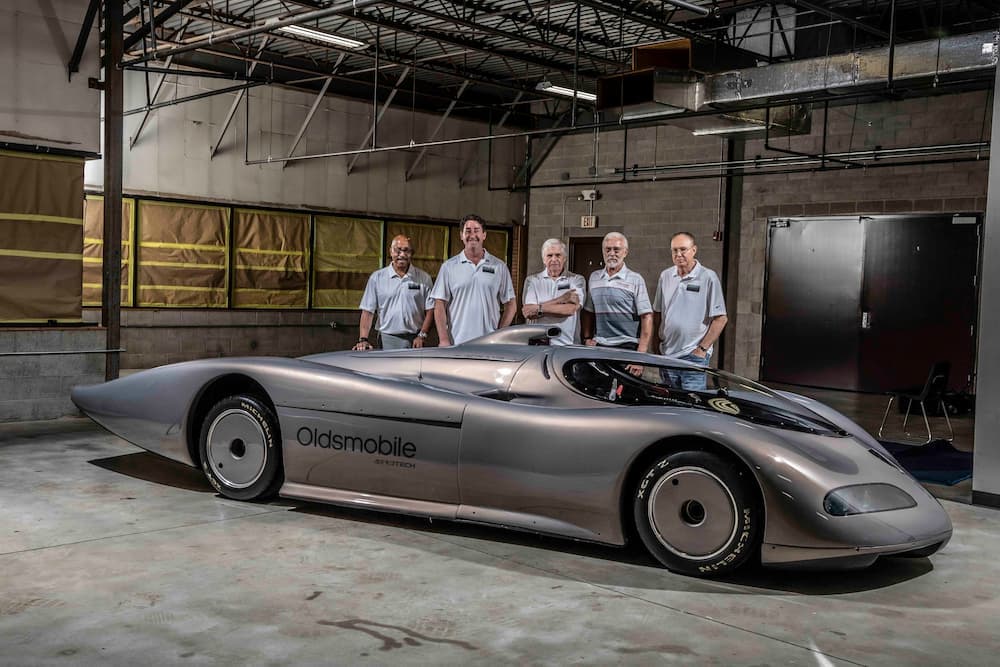
The car would consist of a carbon aerodynamic body designed by GM mounted on a modified March 84C CART chassis, similar to the one that won Indianapolis that year.
Designed by Ed Welburn, the Aerotech's extremely aerodynamic shell originally incorporated a longer rear section, reportedly inspired by the Porsche 917 LH. Welburn was then assistant chief designer at the Oldsmobile design studio. However, this design ran counter to Louckes's plan to set a closed-circuit record at the Indianapolis Motor Speedway, so Oldsmobile ultimately opted for a short-tail version.
The result was two simultaneous cars with different rear ends: the Short Tail (ST) and the Long Tail (LT) — the latter retaining the 917 LH inspiration. Two strategies for two types of record.
Wind tunnel testing showed the shape was aerodynamically efficient but would benefit from some improvements suggested by Max Schenkel, a General Motors aerodynamicist. After extensive wind tunnel testing at the GM Technical Center in Warren, Michigan, it was decided to round the nose and refine the cockpit design. The air intakes were also moved from the sides of the car to the top of the fenders.
The carbon fibre body rested on a specially designed aerodynamic-effect IndyCar chassis, and the entire vehicle weighed just 1,600 pounds — 726 kilograms. High-speed runners need to stay glued to the ground, and the Oldsmobile Aerotech was no exception, with an inch or less of airspace between its lowest point and the ground surface.
The engines
850 hp from the Batten, 1,000 hp from the Feuling — and neither was a production Quad 4
The first two Aerotechs were originally powered by DOHC four-cylinder engines that were not based on production Quad 4 parts, but on a set of engineering parameters derived from the engine, which Oldsmobile called "production architecture". Under this framework, the derived engines had to maintain the Quad 4's four-stroke combustion cycle, twin camshafts, multi-valve head and, significantly, the 100 mm cylinder spacing.
It was the difference between saying "based on" and "is". The Batten engine in the ST and the Feuling engine in the LT shared DNA with the Quad 4, but they were competition beasts.
Batten Heads of Detroit developed the Batten RE engine with a single turbocharger producing an estimated 750 to 900 hp. This engine was used in the short-tail car. Feuling Engineering of Ventura, California developed the twin-turbo Feuling BE engine producing an estimated 1,000 hp, which was installed in the long-tail Aerotech.
The result: the LT was capable of something no motorised vehicle had done in a closed circuit in 1987.
Record day
26 and 27 August 1987: Fort Stockton, Texas
On 26 August 1987, the development team tested both completed cars at the Fort Stockton test track in the presence of FIA officials.
The initial passes with the short-tail Aerotech fell just below the closed-circuit speed record of 250.919 mph held by the Mercedes-Benz C111-IV prototype, prompting the teams to improvise aerodynamic modifications — specifically, taping over the cockpit air intake — to squeeze additional speed from the car.
The previous record was held by the Mercedes C111-IV, the same vehicle documented in the previous article: 403.978 km/h set by Hans Leibold at Nardò in 1979. Eight years later, an Oldsmobile turbocharged four-cylinder was attacking it in Texas.
The following day, Foyt insisted on trying the as-yet-untested long-tail iteration. The Mercedes record was quickly shattered, as the Aerotech managed to reach a peak speed of 275 mph in the flying kilometre. That same day, it also set a new closed-circuit record of 257.12 mph with the short-tail car.
The official figures: the LT reached a peak of 278 miles per hour in one direction, 257 in the other, for an official average of 267.399 mph in the "flying mile".
Foyt broke the old closed-circuit mark, held by a Mercedes-Benz streamliner since 1979, at a speed of 257.123 miles per hour in the "short-tail" Aerotech. And along the way, he erased the world flying-mile record in the 2-litre class, set by Phil Hill in an MG streamliner in 1959, with a two-pass average of 267.399 mph in a "long-tail" car; on one of the passes, Foyt's Aerotech was timed at 278.357 mph.
The second act
1992: Eight days, three cars, 47 records, twenty drivers and –20°C in the seat
Between 7 and 15 December 1992, a third Aerotech was built, and the two previous cars were pulled from storage and prepared to run with the addition of functional lights. All three cars were now powered by Oldsmobile's 4.0-litre Aurora V8 engines. The three cars broke 47 endurance speed records, including the world speed records for 10,000 and 25,000 kilometres.
The records of 10,000 km at 170.761 mph and 25,000 km at 158.386 mph — like running 31 consecutive Indianapolis races at roughly the same pace — were set by a team of drivers working 24 hours a day for 8 days.
As drivers, we thought the whole thing was pretty stupid. We were told to bring the car up to speed gradually, no abrupt gear changes, and cross at 180 mph. It was as easy to drive as going 55 on the motorway. And when we came in, we'd lift off the throttle a mile from the end and shift to neutral and coast in to save the brakes. But for most of the 3 days it was 20 degrees below zero Fahrenheit and a freezing wind in the driver's seat — recalled one of the participating drivers.
The legacy
What the Aerotech left for the road — and why nobody remembers it
Although it never became a production model, the Aerotech put Oldsmobile back in the spotlight in the late 1980s. The Quad 4 engine showcased in the prototypes remained in production for 15 years (1987–2002) and powered a long list of Oldsmobiles, Pontiacs, Buicks and Chevrolets.
The speed records generated considerable publicity for Oldsmobile and helped boost sales. The Aerotechs made several appearances at North American auto shows.
But although the Aerotech caused a sensation in its time, it is an unsung hero that does not receive the attention it deserves now that the Oldsmobile division no longer exists. GM closed Oldsmobile in 2004, after 107 years of history. The Aerotech — all three cars — remained in GM's heritage collection without the brand that had created them to defend their place in collective memory.
It was not until 24 September 2010 that Ed Welburn, by then Vice President of Global Design at General Motors, finally had the opportunity to sit behind the wheel of his favourite project for the first time. Twenty-three years after designing it. The car that Welburn had drawn when he was assistant chief designer at Oldsmobile, the car that had broken the Mercedes C111-IV's record, the car that had exceeded the Bugatti Veyron's peak speed before the Veyron existed — Welburn drove it for the first time in 2010, at the age of 57.
The Aerotech reached 250 mph nearly 20 years before the Bugatti Veyron did so in 2005. And approximately a couple of years before the Callaway Corvette Sledgehammer set the road car speed record at 254.76 mph in 1989.
A four-cylinder engine. An IndyCar chassis. A test track in Texas. A four-time Indianapolis winner at the wheel. And nobody remembers it.