Imagine an engine fundamentally designed in the 1920s, that won its first race in 1922, that dominated Indianapolis from 1947 to 1964 without losing once, that came back with a turbo to win five more times in the 1970s, and whose last competitive victory came in 1978 — fifty-six years after the first. No other engine in history can say that.
The Peugeot that started it all
A broken French car in a Los Angeles workshop — and three men who studied it
In 1913, Offenhauser sensed the opportunity to capitalise on the growing popularity of the automobile and applied for a job at a carburettor manufacturing company owned by one Henry A. Miller. The two men came from different worlds: Miller was the visionary, the man of ideas; Offenhauser was the craftsman, the one who turned ideas into metal. Offenhauser quickly earned Miller's respect and became responsible for the design of special tools and production fixtures.
Rickenbacker was a successful racing driver of the era. He drove a Peugeot with its advanced double overhead camshaft engine and four valves per cylinder. However, the Peugeot engine was faster than it was reliable, and after a frustrating retirement, Rickenbacker sold it to Miller and Offenhauser.
It was the French who had created the blueprint for the modern competition engine. Much like Ernest Henry, Harry Miller was not a formally trained engineer, though he possessed an exhaustive knowledge of foundry work. What Miller and Offenhauser did with the Peugeot was to study it, strip it, understand it, and then improve what did not work: the cast iron pistons were replaced with light alloy units. Their modifications made the French engines more reliable than they had been in the hands of their own creators.
The third member of the trio that would define the Offy arrived shortly after: a young man named Leo Goosen, who had worked for Buick. A talented engineer and draughtsman, Goosen brought technical expertise in stress calculations, bearing design and other details that Miller and Offenhauser lacked.
¿Cómo se ve en la
vida real?Ver en TikTok▶❤️💬🔗TV@LlantaPinchadaTVThe Offenhauser engine: 27 victories at Indianapolis, 56 years competing at the highest level. The story of the most dominant engine in motorsport history 🏁🇺🇸 #Offenhauser #Offy #Indianapolis #Engineering
Disponible en nuestra comunidad vertical
"You would be hard pressed to find another engine that lasted as long and was as successful." — Engine Labs, on the Offenhauser legacy
The architecture
Why a four-cylinder dominated when everyone used eights and sixes
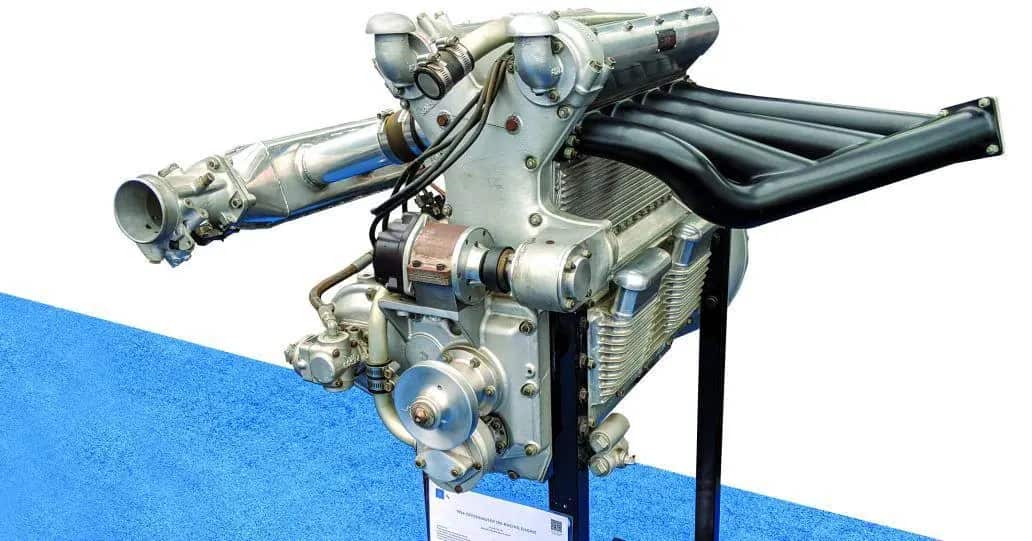
In 1926, Miller had developed a 151 cubic inch inline-4 marine engine with twin camshafts (but two-valve heads) intended for hydroplane racing. It immediately attracted the attention of land racing drivers as a more reliable and powerful alternative to Ford Model T engines. In 1930, Goosen designed the Miller 200, a much lighter and more powerful four-valve four-cylinder aimed directly at the land racing market. The basic architecture of this engine, which was built from the outset to allow for displacement increases, would form the core of what would become known as the Offenhauser engine.
The classic Offy's engineering had several features that set it radically apart from conventional engines.
The Miller/Offenhauser design was actually very simple. The cylinders and head were integral — that is, a single casting — eliminating any head gasket problems. The sump was a separate assembly bolted to the underside of the combined cylinder block and head. At a time when production and racing engines routinely suffered gasket leaks and failures, the Offy simply had no head gasket. It was impossible for that component to fail because it did not exist.
The one-piece construction proved invulnerable to head or cylinder stud problems, and allowed higher cylinder pressures.
Most competitors in those years raced with V8s or six-cylinder engines; the Offenhauser's four-cylinder layout proved surprisingly dominant. With displacements ranging from 97 to 270 cubic inches, Offys generated massive power. Their torque and reliability set them apart in American single-seater racing.
The physical reason a four-cylinder can compete against sixes and eights relates to internal geometry. At equal displacement, an engine with fewer but larger cylinders can have a longer stroke and consequently greater torque. The Offy was not a high-RPM engine — it was a brutal torque engine at a moderate rev range, perfectly suited to American ovals where acceleration out of corners was more important than peak power on the straight.
The bankruptcy and the rebirth
1933: Miller goes bankrupt. Offenhauser buys the pieces.
The Great Depression forced Miller's company into bankruptcy in 1933, and all assets went to auction. Fortunately for the racing world, workshop foreman Fred Offenhauser and designer Leo Goosen were able to buy the designs and tools at the bankruptcy auction, and continued building and developing the Miller engines.
Offenhauser made changes in 1935. The engines bearing his name at the Indy 500 incorporated several changes from the Miller 255. Kelly Petillo's winning Offy was a special "low" block measuring 10.625 inches, actually displacing 262 ci. Offenhauser also made his bearing journals 1/8 inch larger than those of the original Miller 255. Taking first and second place at the Indianapolis 500 firmly put Offenhauser on the racing map.
Harry Miller, the original inventor, had a sad ending. Harry moved — alone, his wife returned to California — to Indianapolis, where he became involved in various aviation projects with Preston Tucker. Everything ended badly. A year later Miller went to Detroit. He set up a small business manufacturing test fixtures and tools, and spent the last two years of his life in near poverty. At 65, having suffered from diabetes for years and having developed facial cancer, the end was near. In early 1943 he suffered a heart attack and died on 3 May. His ashes were deposited in Los Angeles with little fanfare, a sad passing for this flawed but vital man.
The golden age
1947–1964: Seventeen years without losing at Indianapolis
The post-war years were a golden era for Offenhauser racing engines. From 1947 to 1964, every winner of the Indianapolis 500 drove an Offy engine, and in most of those years the entire podium was powered by Offenhauser.
From 1950 to 1960, Offenhauser-powered cars not only won the Indy 500 but claimed all three podium positions, taking pole position in 10 of the 11 years.
To understand what this means: there was not a single race in those eleven years in which an Offenhauser-powered driver did not finish first, second and third simultaneously. It was such complete domination that the Indianapolis 500 organisers began to worry whether the uniformity of the engine was killing public interest.
The flexible base engine could adapt to regulation changes at Indianapolis and other series as set by the AAA and later the USAC, and Midget, Sprint and Indy cars all used Offenhauser engines.
Ettore Bugatti had reached the same conclusion decades earlier. The engine was so prominent in its field that when Leon Duray took two front-wheel-drive Miller Type 91s to Europe to race in 1928, Ettore Bugatti bought both cars to study how the American racers were constructed. The designer of the most famous European automobiles paid out of his own pocket for two American cars in order to strip their engine architecture. That architecture was the direct predecessor of the Offenhauser.
The defeat and the turbo
1965: Jim Clark and Ford. 1968: The Offy returns with a turbo.
Only with the arrival of rear-engined cars, and the Ford twin-cam V8, did this winning streak end, after Jim Clark dominated the 1965 race in his Ford-powered Lotus 38. The atmospheric Offys could not live with the power and fuel efficiency of the Fords, and 1965 also sounded the death knell for the front-engined Indy Roadster — 1968 would be the last year such a design even made the grid.
But the Offy had one more card to play. The turbocharger came into vogue, and that gave the venerable Offy a new lease of life. Offenhauser won Indy again in 1968, taking Bobby Unser to victory lane with a turbocharged 2.75-litre (168 cubic inch) engine.
Then the Offy had another golden era, winning five consecutive years from 1972 to 1976 with a 2.6-litre (159 cubic inch) turbocharged engine format.
It was the second resurrection of the same fundamental design. An engine whose basic architecture had been drawn by Leo Goosen in 1930 was winning Indianapolis in 1976 — forty-six years later. With a turbo, with new alloys, with Hilborn fuel injection instead of a carburettor, but with the same one-piece block, the same four-valve DOHC layout, the same philosophy of torque over RPM.
The legacy
Why no other engine has done what the Offy did
The last time an Offy-powered car competed was at Pocono in 1982 for the Domino's Pizza Pocono 500, in an Eagle chassis driven by Jim McElreath, although two Vollstedt chassis with Offenhauser engines failed to qualify for the 1983 Indianapolis 500.
The final tally: 27 victories in 41 attempts at the Indianapolis 500 — a success rate of 65.9%. From 1947 to 1964, Offenhauser engines powered the winning cars at the Indianapolis 500 (17 consecutive years). From 1950 to 1960, Offenhauser-powered cars not only won the Indy 500 but claimed all three podium positions, taking pole position in 10 of the 11 years.
Ask most motorsport enthusiasts which is the longest-lived and most outstanding competition engine design, and chances are most will say the Cosworth DFV. A fair assumption, given that its first Grand Prix outing was in 1967 and its last in 1985. Yet impressive as the DFV's near-two-decade competitive life was, it does not come close to the Miller/Offenhauser four-cylinder, which was used in one form or another for over 50 years and dominated at Indianapolis for much of that time.
Fred Offenhauser died in 1973. Offenhauser lived to see his mechanical design win the Indianapolis pole with Johnny Rutherford and Gordon Johncock win the race in another Offy-powered car at Indy in 1973. Offenhauser died that same year, just before turbo boost rules brought the Offy dynasty to an end.
But the end took its time. In 1976, Johnny Rutherford put the historic engine back in Indianapolis victory lane — number 27, in 41 attempts, sixty-six years after Harry Miller first began studying Eddie Rickenbacker's broken Peugeot in a Los Angeles workshop.