Imagine a car that in 1967 looked designed in 1982. With a wedge silhouette that anticipated the Audi 100 by fifteen years. No clutch pedal — the gearbox changed itself when you touched the lever. With an engine that sounded like an expensive appliance and revved to 6,500 rpm. And that forced NSU to replace engines under warranty until bankruptcy.
```label The company that bet everything ```
NSU: motorcycle manufacturer, Wankel pioneer, and victim of its own ambition
In the 1950s, NSU was one of the largest motorcycle manufacturers in the world. The Neckarsulm company had a history stretching back to 1873, had broken motorcycle speed records, and in the second half of the decade had begun manufacturing small cars. But what would define NSU's fate was not a motorcycle or a small utility car — it was an engineer with radical ideas about how an engine should work.
NSU hired Felix Wankel after the Second World War and funded development of the first functional Wankel engine in 1957. It was expected that the engine's defects — primarily the wear-prone apex seals, high emissions and elevated fuel consumption — could be resolved with sufficient time, money and engineers assigned to the project.
By 1958, NSU chief engineer Walter Froede had refined the concept into the KKM engine, which became the basis for automotive applications. And in 1964, NSU presented the world's first mass-production car with a Wankel rotary engine: the NSU Spider. A single rotor. Small. A proof of concept with number plates.
The Ro 80 was something else entirely. It was the total wager.
```tiktok https://vm.tiktok.com/ZGdHksRRV/ @LlantaPinchadaTV The 1967 NSU Ro 80: the most advanced car in the world that killed its manufacturer in 10 years 🚗💨 #NSU #Ro80 #Wankel #Engineering #CarOfTheYear https://res.cloudinary.com/db3veuotr/image/upload/v1777335516/image_25_eh3aeq.jpg ```
"Many visitors do not know what to admire first. The futuristic shape, the extravagant engine, or both." — Klaus Arth, NSU authority, on the public's reaction in Frankfurt, September 1967
```label The design that arrived from the future ```
Claus Luthe drew in 1962 what the world would manufacture in 1982
The Ro 80 project was approved in late 1962, with Claus Luthe's first styling sketches completed early that year and a full-size clay model finished in September.
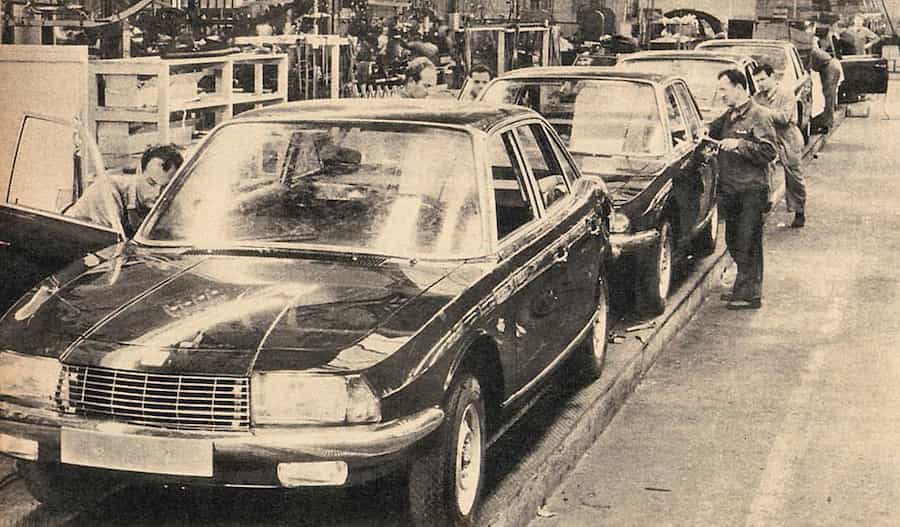
The Ro 80 followed the principle of "form follows function". NSU developed the car in a wind tunnel: its wedge-shaped body line with a flat, low front, a low waistline with a gentle rise, and a raised rear enabled a drag coefficient of 0.35 — and created an overall appearance perceived as futuristic by contemporaries.
Comparisons have been drawn between the Ro 80's design and the aerodynamically advanced 1982 Audi 100, as the silhouette is very similar. It is no coincidence: Claus Luthe designed the Ro 80 at NSU and subsequently became head of design at BMW, where he directly influenced the aesthetics of the Bangle-era BMWs. And Audi's engineers, who absorbed NSU in 1969, inherited that aerodynamic design philosophy which crystallised in the legendary 1982 Audi 100 C3 — the car that popularised the drag coefficient as a sales argument.
The Ro 80's profile, with its clean lines and Kamm-influenced tail, delivered a drag coefficient of 0.355 — well ahead of most contemporaries and indicative that NSU was taking the engineering brief seriously.
```callout Disc brakes on all four wheels were a rarity in 1967 — most cars still used drum brakes on the rear wheels. The Ro 80 not only had them on all four corners: the front brakes were inboard — mounted inside the chassis, next to the transmission, rather than at the wheel hub. This reduced unsprung masses, improving both handling and braking precision. It was racing car technology adapted to a family saloon in 1967. ```
```label The engine ```
No pistons, no camshaft, no vibrations — and no reliable apex seals
In September 1967, after five years of development, the Neckarsulm company presented the NSU Ro 80 to the public at the Frankfurt exhibition halls — as the world's first mass-production car with a twin-disc Wankel engine.
The engine was the car's entire reason for being. The 995 cc twin-rotor Wankel produced approximately 113–115 hp and felt more alive than the numbers suggested thanks to the engine's smoothness and its willingness to rev. No pistons rising and falling, no camshaft, no vibrations inherent in a conventional piston engine. The Wankel spun with the fluidity of an expensive appliance. Occupants described the experience as driving an electric car before electric cars existed.
The Ro 80 was equipped with a twin-rotor Wankel engine with a displacement of 995 cc. Power was transmitted to the front wheels through a three-speed semi-automatic transmission that had a gear lever knob which was pressed downward to actuate the clutch — instead of the more common third pedal.
The clutch system was one of the most elegant innovations in the car. Upon touching the gear lever knob, a sensor sent a signal to the vacuum system which automatically disengaged the clutch. The driver selected the gear and released the lever — the clutch reconnected on its own. No clutch pedal. No manual synchronisation. It was the intuition of what we now call a two-pedal transmission, implemented in 1967.
Felix Wankel, the inventor of the rotary engine, owned a Ro 80 himself. He could never drive it due to extreme short-sightedness, but he had a chauffeur and used the car for his regular daily transport, listening to the sound of his creation humming beneath the bonnet.
```label The failure ```
Three-piece apex seals of the same material — the design error that sank NSU
The Ro 80 engine suffered in particular from construction failures, among many other problems, and some of the first cars needed a rebuilt engine before 30,000 miles (50,000 km), with visible problems as early as 15,000 miles (24,000 km). The three apex seals of the rotor were made from the same material. This design flaw caused the central section to suffer greater abrasion on cold starts than the end pieces, so the apex seals could push against each other, allowing gas to pass into the adjacent preceding chamber.
It was a materials engineering failure, not a conceptual one. The rotary engine principle was sound. The choice to manufacture all three apex seal pieces from the same material was the problem. With a changed apex seal design this was temporarily resolved, and with the central apex seal piece manufactured in Ferrotic alloy (titanium carbide), the problem was completely solved. By the 1970 model year, most of these problems had been resolved.
But the damage was already done.
```callout The most popular "cure" for a worn-out Wankel engine in a Ro 80 was as ingenious as it was brutal: replace it with a Ford "Essex" V4 engine — the same one fitted to the early Transit — which turned out to be one of the few conventional engines compact enough to fit into the Ro 80's engine bay. The result was a car with the most advanced body of its era and the engine of a delivery van. Owners preferred that to the warranty costs of the Wankel. ```
Unfortunately for NSU, the car quickly developed a reputation for unreliability from which it never escaped. The Wankel engine suffered in particular from manufacturing failures, among many other problems, and some of the first cars needed a completely rebuilt engine before 30,000 miles.
NSU honoured its warranties. Every failed engine was a new engine, charged to the company's account. And engines failed frequently enough for the account to grow faster than sales.
```label The death of NSU ```
Absorbed in 1969, erased in 1977
In 1969, Volkswagen acquired NSU and merged it with Auto Union to form Audi NSU Auto Union AG, which significantly influenced ongoing production. Ro 80 production persisted in Neckarsulm without major interruption, but the plant increasingly prioritised other Volkswagen Group models, such as the Audi 100, which began sharing assembly lines and consuming most of the facility's capacity by the mid-1970s.
NSU ultimately disappeared after being absorbed in 1969 by the Volkswagen Group, together with Auto Union GmbH, to become Audi NSU AG, since but for the problems with its engine, the Ro 80 would have had a longer life, and NSU would still be alive today.
The 1973 oil crisis was the final blow. In 1973, the oil price crisis caused petrol prices to rise, turning customers towards more economical vehicles. This spelled the end of the rotary piston engine and therefore the end of the NSU Ro 80. A car consuming 15–18 litres per 100 kilometres, powered by a rotary engine with a reputation for unreliability, at the worst possible moment for that combination.
In total, over the model's life, 37,374 units of the NSU Ro 80 were built. The last one left Neckarsulm in April 1977. The NSU brand disappeared with it.
```label The legacy ```
What NSU left in Audi — and why the Ro 80 is in industrial design museums
The Ro 80 influenced subsequent Audi saloons, including the 100 and the early 200/5000 lineage, which adopted a similar aerodynamics-first design language and Luthe's clean surfaces. In certain respects, the Ro 80 prefigured the trajectory of German executive car design for the following twenty years.
The Ro 80's design, by Claus Luthe — who was head of design at NSU and later at BMW — was considered very modern at the time and continues to stand the test of time well. The Ro 80 has featured in numerous exhibitions in modern industrial design galleries.
Second-hand Ro 80s were worthless in the 1970s due to the well-publicised engine problems. An ironic twist was that one of the smoothest engines in the world was replaced by one of the roughest. Today, those same cars nobody wanted in the 1970s are prized collectors' items precisely because of what made them unpopular then: they are rare, they are unique, and they are the testament to what NSU attempted before materials engineering fully permitted it.
Time has shown that the experiments with the rotary engine should not be a cause for criticism. Thanks to Mazda's perseverance with the rotary design, the rotor seal problem has been eradicated. This progress came too late for the brand whose flagship became an object of ridicule in the motor industry.
The 1968 Car of the Year was the car that killed its manufacturer. And it was, in every sense that matters to design and engineering, the most advanced car of its era.