Imagine an engine where the piston does not always rise to the same point. Where the length of its stroke changes by millimetres as you drive, controlled by an electric motor and a chain of articulated links, adjusting in real time the balance between power and efficiency.
A century-old problem
Why compression matters and why you couldn't change it
Since Nikolaus Otto built the first four-stroke engine in 1876, the compression ratio has been one of the most fundamental and least flexible parameters of any petrol engine. It is the ratio between the cylinder volume when the piston is at the bottom and the volume when it is at the top. A high ratio compresses the mixture more, extracts more energy from each explosion and consumes less fuel. A low ratio allows the engine to be turbocharged without the mixture detonating prematurely — which would cause the dreaded knock, destructive to the engine.
The problem is that you cannot have both at once. A high-compression engine is efficient at cruising but sustains damage under full turbo load. A low-compression engine accepts the turbo but wastes energy when you do not need it. For 150 years, engineers chose a middle ground and lived with it.
In 1998, Nissan decided not to live with that.
¿Cómo se ve en la
vida real?Ver en TikTok▶❤️💬🔗TV@LlantaPinchadaTVThe Nissan VC-Turbo: 20 years to solve the oldest problem in the petrol engine. Here's how it works 🔧⚙️ #Nissan #VCTurbo #Engine #Engineering
Disponible en nuestra comunidad vertical
"Variable compression is the most elegant solution to the oldest problem in the internal combustion engine. The challenge was proving it could also be reliable." — Shinichi Kiga, VC-Turbo chief engineer, 2018
The solution
An electric motor that moves links that move the piston
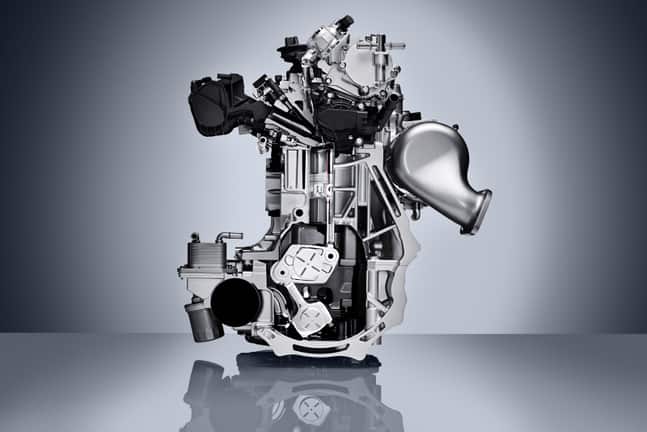
The VC-Turbo — whose internal family name is KR and whose main variant is the 2.0-litre KR20DDET — solves the variable compression problem with a mechanical solution that has no precedent in mass production: the multi-link system.
In a conventional engine, the piston is connected directly to the crankshaft via a connecting rod. The highest point the piston reaches — top dead centre — is always the same. The compression ratio is, by definition, fixed.
In the VC-Turbo, between the piston and the crankshaft there is a chain of four articulated pieces: the upper link (U-link), the central link (multi-link), the lower control link (L-link) and an eccentric control shaft. That control shaft is connected to an actuator electric motor through a special reduction gear called a Harmonic Drive — a highly precise technology that converts the motor's rotation into a very slow and controlled turn of the eccentric shaft.
The result is that the engine's actual displacement physically changes between two values: 1,997 cc when operating at low compression (8:1, maximum power with turbo) and 1,970 cc when operating at high compression (14:1, maximum efficiency at cruising speed). That is just 27 cc of difference, but it represents a fundamental change in how the engine uses energy.
At 14:1, the VC-Turbo operates as a high-efficiency engine in Atkinson cycle mode — the same cycle used by Toyota's hybrid engines to maximise thermal efficiency. At 8:1, the turbo pushes at maximum pressure without any risk of detonation. The transition between the two extremes is continuous, managed by the ECU several times per second according to throttle position, speed, temperature and boost pressure.
The multi-link system itself has a notable secondary benefit: it eliminates the need for balance shafts, which conventional four-cylinder engines require to compensate for their inherent vibrations. The multi-link geometry causes the piston to move in a more vertical and symmetrical path than a conventional connecting rod, reducing lateral forces on the cylinder walls and background noise.
The birth
20 years, 300 patents, a GT-R plant
Research began in 1998 under the direction of Shinichi Kiga, who became the project's chief engineer. The first SAE technical document describing the mechanism was published in 2003. Thirteen more years would pass before the world saw it at a motor show.
The VC-Turbo consumed two decades of development, as Kiga himself noted. The challenges were not only conceptual: machining the actuators and links of the variable compression system to the required tolerances was one of the project's greatest technical hurdles. The multi-link components are made from high-carbon steel, and their tolerances are so critical that Nissan made the decision to assemble the VC-Turbo engine at the same Yokohama plant that manufactures the V6 engine for the GT-R supercar — one of the most precisely assembled engines in worldwide mass production.
Nissan registered approximately 300 patents during the development of the VC-Turbo. The engine was officially announced at the 2016 Paris Motor Show and entered production in 2019 in the Infiniti QX50 and the Nissan Altima — replacing 3.5-litre V6 engines in both cases. The industry responded with enthusiasm: the KR20DDET won the Wards 10 Best Engines award in 2019 and 2020. The 1.5-litre three-cylinder variant (KR15DDT), introduced in the Rogue in 2022, also won the same award that year.
Engineer Kiga confirmed that the gain attributable exclusively to variable compression was 8% in fuel efficiency, though real-world fuel consumption figures proved more modest than laboratory numbers — a familiar pattern for any efficiency technology tested under real conditions.
The bitter memory
The links that did not hold
The multi-link system is a chain of components subjected to combustion forces that in a conventional engine are borne only by the connecting rod. Each of the links — the L-link, the A-link, the C-link — requires bearings that can withstand extreme load cycles over the engine's service life. And it was precisely there that the problem appeared.
On 13 December 2023, the NHTSA opened investigation PE23023 after receiving complaints from Rogue, Altima and QX50 owners reporting abnormal noises, loss of power, knocking and, in the most serious cases, metal fragments found in the oil sump — an unmistakable sign of catastrophic internal failure.
During discussions with the NHTSA, Nissan acknowledged that it had attempted to address main bearing and L-link bearing damage and seizure through multiple manufacturing process changes over time. In other words, Nissan was aware of the problem and had been quietly correcting it in production without making any public communication.
In July 2025, after eighteen months of investigation, the NHTSA closed the inquiry with recall 25V437: Nissan called back 443,899 vehicles in the United States with KR15DDT and KR20DDET engines from model years 2019 to 2024. The inspection procedure involved checking the oil sump for metal particles. If particles were found: complete engine replacement, a process Nissan estimated at up to 15 hours of workshop labour. At no charge to the owner.
Notifications began being sent from 25 August 2025. Owners who had previously paid for related repairs could apply for reimbursement with proof of payment.
The irony of the moment was that the recall arrived just as Nissan was going through one of its most serious corporate crises, with accumulated losses, merger talks explored with Honda and questioned leadership. The engine that had cost twenty years and three hundred patents ended up being the story of a brilliant idea implemented with manufacturing tolerances that took years to stabilise.
The KR20DDET remains in production. The KR15DDT remains in the Rogue. Both with manufacturing improvements. Variable compression remains the only example of its kind in mass production in the world. Nissan remains the only company that makes it.