Imagine sitting inside a steel capsule over 8 metres long, powered by a 44-litre aircraft engine, with enough power to take off… and whose greatest challenge was not accelerating, but preventing it from leaving the ground.
A race without precedent
When speed was propaganda
In the late 1930s, breaking the land speed record was not simply a technical challenge. It was a declaration of technological supremacy.
German driver Hans Stuck, one of the most important names in European motorsport, was convinced that Germany could dominate that record. But he understood something key: no conventional automobile was going to achieve it.
They needed something completely different.
Mercedes-Benz accepted the challenge and turned to one of the most brilliant engineering minds of the twentieth century: Ferdinand Porsche. What they designed was not a racing car. It was a machine created with a single purpose: to exceed 700 km/h.
¿Cómo se ve en la
vida real?Ver en TikTok▶❤️💬🔗TV@LlantaPinchadaTVThe Mercedes-Benz T80, the machine designed to break 700 km/h… that never got to try. ⚡🏁 #Engineering #Mercedes #Speed
Disponible en nuestra comunidad vertical
"It was not designed to race. It was designed to break the limits of speed."
It was not a car
It was an engine with wheels
The central element of the T80 was not its chassis, nor its aerodynamics. It was its engine.
A Daimler-Benz DB 603, an inverted V12 of 44.5 litres designed for combat aircraft such as the Messerschmitt Bf 109. This engine, in its standard configuration, already exceeded 1,700 horsepower.
But the T80 was not going to run under standard conditions.
For the record attempt, the MW 50 system was planned: a mixture of methanol and water injected into the engine to drastically increase power output. With this system, the engine was estimated to reach around 3,000 horsepower.
When aerodynamics decides everything
At speeds above 600 km/h, the behaviour of air ceases to be a detail and becomes the dominant factor.
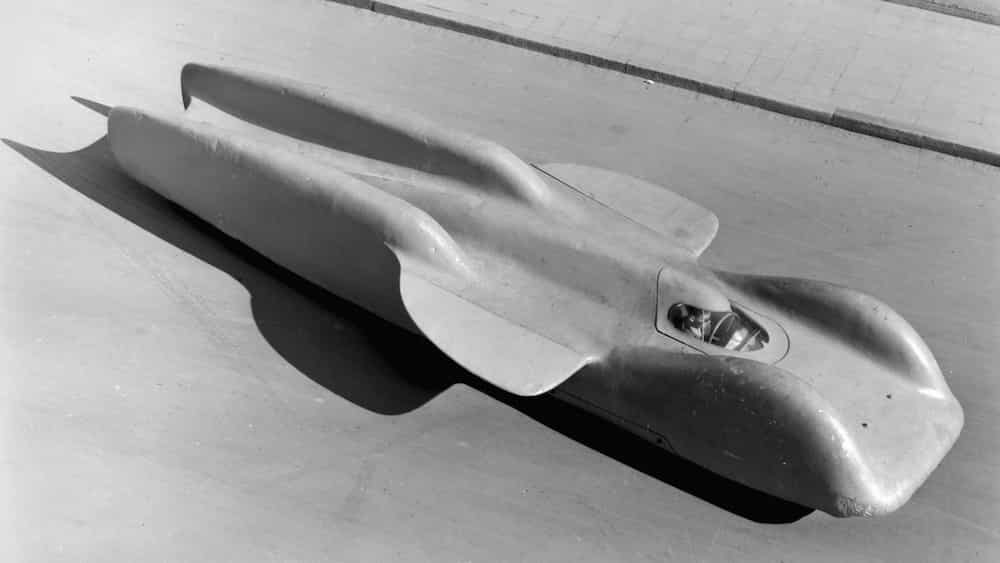
The T80 was designed as a fully enclosed capsule, with an elongated body and an extremely clean profile. Every line had a purpose: to reduce drag and control aerodynamic forces.
But there was a greater problem.
At those speeds, even small irregularities could generate lift. The vehicle could lose contact with the ground.
The solution was counterintuitive: incorporate small inverted wings.
These surfaces did not generate elevation, but the opposite. They applied negative aerodynamic load, pushing the vehicle towards the ground to maintain stability.
The six wheels also played a fundamental role. They not only distributed weight, but increased directional stability under conditions where any deviation could be catastrophic.
The attempt that never happened
The race against time
The record attempt was planned for 1940, on a specially prepared stretch of autobahn. The objective was clear: to comfortably surpass the existing record and approach 750 km/h.
The vehicle was practically ready.
But history had other plans.
With the outbreak of World War II in 1939, all resources were redirected to the war effort. The project was cancelled indefinitely.
The T80 never underwent a full-speed test run.
The machine that went too far
The Mercedes-Benz T80 never broke any record. It never competed. It never demonstrated in practice what it was capable of.
But that does not make it any less important.
It represents one of the most extreme attempts in the history of engineering to push the limits of land speed. A point where the line between automobile and aircraft practically disappears.
Today it remains at the Mercedes-Benz museum in Stuttgart.
Silent. Still.
Like an answer to a question that was never put to the road:
How fast can a vehicle go before it ceases to be a vehicle?