Imagine a company like Mercedes-Benz, known for its conservative saloons, launching in 1969 one of the most radical supercars in the world. And then voluntarily deciding never to sell it. And then using it for ten years to break speed records — first with Wankel, then with diesel, and finally exceeding 400 km/h.
The origin of the orange
A car Mercedes presented because it had to
The story of the C111 begins with a contract. In the 1960s, Mercedes-Benz signed a licence agreement to develop the rotary engine invented by Felix Wankel, which had been patented by NSU. One clause of the contract stipulated that the company must put the car into some form of production — or pay a considerable penalty. To avoid that payment, Mercedes did something it would normally never do: it presented a prototype to the public before having even decided whether it would produce it.
That is how the C111 arrived at the International Motor Show in Frankfurt in September 1969.
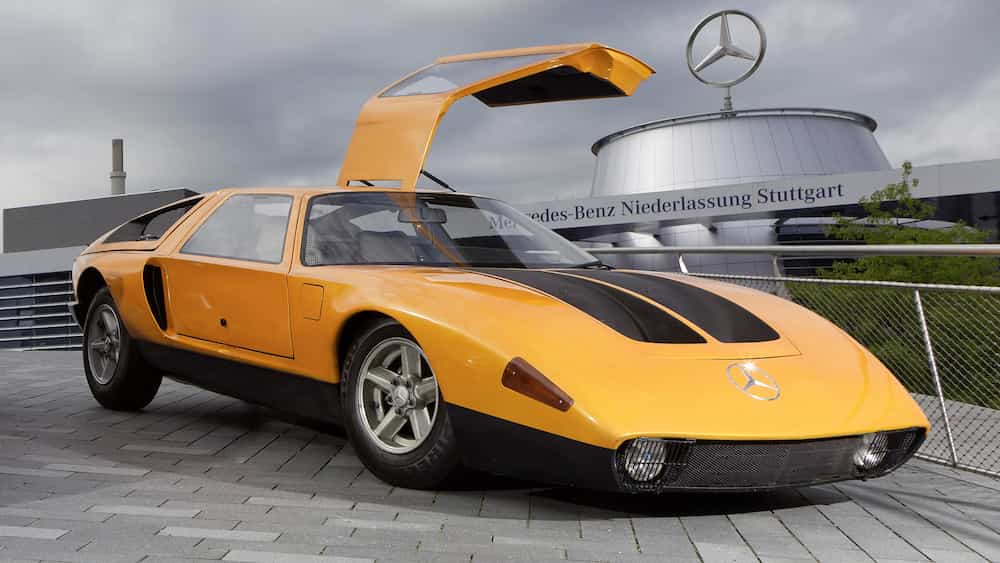
What the public saw was not what they expected from Mercedes. The car was low, wide and flat, painted in a vivid orange shade that the factory called Weißherbst — autumn white wine — which, against all naming logic, was a striking metallic orange. The doors were gullwing, just like the legendary 300 SL of the 1950s, though here the reason was not romantic but structural: the C111's frame layout, with its deep side sills for chassis rigidity, made conventional hinges impossible. The body was glass-reinforced plastic — GRP — bonded with adhesive and rivets onto a steel structure.
The design team was led by Bruno Sacco — who in 1975 would become the brand's head of design — with Joseph Gallitzendörfer contributing the bodywork. The result was so radically different from everything Mercedes had done before that the press took a few seconds to process that it was a product of the same company that manufactured the austere W-series saloons.
¿Cómo se ve en la
vida real?Ver en TikTok▶❤️💬🔗TV@LlantaPinchadaTVThe Mercedes C111: the supercar that broke records with a diesel. The strangest story in German engineering 🇩🇪🔥 #Mercedes #C111 #Wankel #Record
Disponible en nuestra comunidad vertical
"The press and public were astonished by the radical wedge design, the fibreglass body, the gullwing doors and the striking orange paint of a company frequently perceived as conservative and formal."
The engine that sounded like a jet
Wankel: no pistons, no vibrations, one insurmountable problem
Felix Wankel's rotary engine was the antithesis of the piston engine. Instead of pistons moving up and down in cylinders, the Wankel used a triangular rotor spinning eccentrically inside an oval-shaped chamber. No oscillating masses, no free inertia forces. The result was an incredibly smooth, compact unit capable of reaching very high revs with a fluidity that no piston engine could match.
The C111-I mounted a three-rotor Wankel with 600 cc per chamber, with direct fuel injection — highly advanced technology for 1969 — and produced 280 hp. It allowed a top speed of 260 km/h and a 0-100 time of five seconds. For context: the Mazda Cosmo of the same era, also Wankel-powered, produced 130 hp. The C111's engine sounded, according to journalists who heard it, more like a turbine than a car.
But the Wankel had insurmountable problems for Mercedes. The engine consumed more fuel than was acceptable. Its hydrocarbon emissions were very high — at a moment when United States anti-pollution legislation was tightening rapidly. And above all: the durability and reliability did not meet the standards that Mercedes considered non-negotiable for a production car. In 1971, the company made the decision to abandon Wankel development definitively.
The C111 continued. Without a Wankel engine, but it continued.
The diesel nobody expected
How a taxi engine broke speed records
The 1973 oil crisis changed the conversation across the entire automotive industry. Diesel, previously associated exclusively with taxis, trucks and economy, became a subject of strategic interest. And Mercedes made a decision as bold as it was clear-sighted: use the C111 to demonstrate that diesel could be fast.
The starting engine was the OM617, a 3.0-litre inline five-cylinder that equipped the production Mercedes 240 D and 300 D — originally an 80 hp engine designed for efficient transport. Mercedes engineers fitted it with a Garrett turbocharger and an intercooler, raising power to 190 hp in the C111-IID version. The C111-II chassis was adapted, the bodywork refined aerodynamically, and the complete package taken to the newly opened high-speed track at Nardò, in southern Italy, in June 1976.
What happened over the following days was historic. In 60 hours of continuous running, the C111-IID established 16 world records, with an average speed of 252 km/h. A diesel engine derived directly from mass production, running non-stop for more than two and a half days at speeds no compression-ignition vehicle had ever reached before.
Two years later, with the C111-IIID — a completely new body version, longer, narrower, with a drag coefficient of just 0.183, the lowest achieved up to that point by any vehicle — and the same diesel engine raised to 230 hp, Mercedes returned to Nardò. Between 29 and 30 April 1978, the car established 9 more world records, exceeding 322 km/h. It was the first time in history that a diesel-powered vehicle had sustained more than 300 km/h over an extended run.
403 km/h
The last record, the last act
On 5 May 1979, Mercedes returned to Nardò for the last time with the C111. This time without a diesel engine. This time without fuel consumption or durability constraints. The C111-IV carried a 4.8-litre V8 — derived from the production S-Class and SL engine, but enlarged and fitted with twin KKK turbochargers and sodium-cooled valves — producing 500 hp and 710 Nm of torque.
The car's body had been completely redesigned for this purpose: long tail, central rear spoiler for straight-line stability, very low nose with large recessed headlights. It was a machine that no longer resembled any road car. It was pure aeronautics applied to four wheels, developed with the same rigour used to build an aircraft.
Test driver Hans Leibold took the wheel. In one lap of the Nardò high-speed oval that lasted 1 minute and 56.67 seconds, the C111-IV recorded an average speed of 403.978 km/h — the absolute world closed-circuit speed record. That figure comfortably surpassed the previous mark, set by the Porsche 917 at 356 km/h.
The record stood for years. In 2003 it was broken by the Koenigsegg CCR at 387 km/h... on a different track. The Nardò mark remained a reference.
The legacy
The laboratory that never went on sale
Of the 17 C111 prototypes built between 1969 and 1979, two were pure show cars and four were scrapped. The remaining 13 belong to the Mercedes-Benz Museum in Stuttgart.
None was sold. None was homologated. But everything they tested went directly into the world of production cars. The front multi-link suspension of the C111-I was incorporated into production cars in the following years. The real-time telemetry monitoring system, developed specifically for the Nardò records, was a pioneer in vehicle data transmission during competition. The turbodiesel demonstrator changed the perception of the diesel engine across the entire industry and laid the foundations for the reputation for excellence that Mercedes diesels would maintain for decades. The aerodynamics researched in the C111-III directly influenced the drag coefficients of 1980s production models.
In 1991, Mercedes presented at Frankfurt the C112 — the spiritual successor to the C111, with a 6.0-litre V12 engine, gullwing doors and a promised production run. Seven hundred people left a deposit to reserve one. Mercedes cancelled it anyway. It was not the right moment, said the company.
The gullwing doors did not return to a Mercedes production car until the SLS AMG in 2009, forty years after the C111 first opened them beneath the Frankfurt sun.