Imagine a car so low it measures just 1.06 metres in height — lower than the waist of an average adult. With four different types of doors. An engine that revs higher than the Formula 1 single-seaters of the era. And rear lights that change colour depending on whether you are accelerating, braking or cruising. In 1970.
The secret project
X810: researching the future of high-speed inter-city travel
The development of a prototype designed to research the behaviour of plastic bodywork and driving dynamics at speeds above 125 mph had already begun in 1968 under the codename X810.
Mazda — then still Toyo Kogyo Corporation — had just launched the Cosmo Sport 110S in 1967: the world's first mass-production car with a Wankel rotary engine. The rotary was not merely a technological gamble. It was the brand's defining identity against Toyota, Nissan and Honda. And Project X810 had to be the declaration of where that identity was pointing.
The idea was to research the harmony between people and speed in a future society, based on possible future scenarios of inter-city traffic. The Toyo Kogyo team carefully selected the project's designers and engineers. The original brief was a classic, low, sporty coupé. But one of the team's designers disagreed.
Shigenori Fukuda was the designer behind this style. He convinced his colleagues through wind tunnel tests that the shooting brake offered significantly better aerodynamic resistance. The result was not a conventional coupé but something more unusual: a body that extended long towards the rear, with the roof stretching almost to the end of the vehicle as in a sports estate, but with spacecraft proportions.
Fukuda drew inspiration for the car's detail solutions from the then-recent film '2001: A Space Odyssey'. He wanted to avoid using classic automotive design elements as much as possible and instead used futuristic-looking elements drawn from aviation and motorsport.
¿Cómo se ve en la
vida real?Ver en TikTok▶❤️💬🔗TV@LlantaPinchadaTVThe 1970 Mazda RX-500: the concept car Kubrick didn't design but could have — and that the world knew as a Matchbox 🚗🛸 #MazdaRX500 #Wankel #Tokyo1970 #Engineering
Disponible en nuestra comunidad vertical
"It looked like it came from another planet compared to the Cosmo, the Luce and the R100 — the production rotary cars of the era." — AllCarIndex, describing the public's first reaction in Tokyo
The design
Four types of doors to get in and out
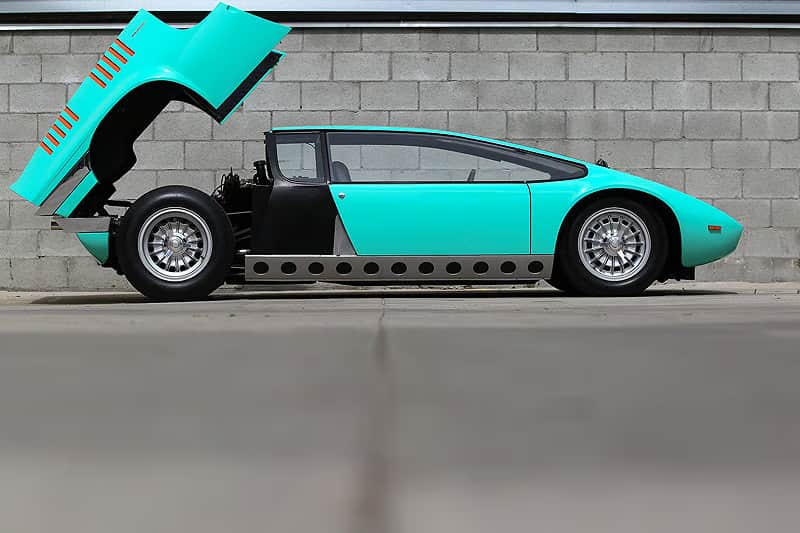
The silhouette alone was enough to enthuse the public. There were also butterfly doors that opened forward and upward, and a rotary engine hidden beneath further gullwing doors at the rear.
The RX-500's access system required a moment of explanation. To enter the RX-500, a pair of butterfly doors were opened. Even standing still, the familiar concept of a car door created a dynamic impression. Behind these front doors, a pair of gullwing doors served as the cover for the engine compartment, divided longitudinally.
Another distinctive design feature was the panoramic windscreen. With the A-pillar completely hidden, the vehicle's glass surfaces appeared fused into a single piece, giving the cabin a dome-like appearance. The effect was that of a fighter cockpit or space capsule: the driver surrounded by glass with no visible interruptions, just 1.06 metres from the ground.
Inside the car, passengers sat in two bucket seats. The eye was drawn to the three semicircular instruments behind the four-spoke leather steering wheel, arranged in a wraparound dashboard. The centre console housed an AM/FM radio behind the four-speed transmission taken from the Mazda Luce R130.
The engine
15,000 rpm in 1970 — higher than F1 single-seaters
The heart of the RX-500 was the reason for the entire project. Powered by an enhanced twin-rotor 10A engine with central placement for perfect weight distribution, the small 982 cc rotary produced 250 hp and revved to 15,000 rpm — higher than the Grand Prix cars of the period.
To understand what 15,000 rpm means in 1970: the Formula 1 engines of that season — the Ford Cosworth DFVs that dominated the championship — revved to around 10,000 rpm. A conventional sports car engine of the era rarely exceeded 7,000 rpm. The RX-500's Wankel 10A revved at a rate that in 1970 was only possible in small-displacement competition motorcycle engines.
The engine was a peripheral-port 10A producing 250 hp from the Family racing programme, mated to the RX87 Luce transaxle gearbox. It was not a conventional production engine but a competition unit adapted for the car, fed by a large Weber carburettor with a pair of enormous velocity stacks. With a glass-reinforced plastic body over a tubular frame, the RX-500 weighed just 850 kg, giving a power-to-weight ratio of 3.4 kg per horsepower.
Road safety
The lights that told everyone what you were about to do
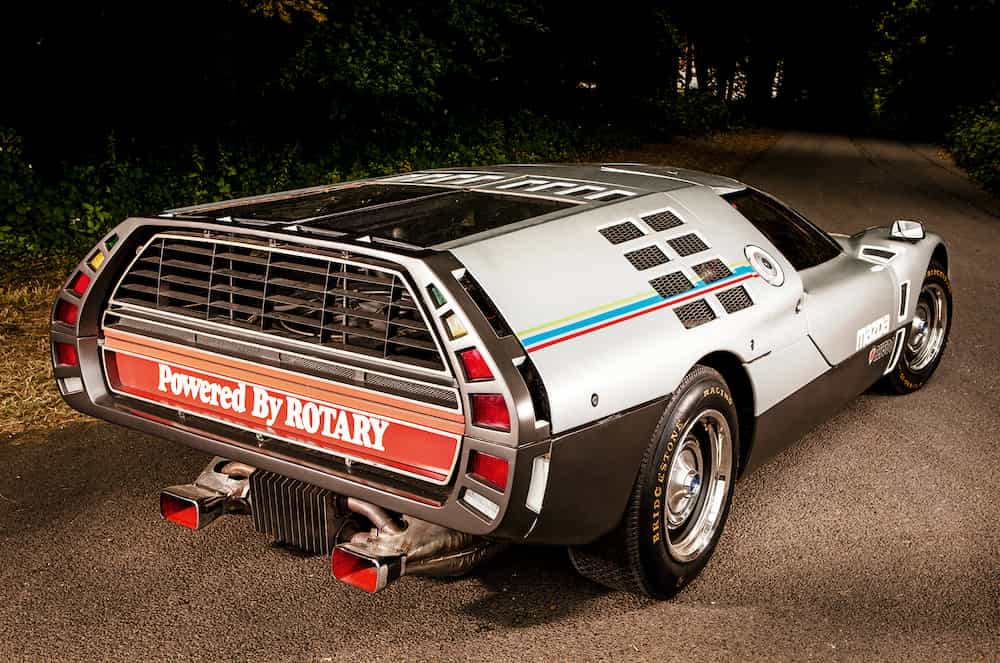
One of the RX-500's most forward-thinking ideas was not mechanical but luminous. The car also had multicolour lights at the rear, indicating whether the car was accelerating, braking or travelling at constant speed. The green lights at the top illuminated when accelerating, the yellow ones when cruising, and the red brake lights activated progressively depending on braking intensity.
In addition to the familiar colours of "braking" (bright red), "turn indicator" (amber) and "reversing" (white), the system also indicated "accelerating" (green), "cruising" and "gentle braking".
It was a system of active communication between the RX-500's driver and the vehicles following it — anticipating by decades the variable-intensity brake light systems, emergency braking lights and ADAS systems considered advanced today. The RX-500 was developed as a mobile test bed for high-speed safety.
The colour mystery
Green, yellow, silver. One single car.
A glance at the Mazda archive reveals photographs of the car in different colours, which caused speculation that several versions of the RX-500 had been built. In fact, only one RX-500 was ever built, originally green, repainted yellow for the Tokyo Motor Show since all Mazda vehicles on display that year were presented in the same vivid yellow with red interiors.
Originally, Fukuda-san presented the concept car in light green. This was followed by a repaint to yellow for the Tokyo show. Finally came the silver, with new headlights under clear glass covers instead of the original pop-up units.
The restoration of the silver vehicle in 2008 provided answers, as the renovation revealed layers of green and yellow paint beneath. What appeared to be evidence of multiple prototypes was in fact the painted history of a single car that had travelled the world for years, accumulating colours like layers of time.
The legacy
What the oil crisis buried and Matchbox kept alive
The 1973 oil price crisis ended any hope of a production RX-500. Mazda, which depended entirely on the rotary engine and whose fuel consumption was higher than equivalent piston engines, was one of the brands hardest hit by the energy crisis. The RX-500 — a supercar with a competition rotary engine — was exactly the opposite of what the world needed in 1974.
The sole example was stored at the Mazda factory. The car was restored for the 2009 Tokyo Motor Show and is now displayed at the Hiroshima City Transportation Museum.
In 2014, the Goodwood organisers flew it to Britain to sit on Lord March's lawn at the Cartier Style et Luxe — where hundreds of sun-burned British visitors dropped their ice cream cones and stood staring at it.
The real-world life of the RX-500 lasted from 1970 to 1973: three years of motor show appearances, international media coverage, and the floating promise of a possible successor to the Cosmo Sport. The toy-world life of the RX-500 lasted over a decade, in the pockets and toy boxes of children across America, Europe and Japan, painted orange, red and green, at 1:59 scale.
Shigenori Fukuda designed a car inspired by the most important science fiction film in history. The film anticipated the year 2001. The car anticipated adaptive lighting systems, structural plastic bodywork and active aerodynamics. The oil crisis turned it into a museum prototype. Matchbox turned it into the object of desire for millions of children who never knew what they were holding a replica of.