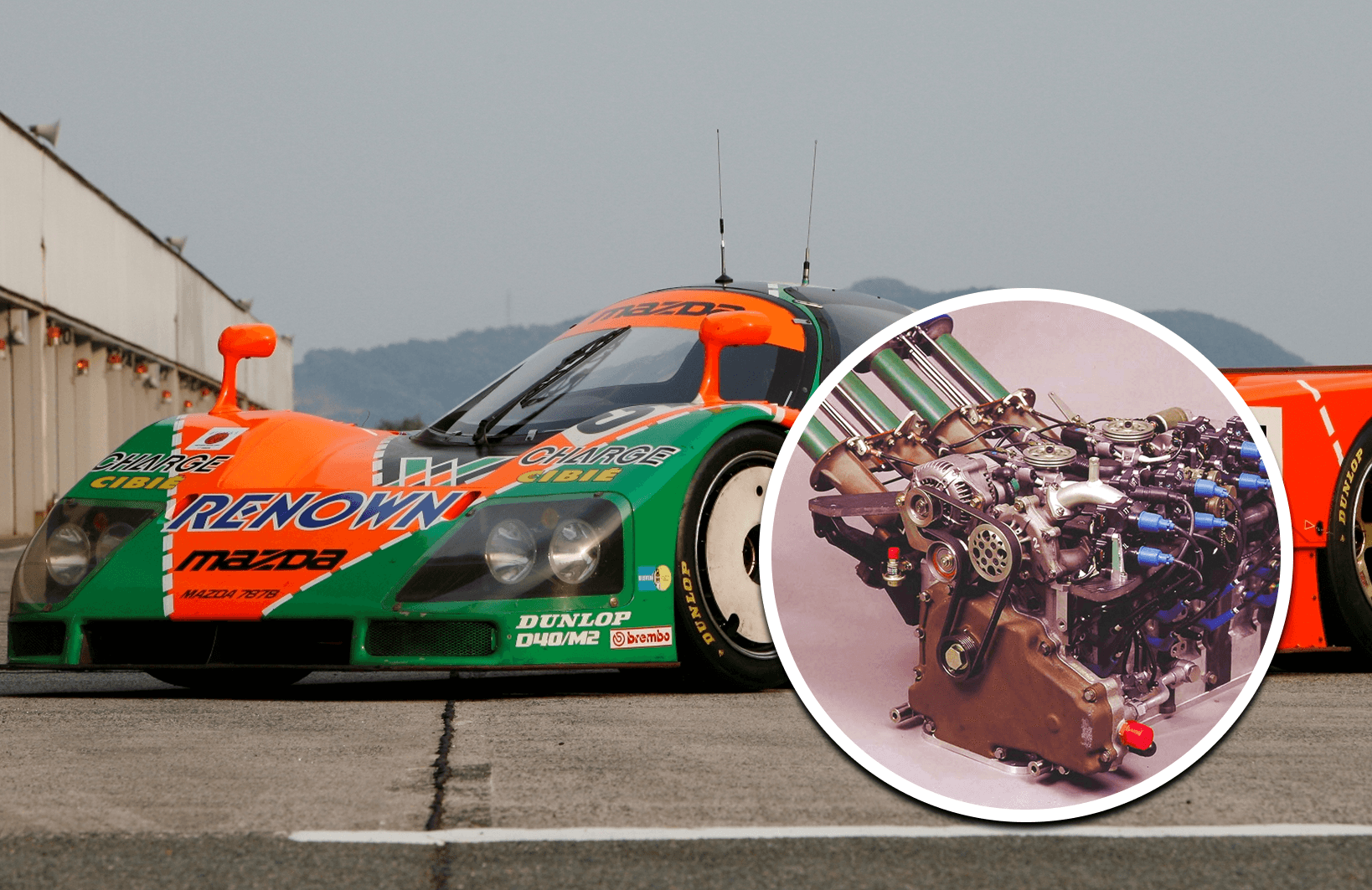
Imagine a 2.6-litre engine with no pistons — four triangular rotors spinning eccentrically inside oval chambers, twelve spark plugs in total, ceramic apex seals, capable of 900 hp at 10,000 rpm in qualifying and producing a sound so high-pitched that spectators at certain points on the circuit received warnings when the car was approaching. And it beat Michael Schumacher's Mercedes-Benz.
13 attempts — and the last one with an expiry date
The FIA announced the ban. Mazda turned it into fuel.
It was Mazda's thirteenth attempt at Le Mans and, apart from a junior class victory in 1984 when a Mazda-engined Lola finished tenth overall, success had been conspicuous by its absence. Before the race began, there were few reasons to think this year was going to be different.
But this year there was one difference that changed everything. At the end of the 1991 season, Group C was replaced by the World Sportscar Championship with 3.5-litre engines, and therefore Wankel-type rotary engines could no longer compete due to the regulation change, as they were banned by the FIA.
The 1991 24 Hours of Le Mans starting grid would have been a quieter place had the FIA gone ahead with its original plans. The governing body wanted to push through a new set of regulations that would see all prototype cars run conventional 3.5-litre piston engines. Jaguar, Mercedes and Peugeot built cars to the new rules, but when it became clear that there would never be enough new cars developed in time, it was decided that cars complying with the previous Group C regulations could also race.
Mazda chose to exploit that window. The engine was extensively revised for the 1991 season. It now had 3 spark plugs per rotor, ceramic rotor tips and a continuously variable intake length system. If 1991 was to be the last year of the rotary at Le Mans, it would also be the year the rotary reached its peak.
¿Cómo se ve en la
vida real?Ver en TikTok▶❤️💬🔗TV@LlantaPinchadaTVThe Mazda R26B: the engine with which they won Le Mans on the last night they could try — and when stripped down afterwards, it could have done another 500 km 🟠🟢🔥 #MazdaR26B #787B #LeMans1991 #Wankel
Disponible en nuestra comunidad vertical
"Words cannot accurately convey the sound of the 787B — however, to say that the R26B screamed at 9,000 rpm would not be hyperbole. There were reports that at certain points on the circuit, spectators were warned when the 787Bs were approaching so they could cover their ears." — Rush Magazine, on the sound of the R26B at Le Mans 1991
The R26B architecture
Four rotors, twelve spark plugs, ceramic in the seals — and an intake system that learned with every lap
The R26B was the evolution of two decades of Mazda rotary development, compressed into an engine that weighed considerably less than any piston rival with comparable power.
The R26B uses three spark plugs per rotor to improve combustion efficiency — a key advantage in endurance racing. The predecessor engine, the 13J, used two spark plugs per rotor. The move to three was a direct consequence of the Wankel's combustion chamber geometry: oval and elongated, with a single plug the flame took time to propagate from end to end. With two it improved. With three — one advanced, one central and one retarded in the chamber — combustion was more complete, faster and more efficient, reducing unburnt hydrocarbons and maximising the energy extracted from each dose of fuel.
Ceramic apex seals and stronger springs improve durability and reduce wear, addressing a common rotary vulnerability. The apex seals were the Wankel's Achilles heel — the small components that maintain the seal between the rotor's three cavities. In conventional metal, wear at high temperatures was the primary failure mode. In ceramic, they withstood higher temperatures with less wear. It was the same technical solution that rocket engines used in their injectors.
But the most important innovation was the intake system: the variable-length intake system was innovative. Previously it operated in steps — different runner lengths for different RPM ranges. The new continuously variable system, controlled by the ECU through telescopic runners, resulted in consistent torque of 448 lb-ft at around 6,500 RPM.
The secret to the victory lay in the variable-length telescopic intake runners, which had previously been optimised so that the engine's power and torque varied across different RPM ranges — good for short bursts, but poor over the long term. For the 1991 championship, the system became more complex and adopted a continuous variation approach, a formula that was far more efficient than the previous version that had "steps" for different rev ranges.
The 787B
830 kilograms, an F1 chassis and a strategy designed by Jacky Ickx
The carbon monocoque chassis was combined with a carbon and Kevlar body for lightweight durability. Weighing just 830 kilograms, it was significantly lighter than competitors such as the Porsche 962C.
The chassis design was the work of Nigel Stroud — an engineer with Formula 1 experience who had also worked on the Porsche 962. The 787B was more than a modified 787. Stroud heavily revised the car for the 1991 season.
Mazda enlisted veteran endurance driver Jacky Ickx to help design their race strategy, centred on one main thing: outlasting the competition. The 787B was nearly 400 pounds lighter than the other cars on the grid thanks to rotary-specific regulatory concessions, which helped preserve tyres and brakes.
Ickx's logic was that of any great Le Mans strategist: Le Mans is not won in qualifying, nor in the first hour, nor the tenth. Le Mans is won by being the last car standing. And for that, the 787B had a structural advantage: the naturally smooth character of the rotary and its high-RPM nature made the car not only fast but also easier to drive over long stints. Drivers could push to the limits with confidence without excessive vibration or component wear.
The race
19th on the grid. Michael Schumacher at night. 362 laps.
The fastest 787B in qualifying had only been twelfth and would start from nineteenth once the rules about the first ten positions were applied. It was Mazda's thirteenth attempt at Le Mans and, apart from a junior class victory in 1984, success had been conspicuous by its absence.
However, the 787B was more than a modified 787. And at Le Mans, reliability is everything.
The 1991 race was one of the most competitive in decades. It took an astonishing 21 hours for the #55 to advance to the lead, with back-and-forth battles against Sauber-Mercedes — with Michael Schumacher as a driver — and Jaguar, who had been sharing victories over the previous 3 years.
As the race progressed, the faster rivals faltered. Peugeot suffered mechanical failures. Jaguar withdrew its fastest entry before the start. Even Mercedes, which had led through the night, saw its leading car retire with overheating problems. Through all of that, Mazda's #55 ran flawlessly.
Crossing the finish line, Johnny Herbert, the driver who drove the final three stints, was so dehydrated after the race that he could not make it to the podium. He had driven for hours inside a capsule where engine and cockpit temperatures combined with the physical effort of racing at Le Mans. The two German and Belgian drivers sharing the #55 — Volker Weidler and Bertrand Gachot — arrived with him. The #55 had completed 362 laps — 4,923.95 km in 24 hours.
The engine autopsy
The R26B could have run another 500 km — without an oil change
On the subject of reliability, not only did the engine withstand 24 hours of racing at the limit, but following the post-race inspection, Mazda's engineers said the R26B was in such good condition that it could have gone out in another 24-hour race with just an oil change.
It was the most eloquent possible verdict on the R26B's engineering. The engine that everyone had considered unreliable for endurance racing — the same argument that had been made against Wankels since the days of the NSU Ro 80 — had completed 24 hours at the limit and still had life left in it.
Mazda Motorsports published a six-minute video detailing the rebuild of the 787B's R26B — the only rotary to win Le Mans. The mechanics also compare the interior and exterior surfaces of the rotor chambers to detect heat-related changes that could affect sealing and compression.
Decades after the victory, Mazda's Heritage Collection team stripped and rebuilt the R26B from the original #55. What they found was an engine designed to be perfect — not for its creators, but for the specific circuit of La Sarthe, in the specific year of 1991, with the specific amount of power needed to survive 24 hours against Europe's best teams.
Lo que usamos

Lo que usamos

Lo que usamos
The legacy
The sound that made spectators cover their ears — and that never returned to Le Mans
The 787B's victory at Le Mans made Mazda the first Japanese manufacturer to win, and the only one to do so with a rotary engine. The subsequent regulation changes ended the use of rotatories at Le Mans, ensuring the feat remained unique.
The R26B was capable of delivering a maximum power output of 900 hp — in 1991, truly impressive given that the Sauber-Mercedes had around 730.
But what those who were at La Sarthe in June 1991 remember most is not the power. It is the sound. What the engine also produced was noise. Words cannot accurately convey the sound of the 787B. However, to say that the R26B screamed at all RPMs up to 9,000 would certainly not be hyperbole. There were reports that at certain points on the circuit spectators were warned when the 787Bs were approaching so they could cover their ears. Indeed, it has been suggested that the noise led to the 787B being banned, though the truth is simply that it was a victim of the regulation changes.
The R26B was the most advanced engine Mazda built in its entire history of rotary engines. It was the one that won, the one that sounded in a way no piston engine can replicate, and the one that never competed again. Four decades of rotary research in Hiroshima culminated in twelve spark plugs, four ceramic rotors, telescopic intake runners — and 362 laps on the June night in 1991 when spectators covered their ears as the orange and green car passed before them.
Mazda keeps the winning car at the Mazda Museum in Hiroshima. At the same time, Mazda produced four replicas and delivered one of them to the Le Mans Museum.
Toyota won Le Mans in 2018 — twenty-seven years after Mazda. Without a rotary engine, with a 1,000 hp hybrid LMP1 against sparse competition. The R26B won against the best Le Mans field of the decade. In its last permitted year. From 19th on the grid.