Imagine building an engine from scratch that has no pistons, no camshaft, no connecting rods, and whose only main moving part is a triangular rotor spinning eccentrically inside an oval chamber. Solving it over six years. Presenting it to the world in a Japanese-designed coupé that looks like it came from 1975 when the calendar said 1967.
The problem that took six years to solve
The chatter marks that almost killed the project before it started
Rotary engine development began at Mazda in 1961, and during the following six years it presented nothing but problems and setbacks. The most serious was the appearance of chatter marks on the interior walls of the rotor chamber.
The team was 47 engineers led by Kenichi Yamamoto — who decades later would become Mazda's president. The engine they were trying to tame was conceptually simple: a triangular rotor spinning eccentrically inside an oval chamber, with the three cavities between the rotor and the wall simultaneously describing the four strokes of the combustion cycle. No pistons, no camshaft, no connecting rods. The only internal moving parts were the rotor, the eccentric shaft and the planetary gears that synchronised their relationship.
The chatter mark problem was devastating: the irregularities on the interior chamber walls produced vibrations that deteriorated the apex seals — the most critical and most fragile elements of the entire system. NSU, which had licensed the design to Mazda and to more than a hundred companies simultaneously, had not solved the problem. No other licensee solved it. Yamamoto's team was the only one that found the solution.
Mazda's solution was a specific treatment of the chamber's interior surface — a microscopic texture that reduced apex seal friction while maintaining sealing. It was the result of thousands of tests, of destroyed engines, of metallurgical analyses, of solutions that seemed to work for twenty hours and failed at twenty-one.
When Mazda president Tsuneji Matsuda drove the prototype to the stand at the 1963 Tokyo Motor Show, it was a surprise to everyone. It was not the announcement the industry expected. It was proof that a medium-sized Japanese company, in a city that had been levelled by an atomic bomb eighteen years earlier, had solved the most difficult technical problem in the engine industry of its era.
¿Cómo se ve en la
vida real?Ver en TikTok▶❤️💬🔗TV@LlantaPinchadaTVThe 1967 Mazda Cosmo Sport: the first production car with a twin-rotor rotary engine — and they built one per day for 5 years 🇯🇵🔧 #MazdaCosmo #Wankel #Rotary #Engineering
Disponible en nuestra comunidad vertical
"More like flying than driving." — Mazda's official description of the Cosmo Sport at the 1963 Tokyo Motor Show
The engine
982 cc actual, two spark plugs per rotor, and a two-stroke lubrication system
The definitive engine, of 998 cc, had two intake ports — though only one was used at low load —, one exhaust port, two spark plugs per rotor and a system that mixed small quantities of oil with the fuel to lubricate the moving parts from the inside.
The use of two spark plugs per rotor — one for early ignition and one for late ignition — was Mazda's answer to the problem the Wankel had with combustion: the oval combustion chamber was long and narrow, which meant the flame took time to propagate from one end to the other. With a single spark plug, the mixture at the opposite end might not burn completely. With two spark plugs in different positions, the flame started simultaneously at two points and met in the centre — more complete combustion, fewer unburnt hydrocarbons, more power.
The 10A engine was capable of producing 110 hp at 7,000 rpm. This performance capability allowed the car to reach a top speed of approximately 185 km/h and accelerate from 0 to 100 km/h in around 8.6 seconds.
The figures seem modest today. In 1967, a car weighing 930 kilograms and reaching 185 km/h with an engine of less than one actual litre of displacement was an unprecedented technical statement. For Japanese taxation purposes, the engine was equivalent to 1,964 cc of conventional displacement — which placed it in the most favourable tax bracket for a two-seat sports car.
The design
Japanese gills, fastback roof and a line that looked like 1975
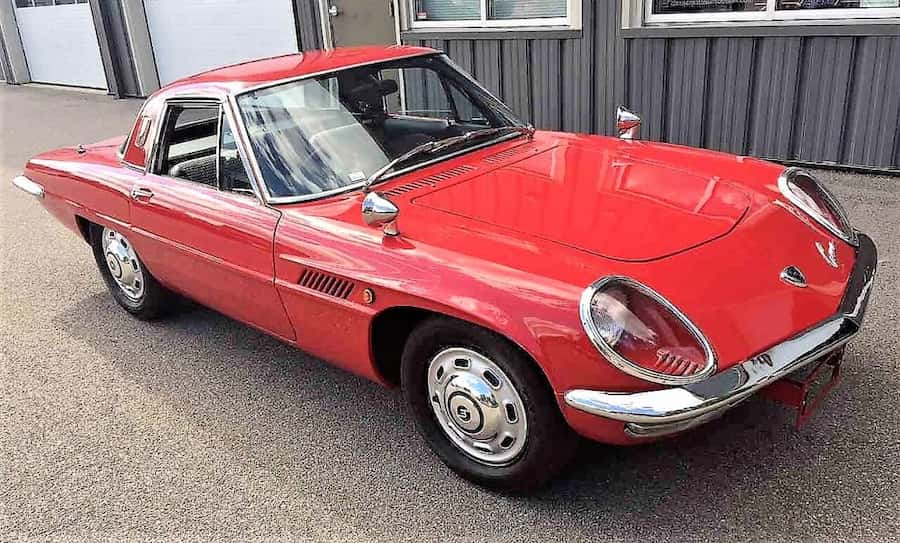
The Cosmo Sport had an attractive and modern style with a smooth roofline, split rear lights divided by the bumper, a sporting stance, fish-gill-like vents on the front wings, clean lines and a pronounced glasshouse.
The front wing gills were not decorative. They were the air intake for the engine's ventilation system — a visual reminder that the rotary had different thermal demands from a conventional piston engine. The Cosmo Sport's water cooling was complex: the rotor, the chamber and the eccentric shaft each had independent cooling circuits that had to be carefully balanced.
The rear suspension was De Dion type — an unusually sophisticated choice for a Japanese sports car in 1967. The 930-kilogram two-seater had a four-speed manual transmission and independent front suspension with a De Dion rear axle. The De Dion axle separates the function of bearing weight from the function of transmitting power — keeping the rear wheels parallel during suspension compression and extension, improving stability under traction. It was the technology Ferrari used in its racing cars of the 1950s.
Production
One per day, by hand, in Hiroshima
Total production of the Cosmo Sport spanned 1967 to 1972, during which 1,176 units were built. This limited production run was due in part to the meticulous, handcrafted nature of the car, with Mazda producing approximately one unit per day. Series I (L10A) was produced from May 1967 to July 1968, with 343 units built. Series II (L10B), from July 1968 to September 1972, added 833 units.
Only two 1967 Cosmo Sport 110S units were exported directly from Japan to the United States. The first was acquired by Curtiss-Wright Corporation, the company holding Wankel licence rights in North America, until February 1984.
The reason Curtiss-Wright had a Cosmo Sport was not sentimental. It was contractual: as the North American licensee of the rotary engine, the company needed to have the most advanced production car with that engine to evaluate it technically. Curtiss-Wright held the licence to build rotary aircraft engines during the 1960s. They were evaluating the Cosmo Sport to determine whether the technology was viable for their own aeronautical applications.
When Mazda America wanted to acquire one of these cars for its historic collection in 2007, for the 40th anniversary, the first one they located was bought faster by another collector: Jay Leno. Mazda had to search for the second exported example, which they found in Arizona.
The 84 Hours
The car that ran a night marathon in Europe — and finished fourth
At the 1968 Tokyo Motor Show, Mazda announced its entry of the Cosmo Sport in the 84-Hour Marathon de France Europe. Two Cosmo Sports participated in the overnight endurance race — the same event the NSU Ro 80 would also contest at the Nürburgring. One of the cars finished fourth in its class.
It was the demonstration Mazda needed: the rotary engine, which NSU had been unable to make last more than 30,000 miles without a rebuild in the Ro 80, survived 84 hours of night-time competition at Europe's most demanding circuit. The difference between the Cosmo Sport and the Ro 80 was not the engine principle — it was the solution to the chatter marks that Yamamoto's team had taken six years to find.
The legacy
1,176 cars — and forty-one years of rotary engines after
The success of Mazda's rotary engine was a milestone that marked the company's vocation for seeking technological innovation, setting it apart from its competitors. Mazda was the only major company to employ rotary engines in mass production, continuing through to the RX-8.
The direct line from the 1967 Cosmo Sport to the 2012 RX-8 spans 45 years. In that time, Mazda built the R100, the RX-2, the RX-3, the RX-4, the RX-7 and the RX-8 — all with variants of the same rotary principle that 47 engineers in Hiroshima spent six years resolving. The success of Mazda's first rotary production car validated the Wankel engine's potential, inspiring the company to refine and innovate on the technology for decades.
NSU abandoned the Wankel after the Ro 80 disaster. Citroën abandoned the Wankel after the M35 and the GS Birotor. Mercedes tried it in the C111 and did not take it to production. Mazda continued alone.
The Cosmo Sport was the first of a long line of Mazda sports and touring cars powered by rotary engines. The company that built one per day for five years, in a city rebuilt from the ashes of 1945, became the only company in the world to make Felix Wankel's pistonless engine work at industrial scale for more than four decades.
The Cosmo Sport — with its fish-gill vents, its fastback roof and its triangular rotor spinning at 7,000 rpm — was the starting point for all of that.