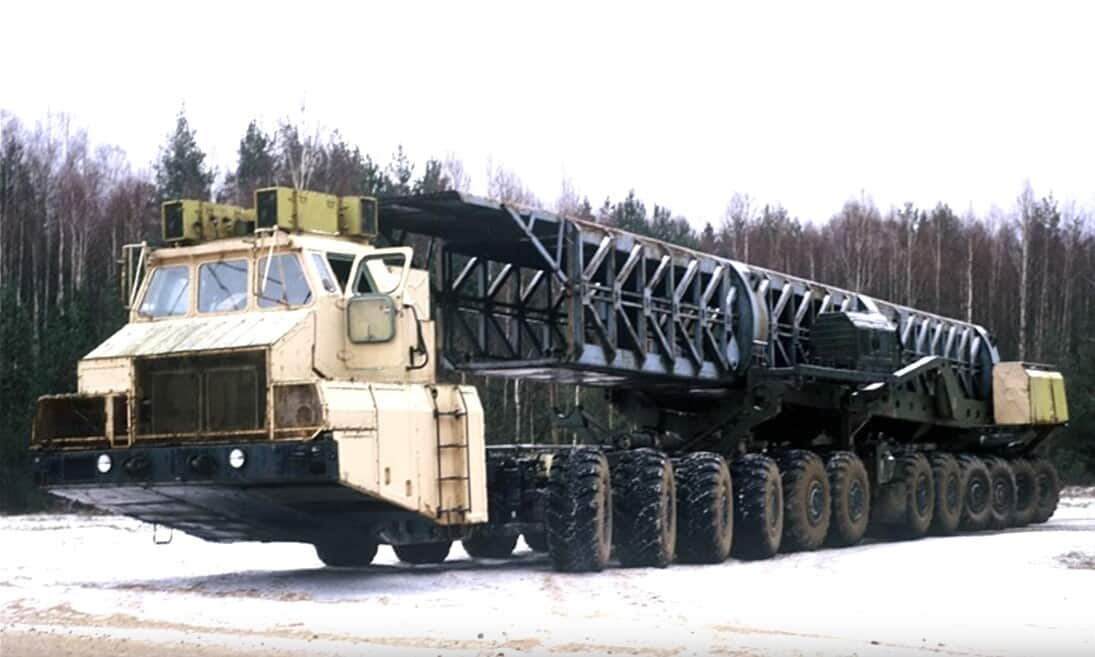
Imagine a vehicle so long that it needs to articulate in two halves joined by a hinge just to turn. Where each of its 24 wheels has its own electric motor. Where the turbine engine does not drive the wheels directly — it only generates electricity to power them.
The nuclear race that created it
The missile that weighed over a hundred tonnes and needed to move
In the 1980s, Soviet nuclear strategy faced a problem of elementary physics: if a missile stays fixed in a silo, the adversary can locate it and destroy it with a first strike. Mobility was survival. That is why the Soviet military already operated the RT-23 Molodets — known in the West by its NATO code, SS-24 Scalpel — in its railway version: camouflaged trains that travelled across the vast Soviet rail network, impossible to detect from satellite among thousands of civilian convoys.
But strategists wanted something more. A road vehicle could leave the railway tracks, venture into forests, cross fields, disappear into terrain without infrastructure. On 9 August 1983, a Soviet government decree ordered the development of the road-mobile variant of the RT-23 under the name Tselina-2 (Целина-2), with industrial index 15P162.
The problem was the missile itself. The RT-23 had a launch mass of 104.5 tonnes, a length of 22.6 metres and a diameter of 2.4 metres in its launch container. Ten independent nuclear warheads, each with a yield of 550 kilotons. The complete container with the missile inside weighed 104.5 tonnes. The support and launch equipment added more. The vehicle needed to carry all of this at full operational load capacity.
The task went to the Minsk Automobile Plant — MAZ — which already had experience building large Soviet missile transporters. Doctor of Technical Sciences Boris Shaposhnik, Hero of Socialist Labour, laureate of the Lenin and Stalin prizes, took charge of the project. It would be the last great project of his career.
¿Cómo se ve en la
vida real?Ver en TikTok▶❤️💬🔗TV@LlantaPinchadaTVThe MAZ-7907: the largest wheeled vehicle ever built. 24 wheels, nuclear missile on top 🚛☢️ #MAZ7907 #Engineering #ColdWar
Disponible en nuestra comunidad vertical
"Nobody had built anything like it. Thirty metres of vehicle with 24 drive wheels, articulated in two halves. And on top, a missile capable of reaching Los Angeles."
The engineering
A tank engine that did not drive the wheels
The MAZ-7907 solved the problem of moving 200 tonnes with a solution that in 1985 was completely unusual in land vehicles: turbo-electric propulsion.
The heart of the system was a GTD-1250TFM gas turbine — a variant of the engine that powered the Soviet army's T-80 tank — producing 1,250 horsepower. But that turbine did not transmit its power mechanically to the wheels. Instead, it drove a VSG-625 alternating current generator that produced electricity. That electricity was distributed through a TE-660-24 electromechanical transmission to 24 synchronous electric motors with air-oil cooling — one per wheel, installed inside the chassis, each producing 30 kW.
To manage the extreme length of the vehicle — around 28 to 30 metres depending on the source — the engineers divided the chassis into two sections of six axles each, joined by a horizontal power hinge with one degree of freedom. The two halves could tilt vertically relative to each other by up to 8 degrees, adapting to the terrain. This articulation was what prevented the MAZ-7907 from breaking in two when crossing uneven ground under a 150-tonne load.
Of the 12 axles, 8 were steerable: the first four and the last four turned for steering. This allowed two turning modes: synchronous — all wheels turning in the same direction, producing a lateral crab-like movement — or asynchronous, with the front axles turning in one direction and the rear axles in the opposite, reducing the turning radius for a vehicle of this length.
The MAZ-7907's wheels were 1,660 mm in diameter — nearly the height of an average adult. Model VI-207, Soviet manufacture.
Fuel consumption was brutal: at maximum speed, the vehicle burned approximately 1.5 tonnes of fuel per 100 kilometres.
The tests
25 km/h with a missile on top
The first prototype was completed in March 1985 at the Minsk plant. The second arrived months later. Between 1985 and 1987, both vehicles underwent field tests with the RT-23 launcher mock-up — the real missile was never actually installed on them for testing.
The technical results under load were solid: the vehicle reached 25 km/h with full load off-road, and up to 40 km/h on the road unladen. The weight distribution across the 12 axles proved effective. The individual electric drive system per wheel worked as intended. The MAZ-7907 demonstrated that it was possible to move that weight under those conditions.
But the programme faced problems that went beyond engineering. The RT-23 missile already existed in a functioning railway version. The road variant demanded additional infrastructure, consumed fuel at a rate that was nearly unsustainable in prolonged operations, and Western reconnaissance satellites were improving. The tactical advantage of road mobility began to look insufficient against the cost and complexity of the system. By 1987, the Red Army decided not to proceed with the road-mobile variant of the RT-23. The MAZ-7907 was left without a mission before reaching its fifth year.
The last mission
An 88-tonne boat and 250 kilometres across Belarus
The story did not end entirely in 1987. After the dissolution of the Soviet Union, both prototypes remained in military facilities, unused, unfunded, without purpose. But in 1996 an unusual request arrived: to transport an 88-tonne boat from the Berezina River to Lake Narach in Belarus, a distance of over 200 kilometres.
Factory technicians spent nearly two months preparing the vehicle for the mission. The substructure that had existed to secure the missile container was redesigned to serve as a cradle for the boat's hull. The turbine was started, the wheel electric motors were checked. Four of them were not working. The 170 total tonnes of the assembly set off on 20 active wheels.
According to data gathered by Russian media, the vehicle covered more than 200 km at speeds of around 20 km/h on some stretches. Only when crossing the bridge over the Berezina River, which was not designed to bear that mass, was part of the load transferred to a four-axle MZKT-79091 with a crane that lifted the stern of the boat above the platform.
Upon arriving at Lake Narach and completing the unloading, the MAZ-7907 could not return. The electromechanical transmission, subjected to the water test during the crossings, did not hold. The vehicle had to be towed back to the factory.
It was its last documented mission. Years later, both prototypes were placed in the outdoor yard of the MZKT plant — the successor to MAZ's special division — in Minsk, where they remain as static monuments. There are no known restoration plans.