Imagine the car in which the President of the United States is assassinated being sent back to the factory three weeks later, completely restored, with new armour and an armoured roof, and returned to active service. For the next president. And the next. And the next. And that car is today in a museum where people leave flowers every 22 November.
The car
A standard Lincoln that the government leased for $500 a year
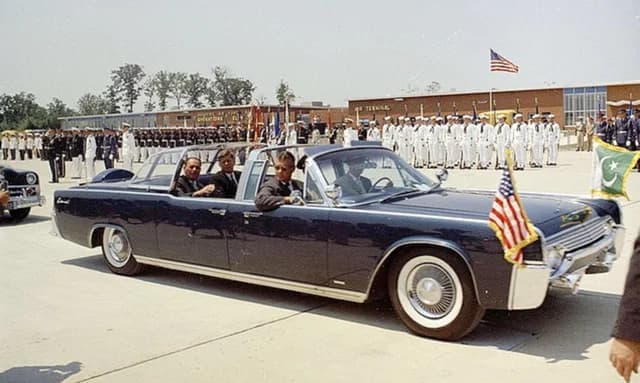
President John F. Kennedy's 1961 Lincoln Continental was originally a production car, built in Wixom, Michigan, with a manufacturer's suggested retail price of $7,347. The federal government leased it from Ford Motor Company for $500 per year, then commissioned Hess & Eisenhardt to modify it for presidential use, at a cost of $200,000.
It was not the first presidential limousine. Eisenhower had used the "Bubbletop" — a 1950 Lincoln with a transparent bubble roof — and before him various presidents had used limousines of different makes. But the SS-100-X had something different: it was the car Kennedy had specifically chosen to project a modern, accessible image.
The car was built from a standard four-door Lincoln Continental convertible — retail price $7,347 — which had come off the assembly line at Ford parent company's Wixom, Michigan plant. The White House leased it from Ford for a nominal fee of $500 a year and sent it for $200,000 in modifications by prestigious custom coachbuilder Hess and Eisenhardt in Cincinnati, Ohio. Among their other high-profile clients was the Queen of England.
Kennedy was aware of the political effect of visibility. Unlike Eisenhower, who had preferred the bubble top that created distance between the president and the public, Kennedy wanted people to be able to see him clearly. The open-top Lincoln, with its rear seat that could rise 26.7 centimetres above normal level, placed the president at the most visible possible point.
¿Cómo se ve en la
vida real?Ver en TikTok▶❤️💬🔗TV@LlantaPinchadaTVThe SS-100-X: Kennedy's Lincoln that cost $7,347 and received $200,000 in modifications — and remained the presidential car for 14 years after the assassination 🇺🇸🚗 #JFK #SS100X #LincolnContinental #Dallas1963
Disponible en nuestra comunidad vertical
"The trail of the SS-100-X after the assassination is quite clear. According to Secret Service records, at approximately 1:09 p.m. on 22 November, the presidential limousine and security vehicles departed Parkland Hospital and returned to Love Field Airport." — Tom McPherson, SS-100-X researcher, quoted in Old Cars Weekly
The modifications
Hess & Eisenhardt cut the car in half — literally
The car was moved to Ford's Experimental Garage at the Proving Grounds, where 41 additional inches were inserted between the front and rear doors and just beyond the rear doors. The car's frame was reinforced to accommodate the additional length and weight.
The process of converting a standard Lincoln Continental into the presidential limousine was so radical that the resulting car shared little more than the outer bodywork with the original. Hess & Eisenhardt — the trusted presidential coachbuilder since the Eisenhower era — received the car, cut it transversely between the front and rear axles, inserted a 41-inch section of reinforced steel, and welded it back together.
The X-100's roof came in three configurations, including the option of removing it entirely as was done in Dallas. The X-100 also featured a rear seat that could rise 10.5 inches to elevate the president. Additionally, it had extra steps for Secret Service agents, who could stand on them while holding onto special handles. The X-100 was also equipped with flashing lights and a siren, along with two radiophones for communications, which were hardly standard features on early-1960s cars.
The 41-inch extension was the rear compartment space — where the president, first lady and protocol guests would travel. A roofline transition so elegant that from outside the car did not appear deliberately extended but simply extraordinarily long. The rear doors remained the original Lincoln units — the famous "suicide doors" hinged at the rear of the frame, which opened towards the front of the car.
The roof was the decision Kennedy should never have taken — though the history is not that simple. The SS-100-X had three roof options: a conventional fabric hood, a transparent plastic section covering the rear compartment, and no cover at all. On 22 November in Dallas, the weather was good enough to do without any cover. Governor Connally — who was riding in the same car — had insisted that the fine weather should not be wasted with a hood that would prevent the public from seeing the president.
The morning of 22 November
Houston, then Dallas — and the open-roof decision
The limousine had travelled aboard a C-130 military transport aircraft from Houston, where Kennedy had been the previous day.
22 November began in Fort Worth, where Kennedy gave a speech at a hotel. The SS-100-X was in Dallas — the flight from Fort Worth to Dallas was so short that loading the limousine was not worthwhile. In Fort Worth, Kennedy made the journey in a white Lincoln Continental loaned by a local dealership to Governor Connally.
At 11:37 in the morning, Air Force One landed at Dallas Love Field Airport. The temperature was 24 degrees, the sky clear. The motorcade began at 11:55.
The SS-100-X drove with the roof completely open. In the rear right seat was President Kennedy. To his left, First Lady Jacqueline Kennedy. On the jump seat in front of Kennedy's seat was Governor John Connally. Beside him, Nellie Connally.
At 12:30, as the convoy turned from Houston Street onto Elm Street — the curve that passed in front of the Texas School Book Depository — Nellie Connally turned to Kennedy and said: "Mr. President, you can't say Dallas doesn't love you." Kennedy replied: "No, you certainly can't."
Those were the last documented words of the president.
The 33 minutes
Love Field at 12:30, Parkland Hospital at 12:38, Air Force One at 1:09
The trail of the SS-100-X after the assassination is quite clear. According to Secret Service records, at approximately 1:09 p.m. on 22 November, the presidential limousine and security vehicles departed Parkland Hospital and returned to Love Field Airport.
In 33 minutes from the first shot, the SS-100-X had reached Parkland Memorial Hospital — where doctors would pronounce the president dead at 1:00 p.m. — and returned to the airport. The driver, Secret Service agent William Greer, had accelerated away from the scene as soon as it was clear what had happened.
At Love Field, the car was loaded onto Air Force One alongside the president's coffin, the first lady and the new President Johnson. During the flight to Washington, the car travelled in the aircraft's hold, with the blood, fragments and forensic evidence untouched.
The limousine was seized as evidence in the weeks following the assassination. FBI and Secret Service investigators photographed the interior and inspected it for evidence before it was cleaned and sent to Hess & Eisenhardt in Cincinnati.
What agents found inside that interior was a scene of historic magnitude. The rear right seat, the dividing glass and the right-side bodywork bore the marks of what had occurred in Dealey Plaza.
The second life
Three weeks after the assassination — back in the workshop in Cincinnati
The White House approved a plan for a renovation of the X-100 around 12 December 1963. The work was completed on 1 May 1964 and extensive testing was carried out in Cincinnati, Ohio and Dearborn, Michigan before the car was delivered to the White House in June.
The list of post-assassination modifications was radical. A complete re-upholstery of the rear compartment, eliminating the damage resulting from the assassination. A new paint treatment: "presidential blue metallic with flashes of metallic silver that sparkle under bright lights and sun."
But the most important transformation was structural. The roof, which in Dallas had not existed, was now permanent and armoured. The car received titanium plate armour and bulletproof glass, and its permanent roof. It remained in service until 1977, being used by Presidents Johnson, Nixon, Ford and Carter, before being retired and donated to the Henry Ford Museum, where it remains a popular exhibit.
The decision to continue using the SS-100-X was as pragmatic as it was disturbing. There was no other presidential car ready. Building a new one would take months. And President Johnson, who had inherited the office under the most traumatic possible circumstances, had to continue being president from day one.
It weighed heavily on Johnson, who hated using the X-100 because of its association with Kennedy's death. Before it was used during his inauguration in January 1965, the Associated Press labelled it the "death car."
The four presidents
Nixon had a hatch cut in the roof — and both security measures were undone
The presidential struggle between visibility and security continued. Johnson wanted to be able to lower the window to wave to spectators during motorcades. A specialised motor was needed to handle the weight of the thick bulletproof glass. Nixon had a roof hatch installed, so he could stand and be seen by crowds. Both updates essentially nullified the countermeasures and armour installed after the assassination.
It was the permanent paradox of presidential protection: every security measure added after a tragedy was gradually eroded by the political need for visibility. Kennedy himself had rejected the bubble top on 22 November for political reasons — he wanted Dallas to be able to see him. Nixon added a hatch that allowed the president to be exposed above the level of the armoured roof.
Ford travelled with the SS-100-X to the Soviet Union. Nixon took it to China. Johnson used it in Vietnam. The Continental would spend the rest of its years in the background.
In 1977, with the fourth successor president to Kennedy already in office, the SS-100-X was finally retired. The licence plates (DC plates, "GG-300") were removed from the X-100 when the vehicle was upgraded after the Kennedy shooting. When they were auctioned in 2015, they sold for $100,000.
The museum
Dearborn, Michigan — where people bring flowers every 22 November
The SS-100-X, dubbed the "death car" by the press, became an enduring symbol of the tragedy, attracting visitors who leave flowers at the Henry Ford Museum annually on 22 November.
The Henry Ford Museum in Dearborn, Michigan — the same museum that houses the 3/8-scale model of the Ford Nucleon, the chassis of the 1913 Ford Highland Park Assembly Line, and dozens of other foundational objects of American history — received the SS-100-X in 1978.
It is not in a separate room with dramatic lighting. It is in the same space as other American presidential cars and objects of everyday American history. And every 22 November, people who never personally knew Kennedy, many of them born decades after 1963, leave flowers beside the car.
There is a symbolic connection between Kennedy and Abraham Lincoln, both assassinated in venues connected to Ford: Lincoln at Ford's Theatre, Kennedy in a Lincoln manufactured by Ford. These are largely coincidences and do not indicate a deeper connection.
The coincidence is real and documented: Lincoln died at Ford's Theatre in Washington in 1865. Kennedy died in a Ford Lincoln in 1963. Both were seated beside their wives. Lincoln's secretary was named Kennedy. Kennedy's secretary was named Lincoln. History is not usually that literary. In this case, it was.
What remains of the SS-100-X in Dearborn is a car that was built for $7,347, modified for $200,000, rebuilt again, driven by four presidents over fourteen years, and now brought flowers every autumn by people who make the journey specifically to be near it.
No other object in American history combines the elements of collective tragedy with the everyday mechanics of the automobile in the way the SS-100-X does. It is simultaneously a 1961 Lincoln Continental — a car anyone could buy at a dealership — and the exact place where the twentieth century changed.