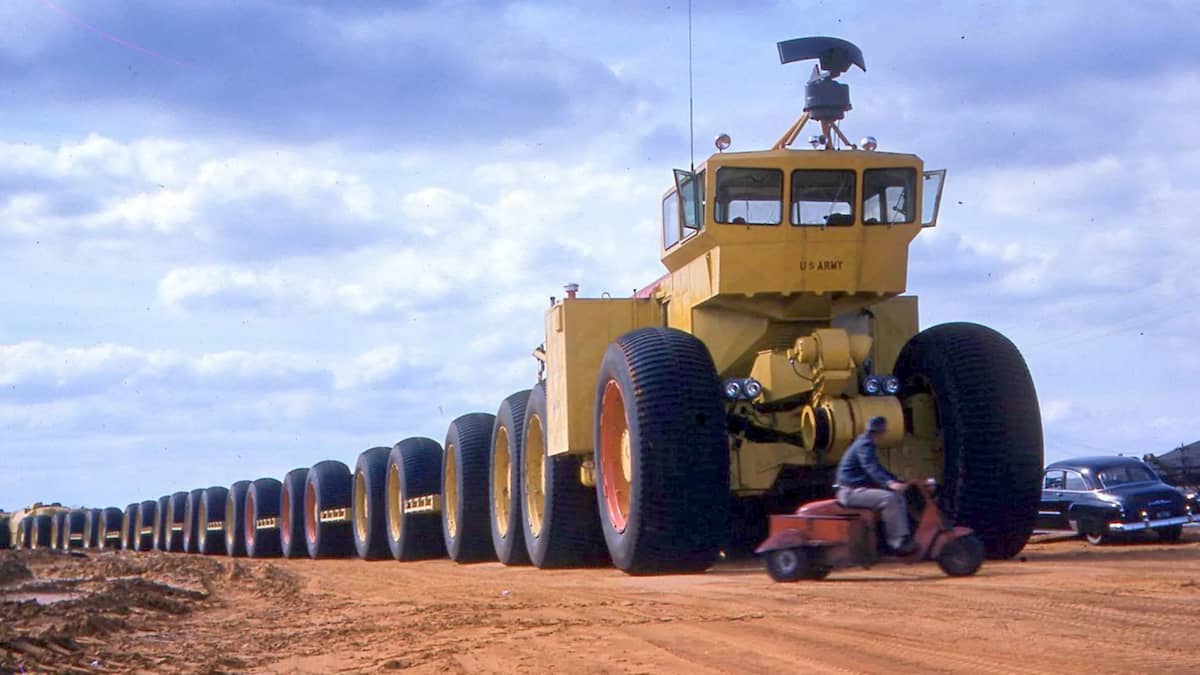
Imagine a vehicle 174 metres long — nearly two football pitches — that needs no road, needs no rails, can cross rivers and Arctic blizzards, and is powered by four gas turbines mounted on separate cars. And that was defeated not by an engineering failure, but by a helicopter.
The man who never finished school
A sixth-grade dropout with 300 patents
Robert Gilmour LeTourneau was born on 30 November 1888 in Richford, Vermont. He left school in sixth grade. In 1965, at the age of 76, the International Correspondence School — where he had studied mechanics by correspondence decades earlier — awarded him an honorary engineering diploma. When it was handed to him, LeTourneau looked at the attendant and remarked: "Now I am an educated man."
Between sixth grade and that diploma there were 299 patents, four manufacturing plants on four continents, and a company that during the Second World War supplied more than 70% of all earth-moving machinery used by the Allied Forces — bulldozers, scrapers, portable cranes, paving roller trains. More than half of the Alaska Highway was built with LeTourneau equipment.
In 1953, LeTourneau sold his entire earth-moving machinery line — including plants, land, machinery and inventory — to the Westinghouse Air Brake Company for $31 million. The contract included a clause: five years' exclusion from the conventional heavy machinery market. During those five years, at the age of 65 and with the free time he had never had, LeTourneau focused on a problem that obsessed him: electric traction in the wheel hub.
The idea was simple in concept and radical in application: instead of transmitting power from the engine to the wheels through a chain of axles, clutches and differentials, why not place the electric motor directly inside each wheel hub? A central generator — diesel or turbine — produces electricity. That electricity travels by cable to the hub motors. Each wheel is completely independent. No differential to distribute. No gearbox to manage. And if one wheel loses traction, the others keep pushing.
It was the same philosophy that decades later would be adopted by the marine Wärtsilä RT-flex96C, the Soviet ZIL-2906 and the MAZ-7907. But LeTourneau applied it, in the 1950s, to vehicles that had to cross the Arctic.
¿Cómo se ve en la
vida real?Ver en TikTok▶❤️💬🔗TV@LlantaPinchadaTVThe LeTourneau TC-497: 174 metres, 54 drive wheels, aircraft turbines. And it was beaten by a helicopter 🚂❄️🇺🇸 #LeTourneau #TC497 #ColdWar #Engineering
Disponible en nuestra comunidad vertical
"The building of machinery will grow larger and larger, and more and more powerful. Instead of tons of capacity, they will be measured in hundreds of tons." — R.G. LeTourneau, two years before his death in 1969
The Arctic problem that created it
63 radar stations, no roads, at the 69th parallel
With the Cold War at its height, the US government decided to build 63 manned radar stations in the high Arctic, around the 69th parallel — 200 miles north of the Arctic Circle. They needed to detect Soviet bombers crossing the North Pole as early as possible.
The project was called the DEW Line — Distant Early Warning. The problem was logistical: the areas had no adequate roads, few airstrips, and sea ice frequently prevented ship access. Heavy-lift helicopters did not yet exist as a practical concept. Everything had to arrive overland. And "overland" in the Arctic means deep snow, tundra that turns to swamp in summer, unbridged rivers and temperatures down to –56°C.
The US and Canadian governments calculated that around 500 tonnes of materials would be needed to build all the outposts.
LeTourneau had the answer: the land train. Not a train with rails — a train with enormous low-pressure wheels that would float over the snow like floats, driven by electric hub motors, capable of crossing rivers, blizzards and tundra without needing anything beneath it except ground.
The complete family
From the Tournatrain to the TC-497: six vehicles in ten years
LeTourneau's first land train was the VC-12 Tournatrain, tested in February 1953. It had a 500 hp Cummins engine and four cars, with four electric hub motors per car. After several months of testing, four more cars were added, with the last housing a second engine. The complete version could carry a maximum load of 140 tonnes.
From there came the TC-264 Sno-Buggy, with eight wheels of 120 inches in diameter — three metres of tyre — at very low pressure. The contact area was so enormous relative to the vehicle's weight that it could literally float over tundra and snow. Tests in Greenland in 1954 were a success. Its giant wheels had a notable second life: the Sno-Buggy's wheels found their way to the original Bigfoot monster truck years later.
Alaska Freight Lines, contracted by Western Electric to deliver 500 tonnes of equipment to the DEW stations in Alaska, commissioned the VC-22 Sno-Freighter in January 1955. The contract required a locomotive and six cars capable of transporting 150 tonnes of material, crossing rivers up to four feet deep, pushing through blizzards and operating at temperatures down to −68°F (−56°C).
The Army asked for its own version: the LCC-1 — Logistics Cargo Carrier — which combined the Sno-Buggy's wheels with the Tournatrain's propulsion. It was a 16-wheel vehicle with a 600 hp Cummins engine, capable of carrying 45 tonnes. The tests impressed the Army.
The TC-497
Four aircraft turbines, 54 wheels, 174 metres
The TC-497 was broadly similar to the LCC-1 in concept, but included a series of features that allowed the train to grow to any length. One of the changes was the replacement of the Cummins engines with higher-power, lower-weight gas turbine engines.
The TC-497 had four gas turbine engines of 1,170 hp each — the Solar Saturn 10MC, manufactured by Solar Turbines. One was in the control cab. The other three were housed in their own separate power cars, distributed along the train. New power cars could be added at any point along the train. The maximum length was, theoretically, unlimited.
The turbines drove generators that supplied electricity to 54 electric motors, one for each wheel assembly. There was no conventional mechanical transmission at any point in the system.
To reduce weight, most of the vehicle was built from welded aluminium. The control cab was more than nine metres tall — enough for the driver to have visibility over the entire train. Inside the locomotive there was accommodation for six people, with a full kitchen and bathroom. The vehicle was designed for extended autonomous operations in the Arctic.
The TC-497 was capable of carrying 150 tonnes at 20 mph for nearly 400 miles — a range that could be extended by adding extra fuel cars. Its total length was 572 feet — the longest of the six LeTourneau land trains.
The defeat
The helicopter that killed the world's longest vehicle
The Army tested the TC-497 in 1962 at the Yuma Proving Ground, Arizona. The results were once again impressive — but so were the simultaneous advances in heavy-lift helicopters such as the Sikorsky CH-54 Tarhe, a fleet of which could achieve what the TC-497 promised in a fraction of the time and effort.
The Sikorsky CH-54 Tarhe — popularly known as the "Flying Crane" — could lift loads of up to 9 tonnes. It was not more capable than the TC-497 in terms of gross load. But it needed no road, needed no passable ground, could reach any point in hours rather than days, and required no fuel for 400 miles of Arctic travel. The logistics of the TC-497 in real operations — fuel, maintenance, crew, speed — made the balance unfavourable compared to a fleet of cargo helicopters.
The era of solving a problem like remote logistics with a massive, almost caricature-like machine such as a land train was over.
The TC-497 never left the Yuma Proving Ground for combat service. It was sold at auction. Fortunately, the Yuma Proving Ground Heritage Center was able to acquire it. Today it is displayed there, without its cargo cars, as the largest witness to a way of thinking about logistics that lasted exactly as long as it took heavy aviation to catch up with it.
The complete LeTourneau land train family met varied fates. The Sno-Freighter is abandoned with at least three of its cars on the outskirts of Fairbanks, Alaska, as is the LCC-1 with one of its cars. The Tournatrain and the Sno-Buggy have uncertain whereabouts.
R.G. LeTourneau died on 1 June 1969, aged 80, following several strokes. He had given 90% of his fortune to Christian and educational causes — including LeTourneau University, which continues today in Longview, Texas. Inscribed on his tombstone: the words of Matthew 6:33. At the Yuma Proving Ground, his last great argument — the longest all-terrain vehicle ever built — remains there, static, waiting for someone to look at it and understand the scale of what a sixth-grade autodidact managed to imagine.