Imagine starting a four-door saloon and having to manage two independent engines, two rev counters, two water temperatures, two oil pressures, and a gear lever that simultaneously moved two separate gearboxes. And what you have behind you is not the boot — it is another engine identical to the front one, with its own sump, its own supercharger and its chronic tendency to overheat.
The problem that created it
1983: the last year a rear-wheel-drive car won the world
In 1984, Lancia needed a replacement for the Rally 037. The rear-wheel-drive car had already worked miracles by winning the World Rally Championship for manufacturers the previous year, overcoming the emerging Audi and Peugeot equipped with four-wheel drive; however, the clear technical superiority of its rivals convinced Lancia to develop a new four-wheel-drive competitor.
The context was one of genuine urgency. The Audi Quattro had permanently changed the rules of rallying. Four-wheel drive was not a marginal advantage on gravel — it was a difference of category. The Peugeot 205 T16 was in development. The Lancia 037, which had done the impossible by winning the 1983 championship as a rear-wheel-drive car, could not repeat it. And the planned successor — the Delta S4 — was not yet ready.
Lancia was falling behind in 4×4 design, caught off guard by the Quattro's success, and with the Delta S4 still not completed, Lancia needed a 4×4 car quickly, to begin testing the Pirelli tyres required for the S4.
The solution they adopted was, in every possible technical definition, a rational act of madness.
¿Cómo se ve en la
vida real?Ver en TikTok▶❤️💬🔗TV@LlantaPinchadaTVThe Lancia Trevi Bimotore: two engines, homemade 4×4, and built in a month to beat the Audi Quattro 🏎️🇮🇹 #Lancia #TreviBimotore #GroupB #Engineering
Disponible en nuestra comunidad vertical
"Giorgio described the car as a 'rolling laboratory'. Production or rally deployment were never planned, and never happened." — Integralingham.com, on the project's philosophy
The man of the month
Giorgio Pianta, driver, test driver and Abarth team chief — with one month and one idea
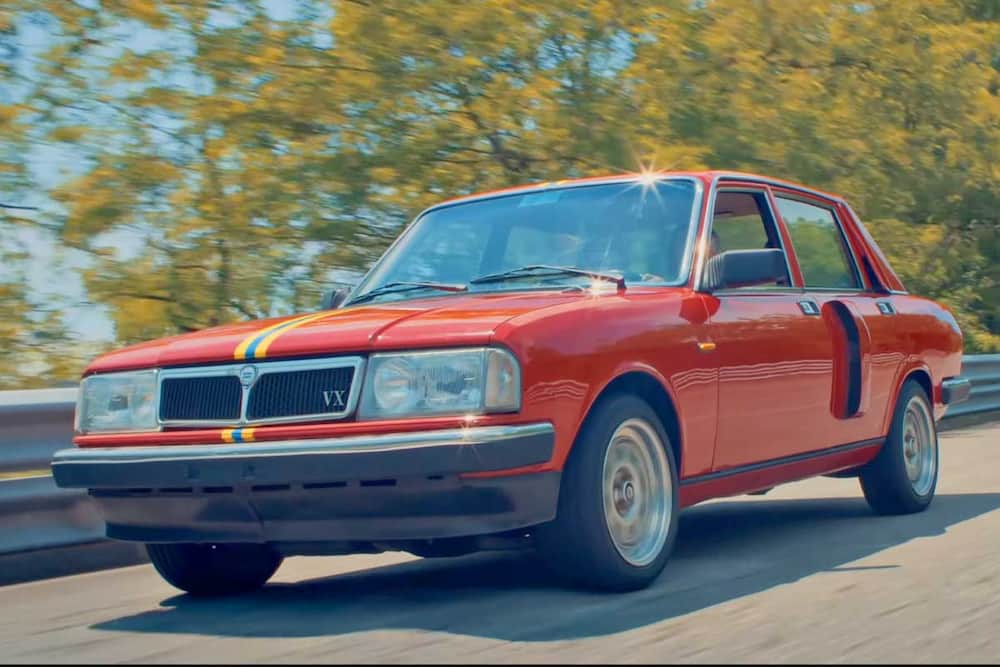
At the Chivasso plant, Giorgio Pianta — versatile racing driver, test driver and Abarth team manager — designed and built a car that used two engines to provide four-wheel drive.
Pianta did not start from scratch conceptually. Pianta took up the "crazy" idea tested by Wainer in the Alfasud Bimotore a few years earlier. The principle was known in competition circles — the 1963 Mini Twini, the Alfasud Bimotore, the twin-engine Austin Cooper of the 1960s — but applying it to an Italian four-door saloon based on a road car was another matter entirely.
The starting point was the new Lancia Trevi Volumex, equipped with a supercharged two-litre engine that provided the vital low-rpm torque needed to win rallies. Pianta dispensed with the rear seat bank, leaving a gap at the rear of the body for a subframe — identical to the front one — that would house a second engine, identical to the first.
The complete work — disassembly, fabrication of the rear subframe, installation of the complete second drivetrain, cooling system, control connections — took one month. Pianta needed a full month of work at the Chivasso plant to bring to life a strange and complex creature equipped with two engines and the coveted four-wheel drive.
The engineering
Two engines with no mechanical connection — and the problem of synchronising them
The two engines fitted to the Trevi Bimotore were not mechanically coupled, although the gearboxes were linked so they could be managed through a single lever and a single pedal to actuate both clutches. In turn, the two throttles were controlled by a rudimentary electronic system that determined the amount of power reaching the rear axle, thus reducing oversteer and achieving faster corner exits.
The electronic system was the closest thing to a centre differential that Pianta could build in a month. This electronic control did not work particularly well, and the traditional Bowden cable system had to intervene. In practice, the synchronisation of the two engines was approximate — sufficient for testing, insufficient for real competition.
To control the car, the hydraulic clutch lines were linked, and the two gearbox linkages were operated from the central gear lever. The engines were equipped with Weber 36DCA carburettors, connected to a basic electromechanical control with an adjustable delay for the rear engine throttle to allow some control over the Trevi's understeer.
The two rear doors were welded shut, adding structural rigidity, and on top of them two large air intakes were installed to cool the centrally located engine. The saloon's rear doors would never open again. They became body panels with an aerodynamic function.
The dashboard included two rev counters — the second replaced the speedometer — and two central gauges indicated the water temperature and oil pressure of each engine. The futuristic dashboard was based on Mario Bellini's standard design, with some indicators modified so that both engines could be kept under control.
The fuel tank was relocated to the boot. A 130-litre tank for both engines was placed in the boot area. No rear seats, no boot, no functional rear doors. The Trevi Bimotore was a four-door saloon with only two operational doors and two real seats.
The car was painted in Montebello red with a central yellow and blue stripe, recalling the colours of the Italian city of Turin.
The tests
Fast. Too heavy. Rear engine running red.
Although the car was fast and very effective, it was excessively heavy due to having twice the mechanical content, and the rear engine tended to overheat.
The two problems were related. A four-door saloon with two complete drivetrains — engine, supercharger, gearbox, subframe, suspension — weighed considerably more than any Group B competitor. The Peugeot demonstrated the merits of compact small cars with rear mid-mounted engines with the 205 T16. The 205 T16 was a machine designed from scratch for the purpose — light, centred, with the engine in the optimal position. The Bimotore was a road saloon with two engines grafted on.
The rear engine overheating was the most serious technical problem. Despite Pianta's efforts to achieve good thermal management of the rear engine through the four air intakes, it tended to overheat easily. The air intakes in the welded doors were not sufficient for an engine working at its limits under competition conditions.
Despite this complex configuration, the Lancia Trevi Bimotore lacked sporting character and competitive spirit. However, it proved to be a very efficient test car.
What it contributed to the Delta S4
The laboratory that made the Group B monster possible
The solution was not adopted in the successor to the Lancia Rally, the Delta S4, but curiously some similarities can be found in the road version of the S4: they include a central engine, enclosed in a casing covered by the same beige carpet used in the passenger compartment, which was exactly the same solution adopted by Pianta in the Trevi Bimotore.
The Bimotore served the purpose Pianta had planned from the outset: the prototype served for the development of the successor to the Lancia 037 Stradale, the Lancia Delta S4. The removable wheels were identical to those of the S4, as the prototype served as a test bed to test and develop the special Pirelli tyres produced specifically for the new Lancia.
Only one was built, as a stopgap solution to allow test drivers to gain experience for the imminent Lancia Delta S4.
The Delta S4 made its competition debut at the 1985 RAC Rally. It was everything the Bimotore could not be: specifically designed for Group B, with a single central engine simultaneously supercharged and turbocharged, with genuine four-wheel drive via a centre differential, and over 500 hp in rally specification. It won five of the eleven rounds of the 1986 WRC before the deaths of Henri Toivonen and Sergio Cresto at the Tour de Corse ended Group B forever.