Imagine a truck with no doors at all. To get in, the entire windscreen swings forward. The driver sits in an aircraft cockpit. Two turbines roar overhead. And the trailer it pulls already uses interchangeable modular containers. In 1964.
The fair where the Mustang eclipsed everything
When the future of transport competed against the most famous pony car in history
On 22 April 1964, the New York World's Fair opened its doors in Flushing Meadows, Queens. It was a colossal event: two consecutive seasons, more than 26 million visitors to General Motors' pavilion alone — the absolute attendance record for any pavilion in the history of any world's fair. The official theme was "peace through understanding". The real theme, in the transport area, was the future.
Ford arrived with the most lethal weapon possible: the Mustang. On the very opening day, Ford dealerships across the country sold 22,000 units. All three national television networks had aired the advertisement simultaneously the night before. There were queues to see the car. There were queues to try it. There were people sleeping at dealerships to make sure they would be first.
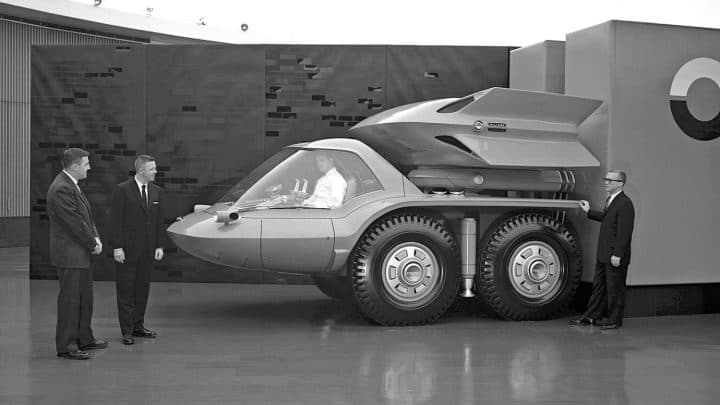
General Motors' Bison concept debuted at the same New York World's Fair, but without the Mustang's fanfare. This turbine-powered truck was quickly forgotten, which is a shame, because the GM Bison was an extraordinarily striking vehicle.
Because while Ford was looking at the individual driver, GM was looking at the entire transport system.
¿Cómo se ve en la
vida real?Ver en TikTok▶❤️💬🔗TV@LlantaPinchadaTVThe GM Bison 1964: the doorless turbine truck nobody remembers from the fair where the Mustang debuted 🚛✈️ #GMBison #ConceptTruck #Engineering #1964
Disponible en nuestra comunidad vertical
"General Motors had been experimenting with turbines for over a decade, and applied that idea to heavy trucks with its Bison concept. It was an aerodynamic design that looked like it came straight out of The Jetsons." — GM, official World's Fair statement, 1964
The design
A fighter cockpit at the head of a semi-trailer
The Bison consisted of three elements: the cab, the two turbines mounted above and behind the cab, and the trailer system with containers at the rear.
The cab was the most radical statement of intent. It was a truly aerodynamic design developed under Bill Mitchell's direction that looked like it had come straight out of The Jetsons. But more than the exterior silhouette, what defined the Bison was what it did not have: doors. None at all. To get into the Bison, you had to open the canopy, which included the entire windscreen. Once seated, the driver pulled towards themselves a futuristic steering wheel that closely resembled an aircraft yoke. Between two vertical controls was a series of switches. More levers and buttons were located on the centre console, where the driver also found a telephone.
The turbines were not hidden. Mounted above and behind the cab, they featured an aerodynamic design that flowed rearward to a huge standardised container. They were part of the vehicle's visual language — a declaration that the propulsion was aviation-grade, not road-grade.
The turbines
The engine GM had spent a decade trying to put in trucks
The centrepiece of contemporary publicity about the Bison focused on GM's fifth-generation turbine engine, the GT-309, developed by the company's Allison division. It was rated at 280 horsepower and 875 lb-ft of torque. The output shaft speed was a maximum of 3,600 rpm, reduced through gearing from the turbine shaft speed of 30,480 rpm.
But the GT-309 was not the only power source. The truck was powered by a pair of turbines capable of producing 280 and 720 hp respectively. The logic was the same as the naval RT-flex96C: two units for two usage regimes. The large unit was for acceleration, hill climbing and maximum load, while the smaller unit was for normal motorway cruising. The turbines fed electric motors that in turn transferred power to the wheels.
Turbo-electric propulsion was not an aesthetic whim. Gas turbines have the advantage of very few moving parts compared to a piston engine — which in theory translates into less maintenance. But they have one insurmountable drawback for road applications: their enormous fuel consumption, in the low single-digit miles-per-gallon range. A turbine is efficient at the constant regime of an aircraft. In the continuous stop-and-start of an urban truck, it consumes in proportion to the weight of traffic management.
The vision of the future
Standardised containers four years before the ISO
The most prophetic aspect of the Bison was not the turbine or the glass canopy. It was the trailer.
The trailer was a specially designed unit that GM hoped would become the standard for semi-trailers. It allowed 8×8 ft modules in lengths of 10, 20 or 30 feet to be loaded into a closed gondola unit. GM predicted that these trailers could come in various lengths, doubled or tripled for long-distance interstate deliveries.
In 1964, the standardised intermodal container system was in its infancy. Malcolm McLean had converted a tanker in 1956 into the first container ship in history, and the concept of moving the same container without reloading its contents from ship to truck to train was gaining traction in the logistics world. But the ISO would not adopt the international standard for 20- and 40-foot containers — the TEU that today moves 90% of world trade — until 1968.
This was four years before a world standard for shipping containers was adopted. GM's engineers were already designing the truck for an intermodal system that the world would take nearly five more years to formalise.
GM's engineers had anticipated that the day would come when most cargo would move in standardised containers across a rapidly growing motorway network. The Bison was the vehicle for that imagined network — a system where containers would be loaded and unloaded automatically, where the truck would arrive at a dock and the cargo module would transfer without human intervention.
Four-wheel steering
Turning a semi-trailer like a sports car
GM's Bison concept offered a four-wheel steering system that activated on the axles when the wheels turned in the same direction or in opposite directions, depending on the steering angle.
This meant two completely different manoeuvring modes. At low speed — port manoeuvres, dock loading, parking — the front and rear axles turned in opposite directions, drastically reducing the turning radius for a vehicle of this length. At high motorway speeds, all axles turned in the same direction, giving the whole assembly superior lateral stability compared to a truck with front steering only. Four-wheel steering in production cars would not become widespread until the 1980s.
The heir and the oblivion
One year later: the Turbo Titan III, the Bison that could actually move
It is possible that the true purpose of the Bison turbine truck concept was related to the Chrysler Turbine. The turbine car was introduced approximately one year before the 1964 World's Fair opened, and with 50 Italian-built cars circulating around the country, Chrysler was gaining publicity at international, national and local levels simultaneously.
If the Bison was the declaration, the 1965 Turbo Titan III was the demonstration. GM presented that truck — this time driveable, real, functional — with a turbine and Allison six-speed automatic transmission, leather seats with full headrests that Chevrolet called "astronaut seats", and a dual-control steering system that bore similarities to the Bison's.
The Bison itself was never driveable. It was a static model, perfect for the Futurama exhibit, but impossible to adapt to the realities of the transport world.
Today nobody knows what happened to the Bison concept. It was never developed beyond the initial concept stage. Nevertheless, the Bison truck will always be part of the design history of General Motors and of Bill Mitchell.
It was not until 2023 that the GM Design Instagram account (@generalmotorsdesign) published the original archival photographs of the Bison, and the vehicle was massively rediscovered by a new generation of industrial design enthusiasts. The images showed something that sixty years had not aged: a truck that today, in 2026, still looks like it came from a science fiction film set in the future.