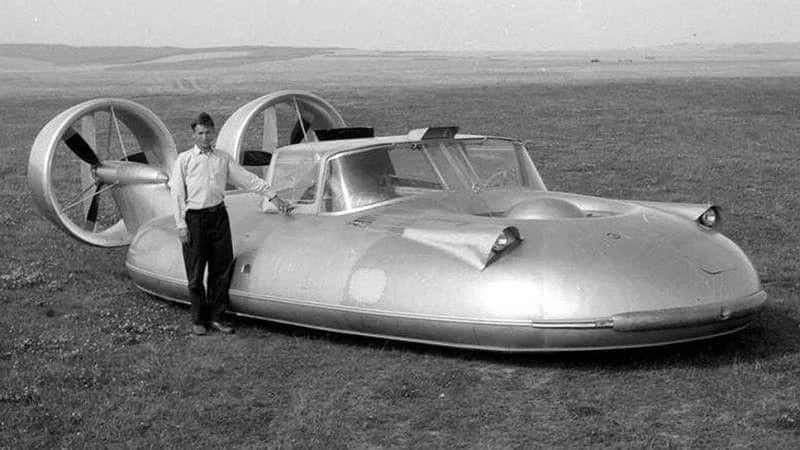
Imagine a car with an aviation alloy body, four propellers mounted on the structure and no wheels in contact with the ground when operating. It was not a boat. It was not a plane. It was a 1962 Soviet automobile designed to float on a cushion of air.
The context that explains it
The USSR and vehicles that did not touch the ground
The Soviet fascination with vehicles that travelled without contact with the terrain has roots that go much further back than 1962. In the 1930s, engineer Vladimir Levkov had built in the USSR the world's first air cushion craft — fast military platforms with solid sidewalls and aircraft engines capable of reaching 70 knots (130 km/h) in tests, decades before the Briton Christopher Cockerell patented his hovercraft design in 1955. The Second World War interrupted that work and destroyed the prototypes, but the seed had been planted.
When in July 1959 the Saunders-Roe SR-N1 crossed the English Channel in just 20 minutes, worldwide interest in air cushion vehicles surged. Engineers in Britain, France, the United States — and naturally in the Soviet Union — began exploring what this technology could do on land, on water, on frozen rivers, in Arctic swamps.
In Gorky — the city that housed the GAZ Automobile Plant — engineers lived in the same ecosystem that built the most iconic Volgas in the USSR, but also a few kilometres from the Krasnoye Sormovo shipyard, where Rostislav Alexeyev was developing hydrofoils and the first ekranoplanes. It was an environment where the question of whether a land vehicle could float did not sound far-fetched.
¿Cómo se ve en la
vida real?Ver en TikTok▶❤️💬🔗TV@LlantaPinchadaTVThe GAZ-16: the 1962 Soviet hovercar that nobody saw and almost nobody documented ☭🚗✈️ #GAZ16 #USSR #HoverCar #Engineering
Disponible en nuestra comunidad vertical
"The same factory that gave the Soviet citizen their Volga 21 — the most aspirational saloon in the country — was secretly building a car that needed no wheels."
The vehicle
Four propellers, zero wheels, one unanswered question
What is known about the GAZ-16 comes from a handful of photographs and references in the official GAZ vehicle catalogue. It is one of the least documented Soviet prototypes, possibly because it never left the test facilities and never received a formal military classification.
The body was made from aviation alloy — the same material used to build aircraft fuselages — giving it a weight far below that of conventional steel for its size. The exterior form followed a rounded and compact line, with the saloon design as a visual starting point but with no conventional openings beneath the body.
The propulsion system was completely unlike any car of the era. The GAZ-16 mounted two lift propellers — one at the front and one at the rear — whose function was to pump air downwards to create the pressure that lifted the vehicle from the ground. Independently of these, two large lateral propulsion propellers generated the horizontal thrust needed to move the vehicle. There was no transmission, no drive shaft, no differentials.
The vehicle also had a conventional wheel system — photographs of the scale model confirm this — suggesting it could travel on asphalt using wheels when not operating in air cushion mode. This ambivalence between a conventional road vehicle and an aeromobile was precisely the problem that all similar projects of the era were trying to solve.
What is not known
The most opaque prototype in the GAZ family
Unlike other Soviet experimental vehicles of the same era — the ZIL-2906 (for which detailed technical specifications and operational photographs exist), the MAZ-7907 (documented under load testing) or the GAZ-21 (with complete production records) — the GAZ-16 is a practically blank page in technical history.
There are no verified public data on its engine, its weight, its maximum cruising speed in floating mode, or how many hours of testing it accumulated. There is no record of whether it ever lifted stably off the ground under controlled conditions, or whether the prototype was limited to static tests. Its physical fate is equally unknown — it may have been scrapped, it may be in some closed archive, there may be no surviving example.
What the official GAZ vehicle list confirms is its existence: "GAZ-16 — hovercraft prototype (1962)". The colloquial name circulating in informal sources and among enthusiast communities is "the flying Volga" — a reference to the fact that it came from the same factory as the country's most famous saloon, even though it had nothing mechanically in common with it.
The legacy
Why the hovercar went nowhere
The international experience with air cushion vehicles in the 1960s was consistent: spectacular in the right conditions, problematic in everything else. The large British civilian projects using the SR-N4 to cross the Channel were viable but expensive and noisy. General land-use projects failed systematically because hovercrafts work well on homogeneous, obstacle-free surfaces — the exact opposite of a real road with potholes, bends, gradients, stones and vegetation.
A car that floated above the everyday traffic of Gorky in 1962 was an attractive idea on paper. In practice, the same problems that made the hovercar impossible in the West applied equally in the USSR: disproportionate energy consumption for sustentation, the impossibility of braking efficiently without ground contact, and the simple fact that the flat, regular asphalt it required was precisely the type of infrastructure least abundant in the USSR of that era.
The USSR found its own uses for air cushion vehicles: rivers, swamps, roadless Arctic zones, and the gigantic military ekranoplane platforms that Alexeyev would develop in the same Gorky in the years that followed. The GAZ-16 belongs to a branch that did not prosper — that of the city car that flew centimetres from the ground — but which in 1962 someone, in some department of the Gorky Automobile Plant, believed sufficiently possible to build.