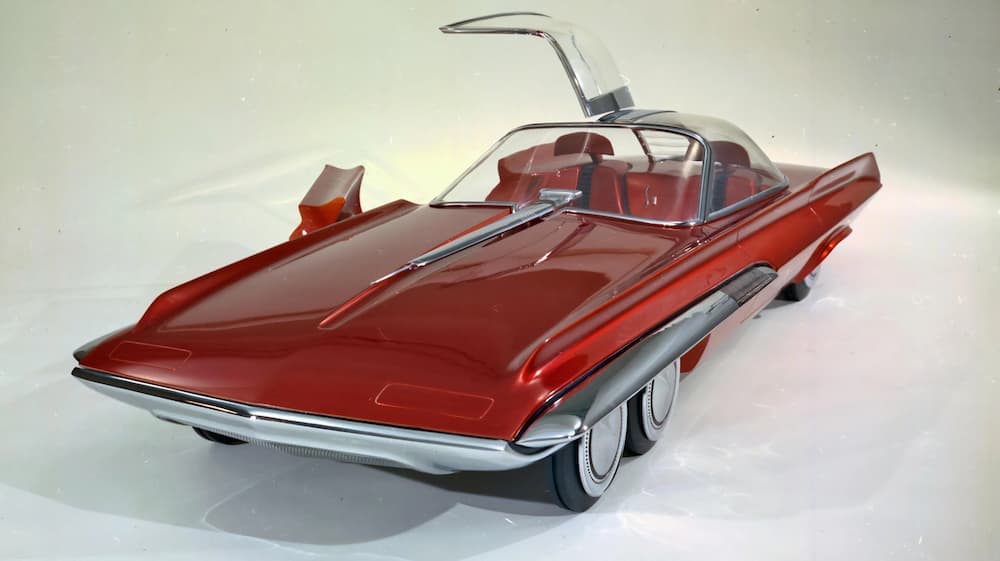
Imagine a car with six wheels — four steering at the front, two fixed at the rear — where the entire drivetrain uncouples and is swapped out for another depending on the journey's needs. With fuel cells. With a navigation computer. With variable-density glass. In 1962. And it fits in the boot of a modern car.
The designer
The man who designed the Tucker, the Cord 812 and the Subaru BRAT — without a university degree
Alexander Sarantos Tremulis was born in Chicago in 1914, the son of Greek immigrants. He had no formal design training — he entered the industry at 19 as a stylist at Duesenberg's Chicago sales office in 1933. Under the tutelage of Gordon Buehrig he contributed to the design of the Cord 810, and when Buehrig left, the 22-year-old Tremulis became head of design, leading the design of the supercharged Cord 812 before the company closed in 1937 in the depths of the Great Depression.
Then came GM, Briggs, Kaiser-Frazer, the Air Force during the Second World War — where he worked on advanced aircraft designs — and finally Preston Tucker, who hired him to design the Tucker 48, the most innovative and most ill-fated American saloon of the post-war era. It was Tremulis who was primarily responsible for bringing the "Tin Goose" prototype to completion.
Tremulis was in Ford's design department between 1952 and 1962, and established his own consultancy in 1963. During that decade at Ford, he produced designs so advanced that they are still considered far ahead of their time: the atomic-powered Nucleon, the gyroscope-stabilised two-wheel Gyron, and the six-wheel Seattle-ite XXI, in honour of the Seattle World's Fair.
¿Cómo se ve en la
vida real?Ver en TikTok▶❤️💬🔗TV@LlantaPinchadaTVThe 1962 Ford Seattle-ite XXI: GPS, swappable nuclear engine and six wheels. It predicted the modern car 60 years early 🚗☢️ #FordSeattleite #ConceptCar #Engineering #1962
Disponible en nuestra comunidad vertical
"In 1957, Tremulis was assigned the task of designing the car he 'believed we would drive in the year 2000'." — Grokipedia, on Ford's brief to the designer
The Century 21 Fair
Why it is called XXI and what it had to demonstrate
The Seattle-ite XXI was specifically conceived in 1961 as Ford's contribution to the Century 21 Exposition. The fair, themed "The World of Tomorrow", was held in Seattle between 21 April and 21 October 1962. It attracted nearly 10 million visitors over its six-month run, providing a massive audience for Ford's futuristic presentation.
The Seattle-ite is named after the purpose for which it was designed: as an exhibit at the 1962 Seattle World's Fair. The event's theme was the Twenty-First Century, hence the "XXI" portion of the car's name.
The Seattle-ite XXI was presented on 20 April 1962, one day before the official opening of the Century 21 Exposition, where it served as the centrepiece of Ford's pavilion. It was not the only Ford concept car that year — they were also showing the Mustang I, the driveable precursor to the 1964 Mustang — but the Seattle-ite was the furthest reach into the future: not next year's car, but next century's.
The six wheels
Four steering wheels at the front — thirteen years before F1
The car had six wheels, with four steering ones at the front and two fixed at the rear — similar to the fictional FAB1 of 1965 and the real Tyrrell P34 racing car of the early 1970s.
The logic behind the four front wheels was the same that would lead designer Derek Gardner to create the Tyrrell P34 for Formula 1 in 1976: the benefits of four front wheels were first articulated in 1962 by Ford's Seattle-ite stylists, who believed they would "greatly improve path stability, traction and braking efficiency."
The six-wheel configuration, with four front steering wheels to improve traction and braking, was a forerunner of multi-axle designs, notably influencing the Tyrrell P34 Formula 1 car that won a Grand Prix in 1976. In that Swedish Grand Prix, Jody Scheckter crossed the finish line in a car with exactly the same wheel configuration the Seattle-ite had proposed fourteen years earlier — though the Tyrrell engineers arrived at that solution by their own path.
Access to the car was also unusual: the design was equally unusual in terms of access, with a conventionally opening door and an upper glass gullwing.
Modular propulsion
The engine you swap at the service station — or the compact nuclear unit
One of the most revolutionary aspects of the Seattle-ite XXI was its modular drivetrain design. Ford's designers envisioned a vehicle that could run on a variety of power sources, from fuel cells to even a compact nuclear propulsion device. The entire front section of the car was designed to detach from the passenger compartment, allowing the driver to swap power capsules according to driving needs.
This modular concept would have given the Seattle-ite XXI immense flexibility, allowing the car to be adapted to different purposes with ease. The power units would be connected through a flexible coupling, seamlessly linking the controls to the passenger compartment.
There were two power options: a 60-horsepower economy unit for urban driving, or a more powerful option for long distance. Both would be interchangeable within minutes — the 1962 equivalent of battery swapping now explored by companies like NIO or the swap networks for electric vehicles.
The concept of some kind of compact nuclear propulsion device was included as a possible energy source, under the assumption that radiation problems could be overcome without the need for massive shielding. It was 1962 — the same year John Glenn orbited the Earth, when the space race seemed capable of solving any physical problem given sufficient time and funding.
The interior of the future
The central screen that cars took 40 years to have
Finger-tip steering and a trip-programming computer are among the interior features of the Seattle-ite. A display screen would show the car's operating characteristics, road and weather conditions, the vehicle's position relative to an automatically updated road map, and the estimated time of arrival at any selected destination.
It was the exact description of what is today an infotainment system with GPS navigation — a technology that did not reach mass-production cars until the 1990s, and did not become standard until the 2000s.
Variable-density glass around the passenger compartment would give the interior fresh, diffuse light, eliminate glare and allow efficient climate control. Variable-density or electrochromic glass — which electronically darkens or lightens — has existed in production since the 1990s and has reached luxury cars in recent years.
The seats were fixed, forming an integral part of the car's structure, but the floor panels were designed to be adjustable. This allowed the pedals to move to a position suited to the driver, increasing comfort and ease of driving.
Jalousie windows — louvred windows that could be opened or closed to control ventilation — would reduce noise and improve airflow, while the variable-density glass would provide a cool, glare-free interior environment.
The legacy
What it predicted, what remained on paper and what time validated
With the 20-20 vision that hindsight provides, Ford's 1962 World's Fair piece stands out as one of the most visionary concept cars in history. Many concept cars have anticipated technologies that have become standard equipment, but few have anticipated so many technologies so far ahead of their time as the Ford Seattle-ite XXI.
The tally of verified predictions is remarkable: the central information and navigation screen, variable-density glass, precision electronic steering, interchangeable power units, modular bodywork, four front steering wheels. The car contained novel ideas that have since become reality: interchangeable fuel cell power units; interchangeable bodywork; interactive computer navigation, mapping and automobile information systems; and four driven and steered wheels.
What did not come true was compact nuclear propulsion — though small modular reactors returned to the energy conversation in the 2020s as stationary power sources. And battery swapping for electric vehicles is exactly the "interchangeable power capsule" concept the Seattle-ite described, adapted to the actual twenty-first century.
The Seattle-ite XXI was designed by Alex Tremulis as a 3/8-scale conceptual vehicle, embodying visions of twenty-first-century mobility. Tremulis left Ford in 1963 — the year after the Seattle-ite's debut — to open his own studio. His last documented contributions include the 1978 Subaru BRAT, the dual-purpose utility vehicle that reached production and was sold until 1987. He died on 29 December 1991.
The Seattle-ite XXI, that 3/8-scale model that never had a real engine, was the only concept car in Ford's history that simultaneously anticipated GPS, the central infotainment screen, electrochromic glass, automotive fuel cells and front four-wheel steering. And it did so in the same year the first Telstar communications satellite was launched and NASA sent the first American to orbit the Earth.