Imagine a car with no combustion engine, no petrol station, no exhaust. Just a uranium fission reactor between the rear axles, two steam turbines — one for the wheels, one for the electrics — and the promise of 8,000 kilometres between refuels. The driver sat as far as possible from the reactor. And the reactor sat in the boot.
The era that made it possible
When the atom was going to solve everything
To understand the Ford Nucleon you need to understand what the United States was in December 1953, when President Eisenhower stood before the United Nations General Assembly and delivered the speech that would define an era: Atoms for Peace. In Ike's words, nuclear technology could foster a new era of peace and international understanding. The bomb that had destroyed Hiroshima and Nagasaki was going to become the same force that would light homes, move ships and power industries.
The cultural response was immediate and total. Few aspects of the American landscape remained untouched by the promising pledges of the atomic age. Children experimented with atomic toys and followed the exploits of comic-book atomic superheroes. In 1951, Motor Trend was already publishing articles on "The Atomic Car of the Future", predicting that within a few decades nuclear reactors would be the size and weight of a conventional car engine.
In 1957, Ford Motor Company unveiled the most ambitious project in its history: a sleek, futuristic-looking conceptual vehicle that emitted no harmful gases and offered incredible fuel mileage, far superior to that of the most efficient cars ever built.
They presented it the same year the world's first commercial nuclear power station opened at Shippingport, Pennsylvania. The context was not science fiction — it was the promise of the moment.
¿Cómo se ve en la
vida real?Ver en TikTok▶❤️💬🔗TV@LlantaPinchadaTVThe 1958 Ford Nucleon: the car with a nuclear reactor in the boot that Ford presented as if it were completely reasonable ☢️🚗 #FordNucleon #AtomicAge #Engineering #History
Disponible en nuestra comunidad vertical
"The Nucleon was styled on the assumption that the current bulkiness and weight of nuclear reactors and the associated shielding will someday be reduced. It seems reasonable to assume that engineers will eventually discover a way to make this weight reduction possible." — George W. Walker, Ford Vice President of Styling, 1958
The designers
A first year in the industry, a boss who designed the Tucker, and an order to think without limits
Ford's Advanced Styling Studio, whose premise was to work on projects looking 10 to 20 years into the future, was the Nucleon's birthplace. George W. Walker led the styling division. He believed concept cars should generate publicity and reportedly told designers to develop ideas that would capture public interest, even when the technology did not yet exist.
James R. "Jim" Powers was a recent graduate of ArtCenter College of Design in Pasadena, California, who had been recently discovered and hired by Ford. It was his first year in the industry. He drew a series of sketches illustrating what a nuclear-powered automobile might look like. Called the "Nucleon", it looked like a futuristic spacecraft on wheels. Alex Tremulis, Ford's senior designer who had previously helped produce the Tucker automobile, saw Powers's sketches and asked him to make a concept model.
It was the same Alex Tremulis who years later would design the Ford Seattle-ite XXI — Ford's other nuclear concept car, with six wheels — and who had earlier given shape to the Tucker 48, the most innovative and most ill-fated American saloon of the post-war era.
The Nucleon began as a packaging study. Engineers asked the styling team to design a car with a heavy powertrain mounted at the rear rather than a front engine. This requirement forced Powers to shift the cab forward to balance the weight. The cab-forward layout became the defining characteristic of the vehicle's proportions.
The design
A fighter canopy, rocket fins and air intakes to cool the reactor
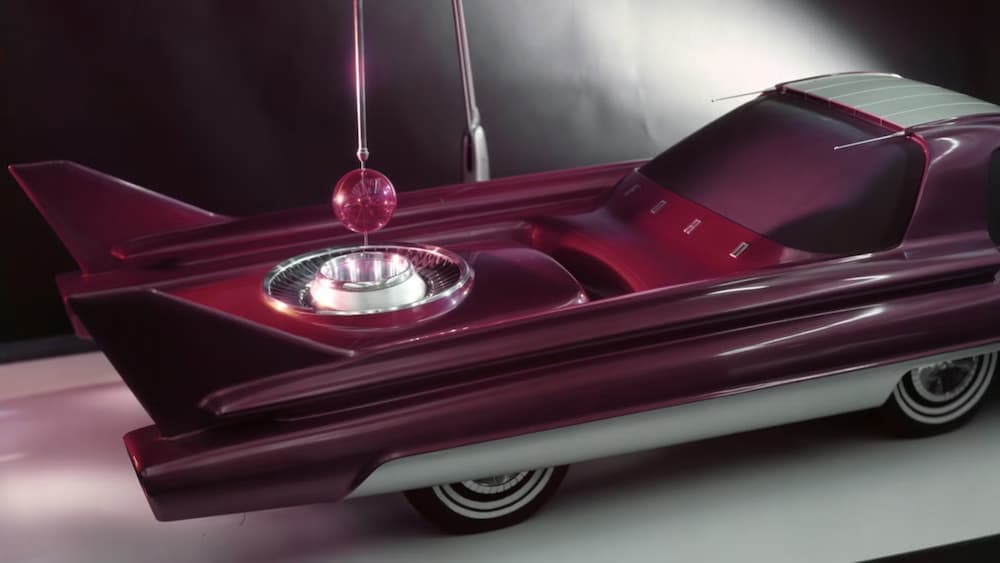
A dome houses the cabin, an element that references the fighter cockpits of the era and appears in other concept cars of the 1950s such as the Lincoln Futura. Since the nuclear reactor would generate residual heat that must exit the system, James Powers placed air intakes on the leading edge of the roof to channel cooling air towards the reactor at the rear. The team also added more air intakes on the roof support pillars.
The visual result was a car of extreme proportions. At 200 inches long with a 69-inch wheelbase, the Nucleon had extreme overhangs, with the front wheels positioned beneath the cab itself. It was almost as low as the Ford GT40 at Le Mans — the racing prototype that would win four consecutive times at the 24 Hours. And with proportions where the nose was a low triangular beak and the tail was a long, flat platform framed by twin fins.
The Nucleon's rear section houses the Power Capsule with twin rear fins that could stabilise it during high-speed travel. The fins created a V-angle that drew attention to the reactor's location, and the bumpers retracted to reduce air resistance during motorway driving.
Ford planned to use aluminium body panels to reduce weight and partially offset the lead shielding the reactor would require. The promise of materialisation never came — because the model they built was 3/8-scale, not full size.
The propulsion
Uranium-235, steam, turbines — and a capsule swapped like an electric car battery
The Nucleon's propulsion system was conceptually similar to that of a nuclear submarine of the era — which in 1958 already existed: the USS Nautilus had navigated under the North Pole that same year powered by a nuclear reactor.
A reactor using Uranium-235 would heat a primary coolant circuit, sending thermal energy to a steam generator. High-pressure steam would spin turbines, with one turbine driving the wheels and another powering pumps and electrical systems. After cooling in a condenser, the water would recirculate through the system.
It was a closed steam cycle — the same thermodynamic principle as a conventional power station, miniaturised to fit between the rear axles of a saloon.
This "replaceable power capsule" would be available in various sizes, allowing the driver to select their own power output. It was Ford's vision of a modular exchange system decades before companies like Better Place or Tesla proposed it for electric car batteries. A high-performance driver would choose a more powerful uranium capsule. A domestic economy driver would choose one with lower output and greater durability.
It was expected that even a small reactor could keep the car running for at least 5,000 miles. When the plutonium or uranium fuel was exhausted, the driver would go to a service station to have the entire Power Capsule extracted and replaced with a new one.
Petrol stations would disappear. They would be replaced by nuclear capsule swap stations staffed by technicians specialised in handling radioactive materials. Ford imagined it as a routine service — like changing the oil, except with uranium.
The three insurmountable problems
Why physics could not wait for engineering to catch up
The main problem was the weight of the radiation shielding. A fission reactor releases neutrons and gamma rays. Gamma rays require dense materials such as lead or tungsten to block them. Neutrons require hydrogen-rich materials such as water or concrete to slow them. A reactor producing 100 to 200 horsepower would need shielding weighing approximately 50 tonnes.
Fifty tonnes. The weight of a fully loaded articulated lorry. Inside a saloon car.
George Walker stated that the design assumed the volume and weight of the shielding would decrease in the future, but this assumption proved to be incorrect. The physics of how radiation interacts with matter cannot be changed through engineering. It was not a problem of better materials or smarter engineering — it was the direct and immutable consequence of the laws of nuclear physics. Gamma rays have the wavelength they have. Lead is as dense as it is. There is no way to change those constants.
The second problem was heat rejection. The concept relied only on air to dissipate residual heat, and the roof air intakes James Powers designed could not remove the residual heat the reactor would produce.
The third was the most obvious in retrospect: crash safety. A traffic collision that breached the containment vessel would release radioactive steam and core material. In an era when cars had no standard seatbelts and no crumple zones, designing a fission reactor vessel to survive a 100 km/h crash was an engineering problem with no available technological solution.
The legacy
The model that survived — and the idea that returned 70 years later
Although the vehicle was never produced, a non-functional ⅜-scale model exists today at the Henry Ford Museum in Dearborn, Michigan, within the Driving America exhibition. The museum has loaned it to other institutions, including the Atomic Museum in Las Vegas. Studio photographs from 1957 to 1958 show that Ford built at least two models during development. One was plaster for studying shapes. One was fibreglass for the final exhibition model. The surviving artefact is the fibreglass version.
Ford created several more concept cars hypothetically powered by atomic energy, including the La Galaxie by L. David Ash and the Seattle-ite XXI designed by Alex Tremulis, and like the Nucleon, they were more fantasy than reality.
The idea Ford dismissed in 1958 has found an unexpected second life. The Nucleon showed that small modular reactors were the future, seven decades early. In the 2020s, SMRs — Small Modular Reactors — became one of the most active energy debates in the world. Companies such as NuScale, Rolls-Royce and TerraPower have spent years developing compact reactors for distributed electricity generation. The premise is identical to the Nucleon's: a smaller, more manageable reactor that can be installed where it is needed rather than in a large central power station. Except for buildings and cities, not for cars.
The Nucleon's problem was not the concept of the modular reactor — it was the scale. A car needs tens of kilowatts. A city needs megawatts. The shielding required scales with the power. And at the scale of a car, physics allows no margin.
Jim Powers, the first-year designer who drew the Nucleon, never produced anything as famous again. The fibreglass model he built at 3/8-scale remains, sixty-seven years later, the only Ford Nucleon that has ever existed — and that ever will.