Imagine telling yourself: I'm going to put a car on the 86th floor of the Empire State Building. There's no crane that reaches that high. A helicopter can't land because of the spire. Only the elevators are left. And the car doesn't fit. So we cut it into four pieces.
The idea
The man who wanted a Mustang in the Manhattan sky
In the autumn of 1965, the Ford Mustang had been on the market for just over a year and had sold more than 418,000 units — an absolute record for a new car in the history of the American industry. It had debuted on 17 April 1964 at the New York World's Fair with a base price of $2,368, and 22,000 people bought it on that very first day. Time and Newsweek put it on their covers simultaneously. The night before the launch, all three major American television networks aired the Mustang advertisement at the same time. A buyer in Texas slept at the dealership to make sure he would be the first.
In October 1965, Robert L. Leury, general director of what was then the tallest building in the world, had an idea: exhibit the iconic sports car at the top of Manhattan's emblematic skyscraper, on the observation deck of the 86th floor. If they pulled it off, the Mustang would be the first automobile and also the heaviest object ever displayed there.
The problem was obvious: how do you get a car to the 86th floor of a building?
¿Cómo se ve en la
vida real?Ver en TikTok▶❤️💬🔗TV@LlantaPinchadaTVHow Ford took a Mustang to the 86th floor of the Empire State in 4 pieces 🐎🏙️ #Mustang #EmpireState #Ford #Engineering
Disponible en nuestra comunidad vertical
"There is no portable crane that reaches the 86th floor. A helicopter cannot land because the spire rises above the relatively narrow terrace. Only the elevators were left. And the car did not fit."
The plan
Measure, cut and hope it fits
Ford agreed. It sent a team of engineers to New York with tape measures. They measured doors, corridors, service passages and, above all, the Empire State's elevators. The elevator had a clear height of seven feet — 2.13 metres. The Mustang convertible was a 15-foot car — 4.57 metres long.
The team determined that the convertible could be dismantled into four main sections — windscreen, front section, central body and rear section — along with other loose parts, which would allow them to be taken up in the seven-foot elevators to the observation deck.
The technical solution was elegant: rather than cutting the car haphazardly, the engineers designed a series of special brackets and slides that would allow the sections to slide over each other and be bolted back together. The cuts were made along lines that would be hidden or disguised in the final assembly. The engine, transmission, drive shaft, front seats, centre console and doors were also removed separately.
To leave nothing to chance, the team ran trials in Detroit using elevators with dimensions similar to those of the Empire State. Everything appeared to be working.
The night
10:30 PM. 33rd Street. 65 km/h winds on the 86th floor.
At 10:30 in the evening on 20 October 1965, eight Ford mechanics in immaculate white overalls began dismantling a white Mustang convertible on 33rd Street, in front of the Empire State Building.
Everything was going according to plan. Until it wasn't.
When the turn came for the front section with the steering column, the team discovered it was exactly one quarter of an inch too tall to pass through the elevator door, despite all the prior planning. Six and a half millimetres. Weeks of preparation in Detroit nearly came undone on 33rd Street at two in the morning.
The mechanics improvised. They tilted the section, rotated it, adjusted the angle of entry to the elevator — and the steering column passed through. The remaining sections went up without incident. The 86th floor terrace, more than 300 metres above street level, was receiving winds of around 65 km/h that night.
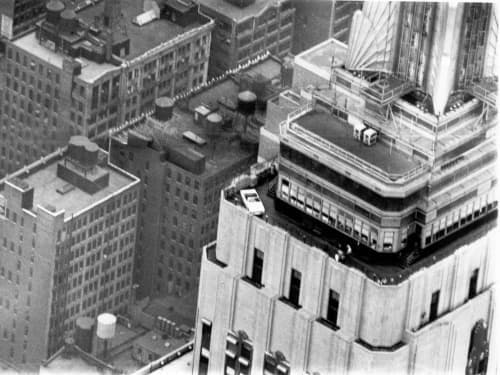
The Mustang was fully reassembled on the outdoor terrace at 4:30 in the morning. A helicopter then flew over the building to take the first aerial photographs of the convertible on the terrace. When the photographers finished at 11 in the morning, the team dismantled the car a second time and reassembled it again inside the glass-enclosed observation room, where it would be displayed to the public.
That means the car was dismantled twice and assembled twice in the same night and morning — all so that a photograph could show it in the open air before dawn, and so that visitors could see it in a safe, controlled environment.
The impact
14,000 people on the first day. Five months in the sky.
Visitors to the Empire State Building were pleasantly surprised to find the Mustang enjoying the views alongside them. Many assumed the car had been lifted by helicopter, not transported in an elevator.
The feat worked beyond all expectations. More than 14,000 people went up on that first day alone to see the Mustang on the 86th floor. The car remained in the Empire State observation deck for five months — until 16 March 1966, when it was dismantled for the last time and removed from the building.
The effect on sales was real and measurable. In 1966, Ford sold 607,568 Mustangs — the best sales year in the model's history, a record that still stands to this day.
The story of the Mustang in the Empire State is a marketing story that worked because it was genuinely difficult. It was not a simulation or a cheap trick — it was a real Mustang, truly dismantled, truly taken up in an elevator, truly reassembled by real mechanics at the top of one of the most famous buildings on the planet, with the Manhattan wind blowing at 65 km/h at four-thirty in the morning.
And the steering column, of course, arrived one quarter of an inch too tall. Because if everything had gone perfectly from the start, there would have been no story to tell.