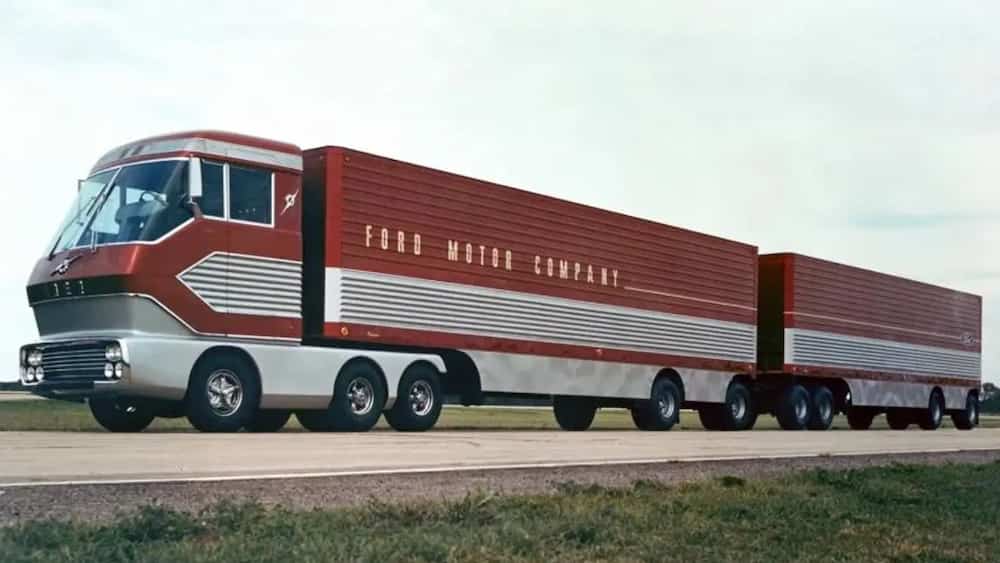
Imagine a truck 13 metres tall and 29 metres long with trailers, powered by a military aircraft gas turbine, with hot and cold running water in the cab, a bathroom, a television, and air-ride suspension adjustable from the driver's seat. In 1964. And the same year they presented it to the world, they also presented the Ford Mustang — and nobody remembered the truck.
The context
1964: the year Ford wanted turbines in everything
While turbines are common in military tanks, helicopters and commercial aircraft, their use in production automobiles has been quite limited. However, Ford dedicated approximately two decades of research starting in the 1950s to making that possible.
The gas turbine race of the 1960s was one of the great technological bets of the American industry. Chrysler built 55 turbine cars and loaned them to ordinary citizens for road testing. GM had built the Firebird concept cars with turbines at the Motoramas. And Ford was developing its own turbines under military contracts, testing them in long-distance line buses and parts transport fleets between Michigan and Ohio.
The Big Red was the showcase of Ford's efforts — a massive 96-foot semi-truck powered by a 600-horsepower turbine.
The project was led by Roy Lunn at Ford's Scientific Research Laboratory. Lunn was no stranger — he was the same engineer who had directed the Ford GT40 programme, the car that would win Le Mans four consecutive times. Applying that same level of ambition to a freight semi-truck was exactly the kind of challenge Ford wanted in 1964.
¿Cómo se ve en la
vida real?Ver en TikTok▶❤️💬🔗TV@LlantaPinchadaTVThe 1964 Ford Big Red: the aircraft turbine truck they presented alongside the Mustang — and that disappeared for 30 years 🚛✈️ #FordBigRed #Turbine #WorldsFair #Engineering
Disponible en nuestra comunidad vertical
"This truck is a concept vehicle from our product research office. It is a test bed in which advanced engineering ideas are demonstrated in actual road operation." — Charles H. Patterson, Ford Executive Vice President, 1964
The turbine
A war engine in a road truck — and Chrysler doing the same with cars
The Big Red was powered by a 600-horsepower Model 705 turbine originally developed by Ford for the US Army. It was not an engine designed from scratch for trucks — it was military technology adapted for the road. The same principle that had powered Army helicopters and armoured vehicles now had to move 10 tonnes of tractor plus two loaded trailers along America's highways.
The 600 hp gas turbine engine powering the Big Red was developed and produced by Ford under a contract with the Department of Defense.
The advantages of the turbine over diesel were real and significant for the era: fewer moving parts, less maintenance, extraordinarily smooth operation without the vibrations of a multi-cylinder diesel. Unlike other engines, the turbine was silkily smooth, vibration-free — to the point that when the programme was cancelled years later, the turbines found their place as power units on offshore oil platforms.
The problems were equally real: brutal fuel consumption, a limited power range, extreme exhaust temperatures, and the compressor noise that fighter pilots know well but that road truckers had never experienced.
According to some sources, the Big Red consumed around 2 miles per gallon. With a range of approximately 600 miles, it needed to refuel with a frequency that diesel trucks of the era comfortably surpassed.
The cab
Fibreglass, running water, television and aircraft suspension
The cab design was made of fibreglass, a lightweight material. The fibreglass design was independently mounted and featured the body frame along with an air conditioning unit for the driver and passengers. The truck's interior was steel and could accommodate two passengers.
But the Big Red's interior was not simply functional. It was deliberately spectacular: the design was based on wind tunnel data and offered air-ride suspension. A full kitchen with hot and cold running water was included, along with a bathroom and television.
It was Ford's vision of how an American trucker would live in the near future — with the comforts of a moving apartment. The cab was so tall that it included a side access ladder. From that height, the forward visibility was extraordinary — fair visitors who climbed up to see it from inside described the feeling of piloting an aircraft above the road.
The cross-country trips
A bridge too low, a radio, and six men deflating the tyres
After its debut, the experimental truck made several cross-country trips to demonstrate operating costs comparable to a traditional diesel engine.
During the 1964 cross-country demonstration tour, the Big Red travelled with a 1965 Ford Mercury station wagon as an escort vehicle, whose occupants transmitted directions to the truck driver via a two-way radio. While passing through an unspecified town, a communication misunderstanding sent the Big Red down a narrow street that ran under a bridge that was literally too low for the enormous vehicle.
The bridge was blocking the path and there was no way to reverse a 96-foot combination on a narrow street. "The driver stopped the truck before the bridge, which created a traffic jam. There was no way to back up the Big Red. The six men got out, deflated the air bags to lower the truck about four inches so it could pass under the bridge," recounted the current owner. "The stringers under the bridge had large metal nuts on the bottom that the driver needed to avoid, so he had to carefully manoeuvre the truck under the bridge between the metal nuts."
The scratch on the cab roof that manoeuvre left was still visible decades later when the current owner found it. It was the signature of that trip — the physical memory of six men kneeling on the asphalt of an American town, deflating the air bags of the largest truck Ford had ever built so it could pass under an ordinary bridge.
The disappearance
Atlanta, 1970 — they drain the oil and nobody starts it again
In 1970 it was on display at The Omni in Atlanta, at a large auto show. And to be on display, they had to drain all the fuel and all the oil from the vehicle. Nobody started it again after that.
It was the beginning of the end. Environmental regulations were tightening. Turbine production costs proved prohibitive. Gas turbine regulations varied state by state, making national homologation virtually impossible. The three problems that prevented Ford's top executives from manufacturing the Big Red in 1964 were: 1) new American environmental regulations, 2) enormous production costs and 3) different requirements for gas turbines across different states.
The truck passed to Holman-Moody — Ford's legendary racing team based in Charlotte, North Carolina, which had prepared the Le Mans-winning GT40s. Holman-Moody had the vehicle in a storage hangar in Charlotte through at least the late 1970s. This is supported by photographs and numerous eyewitness accounts, plus a brochure where it was actually listed for sale as a surplus item.
Then it disappeared. Completely. For decades.
The rediscovery
The Drive found it in 2021 — in a private garage in North Carolina
The Drive began an investigation to track down the Big Red. The last documented public appearance showed it in Holman-Moody's hands, parked in a storage hangar in Charlotte. What had never been clear was how the Big Red ended up in Holman-Moody's hands in the first place, and what happened afterwards.
What they found was, by all accounts, astonishing: the Big Red survived precisely because it escaped Ford's control just long enough to reach private hands. Manufacturer concept cars normally end up destroyed — Ford had a policy of scrapping its prototypes to prevent them falling into competitors' hands or causing legal problems. The Big Red escaped that fate by chance.
As for the Big Red's two original trailers, they have not yet been located. The tractor itself is apparently in immaculate condition and sitting in a custom-built garage, but has not been driven since 2000. The owner said he might be willing to take some updated photos of the famous Ford turbine semi, and admits that perhaps it should be on display at The Henry Ford.
The legacy
The turbine that worked on oil platforms — and the truck that survived everything
When Ford hired new staff in 1973, the Heavy Truck Engineering Division was still developing the next-generation turbine truck. The programme was shelved a year later, but the Ford turbine found its usefulness on oil platforms as power units since, unlike other engines, the turbine was silkily smooth, vibration-free.
The story of the Ford Big Red ends — for now — in a North Carolina garage, with a restored truck that has not been driven since 2000 and two trailers nobody has been able to locate. It is one of the largest objects ever "lost" in automotive history: 96 feet of gas turbine semi-truck with running water and television, missing for three decades in the America that had applauded it at the 1964 World's Fair.
The same year the Ford Mustang permanently changed the automotive industry, Ford also presented this. And the world chose the Mustang.