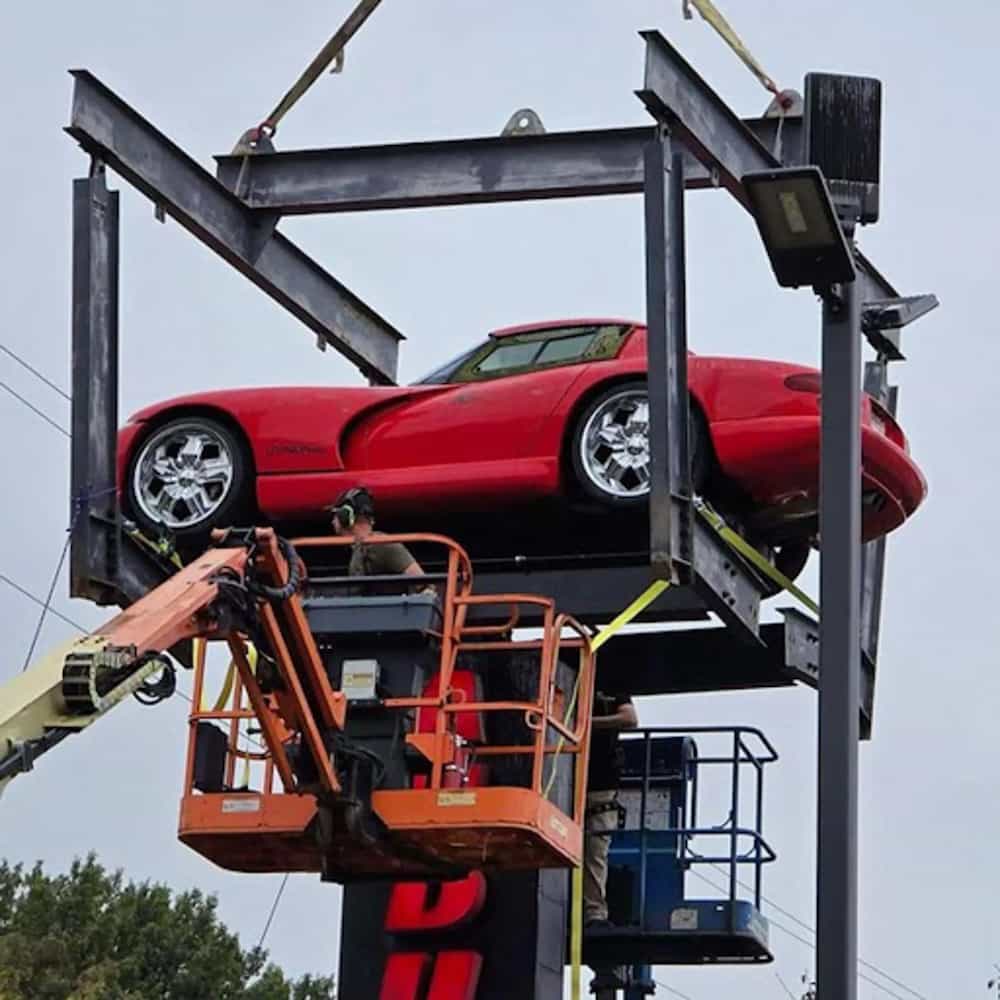
Imagine buying a new car with 12 miles on the odometer, hoisting it nine metres above a highway, plugging it into the mains so the lights work — and leaving it there for three decades. Through rain, sun, snow and birds nesting in the engine block.
```label The car ```
The 1996 Viper RT/10 — the most brutal American sports car of its era
To understand why a Kentucky dealership decided to hoist a Dodge Viper nine metres into the air rather than sell it, you need to understand what a Dodge Viper was in 1996.
The first Viper concept debuted at the 1989 Detroit Motor Show. The aluminium V10 showed its involvement with Lamborghini — which at the time was working under Chrysler's ownership — in the cooling system, crankshaft balancing, weight reduction and fine tuning. The result was an engine unlike anything that had come out of Detroit before.
A major refresh in 1996 raised power to 415 hp and torque to 488 lb-ft, thanks to a new Jeep-Truck powertrain controller with OBD II, a revised camshaft and higher compression. The updates included relocating the exhaust to the rear — eliminating the distinctive side exit of the first generation —, a reinforced driveline, forged aluminium wheels, a better-sealing convertible top and fully aluminium suspension components.
The 1996 version of the RT/10 is sometimes considered by the Viper community as "generation 1.5", as it incorporated parts from the second generation while retaining elements of the first.
The car had no ABS. No traction control. No assistance of any kind between the V10 and the tarmac. It was a true hero and poster car. One of the few American cars with a V10 engine. In 1996 it cost $58,600 — nearly double what a Corvette of the same era cost.
```tiktok https://youtu.be/pWKbAVL21Mg @LlantaPinchadaTV The Dodge Viper that spent 28 years on a pole with 12 miles on the odometer — and a bird's nest in the V10 🐦🐍 #DodgeViper #Kentucky #History #Engineering https://res.cloudinary.com/db3veuotr/image/upload/v1777379757/image_26_rxluup.jpg ```
"We thought it was a replica. It was a real, functional Viper, with the V10 inside. It had been up there for 28 years." — US-41 drivers, upon learning of the 2024 descent
```label The decision ```
Why hoist it instead of selling it
In May 1996, Audubon Chrysler had a brand new Dodge Viper RT/10 in its inventory. And it decided to do something very different. Rather than selling the Viper on the sales lot, the Kentucky dealership decided to use it to attract business in a different way. So Audubon Chrysler hoisted the Dodge Viper onto a thirty-foot pole outside the dealership.
The man who put it up there also placed a Chevrolet Corvette sixty feet up at a location in Indiana. It was not the first time anyone had used a car as a giant sign. It was the first time anyone had used a Viper RT/10 for it.
The Audubon Chrysler dealership in Henderson, Kentucky, installed a first-generation Dodge Viper R/T on an elevated platform high above the rural dealership. And left it there ever since.
The logic was straightforward: Highway US-41 runs right in front of the dealership. Thousands of drivers travel it every day. A red Viper nine metres up, visible for kilometres, was a billboard no agency could design. It was also completely free in advertising terms — the car was already paid for.
```callout The Viper's electrical system was adapted for life at height: the front, rear and position lights were reconnected to the pole's 110-volt mains supply. That way the sidelights and headlights worked without a 12-volt battery that would need replacing. From the highway, at night, the illuminated Viper nine metres up looked like a car flying above Henderson. ```
```label 28 years of exposure ```
What time, rain and birds did to the V10
The V10 sports car's wheels had only touched the ground once in 28 years, and that was for a touch-up fifteen years earlier. On that first descent, in 2009, the car received its first service and its original wheels were swapped for aftermarket chrome units popular at the time.
When it came down for the second time in November 2024, the condition told the story of three decades outdoors in Kentucky.
The images of the second iteration of the first-generation RT/10 acclimatising to life at lower altitude in Audubon's lot serve as a reminder of why most owners of nice cars do not leave them outside, even in states that experience less extreme weather conditions.
The bright red paint had started to bubble and peel, while the tail lights had caved inward. The window frames had turned green over all these years.
And then there was the engine. The hardest part of the task may be cleaning out the engine compartment. It seems several birds decided to build nests inside the recesses of the car's 8.0-litre V10 over the years.
Inside the car the interior was found full of mould. A complete bird's nest had managed to develop inside the engine compartment. Vegetation, mud, branches, and the structures of at least one active nest — all of it lodged inside the V10 block that in 1996 produced 415 horsepower.
A dealership employee named Alec Girvin confirmed that the car was completely new when it first went up in 1996 and had only 12 miles on the odometer. Those 12 miles remained the same when it came down, 28 years later.
```label The restoration ```
From bird's nest to bright red — and back up the pole
Fortunately, Henderson's sky-bound Dodge Viper could be revived. It was sent to Keen's Auto Body and Paint to revitalise the red paint finish.
Keen's Auto Body and Paint got to work giving the famous "Viper in the Sky" a fresh coat of paint. "This iconic vehicle, which has attracted attention from all over, is receiving a fresh, professional repaint by our expert team," the workshop declared. "Not every day do you get the opportunity to give new life to a car with so much history and visibility."
After its "stunning red makeover", the Dodge Viper is expected to look fiercer than ever back in its commanding position above the town.
The dealership's plan was clear from the outset: restore the car and send it back up. Once the restoration is complete, the model will return to the top of the dealership pole. It will probably remain parked up there for another thirty years before the dealership decides to bring it back down to earth again.
```label The legacy ```
The Viper that was never sold, never driven, and never forgotten
There is something profoundly American about this story. A dealership in a Kentucky town of fewer than 30,000 people decides that the best use for a $58,600 supercar is not to sell it — but to turn it into the most recognisable visual landmark in the county. And it works.
Over the years, the iconic car has become a sort of beloved local landmark. After being in the sky for nearly three decades, locals had various theories about what was inside. The most common: that it was a fibreglass replica, an empty shell in the shape of a Viper with nothing inside. Motorists who saw it thought it was just an empty shell, but they were wrong. It was, in fact, a fully functional car at the time it was hoisted.
The Henderson, Kentucky, Viper never accelerated from zero to sixty miles per hour in 4.1 seconds. Never used its 488 lb-ft of torque to flatten a motorway on-ramp. Never spilled a drop of oil through a tight corner. It did something different: it became a monument. The only Dodge Viper in the world that everyone in Henderson knows, even though none of them have ever driven it. The car with 12 miles on the odometer that spent 28 years looking down from above at the same highway other Vipers were screaming past on.
And when it came down in 2024, the first thing it did was remind everyone why it had worked as a monument: because it was a real Viper, with a real V10 inside, and very real bird nests as well.