Imagine a motorcycle engine where each valve has not one but two cams and two rocker arms — one to open it, one to close it mechanically. No springs. No dependence on metal elasticity. With mathematical certainty that the valve will be exactly where the engine needs it to be, at any rev.
The problem that created it
Why valve springs have a physical limit
In any four-stroke engine, the pistons rise and fall driven by combustion. The valves — small metal doors in the cylinder head — open to let in the air-fuel mixture and then to let out the burnt gases. The camshaft, driven by the crankshaft, pushes each valve open. A steel spring returns it to its closed position when the cam no longer pushes it.
This system works perfectly... up to a certain rev limit.
In conventional four-stroke engines, valves are opened by a camshaft but rely on spring pressure to close. This works well for most uses, but the limitations appear when the engine is pushed increasingly to its limits.
The problem is called valve float. As the engine spins faster, the camshaft completes more revolutions per second. A point is reached where the cam has already advanced to its next position before the spring has finished closing the valve. High-speed photography showed that at specific resonance speeds, the valve springs were no longer making contact at one or both ends, leaving the valve floating before crashing against the cam on closure.
The consequences are serious: the valve does not properly seal the combustion chamber at the moment of ignition, pressure drops, the engine loses power. In extreme cases, the piston rises and strikes the still-open valve — an instantaneous mechanical catastrophe.
In the 1950s, metallurgy did not allow springs to be manufactured that could withstand those oscillation frequencies at high RPM. The metallurgy of the era limited valve spring resonance from operating at high RPM; the moving parts of the combustion engine literally exceeded the ability of valve springs to return valves to the closed position before the piston reached top dead centre.
¿Cómo se ve en la
vida real?Ver en TikTok▶❤️💬🔗TV@LlantaPinchadaTVDucati's desmodromic system: why they eliminated valve springs in 1956 and why 70 years later they are still the only ones 🏍️🔧 #Ducati #Desmo #Engineering #MotoGP
Disponible en nuestra comunidad vertical
"Why use springs? Let's use a second cam." — The logic of Fabio Taglioni, 1956
Taglioni's solution
Two cams, two rocker arms, zero springs
In the late 1950s, Ducati engineer Fabio Taglioni looked at this problem and thought: why use springs at all?
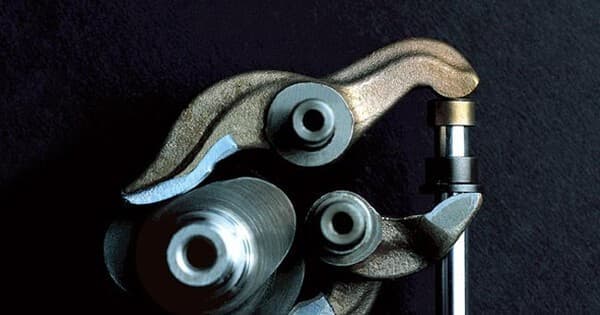
His desmodromic system — from the Greek desmos (controlled) and dromos (course) — uses a second set of cams and rocker arms to close the valves mechanically rather than relying on springs. Think of it as having someone actively pulling a screen door shut instead of letting the spring do it. The valve opens. Then it closes actively and positively. No float. No uncertainty. Just mechanical certainty.
The specific components of the system are: in a desmodromic system the camshaft has two lobes for each valve — one to open it and one to close it. The rocker arms are the mechanical levers that transfer movement from the cams to the valves. In the desmodromic system there are two rocker arms per valve — one for opening and one for closing.
The advantages of the system go beyond simply being able to rev higher. In early experiments they discovered that in addition to the higher achievable RPM, there was greater efficiency in the dispersal of burnt gases, as well as the production of greater torque at low engine RPM. The precise control of opening and closing allows the cam profile to be optimised for both opening and closing — something that with springs was only possible for opening, since closure was at the mercy of the spring's elasticity.
The man behind the system
Fabio Taglioni: the engineer who turned down Ford to go to Ducati
Born in 1920 in Lugo di Romagna, Taglioni graduated as an engineer in 1948. He worked at Mondial in the early 1950s, and when he had a disagreement with management, offers soon arrived from Ford and Ducati. Ford's was certainly more lucrative, but Ducati offered something Ford could never offer: autonomy and the opportunity to build a racing team.
Taglioni went to work at Ducati as head of design and technical director in 1954, and worked there until 1989 — the first of a series of decisions that ignored money in favour of doing what he wanted to do.
The context of his arrival was critical. Ducati's managing director Giuseppe Montano sought out Fabio Taglioni, a young and talented engineer, and said: "I know your talent and I need you. If you build 100 motorcycles to win the Tour of Italy, Ducati will stay open, because I only have one month's wages for my workers. If not, we close and everyone goes home."
Taglioni did not just build the hundred bikes. In 1956 he designed Ducati's first desmodromic application: a 125cc single-cylinder engine for competition under Taglioni's guidance as the company's chief engineer.
Ducati's 125 GP Desmo won the Grand Prix in its class in 1960 — and the desmodromic system has been fully adopted by the Bologna brand ever since.
His desmodromic V-twin design continues to be used in all current Ducati motorcycle engines. Among the many victories of his early desmo twin, Mike Hailwood's legendary comeback at the Isle of Man in 1978 is perhaps the most memorable. Fabio Taglioni died in Bologna in late July 2001, aged 80.
The story nobody tells
Ducati did not invent the desmodromic — but it was the only one that survived with it
The first 1914 Delage Grand Prix and the Nagant used a desmodromic valve system. In 1925, Spanish engineer Wifredo Ricart obtained patent FR590149 for a similar valve actuation mechanism. A later version of the Daimler-Benz inverted V12 had desmodromic valves. The 1954–1955 Mercedes-Benz W196 Formula 1 car, and the 1955 Mercedes-Benz 300SLR, had desmodromic valve actuation.
The technology dates from the 1950s when the desmodromic valve system was adopted — not invented — by Ducati.
What Taglioni did differently was not to use it as an emergency solution in a racing car that would last a single season. He refined it until it was reliable, applied it to mass production in 1968 — with the 450 "widecase" single-cylinder in the Scrambler — and Ducati applied it consistently in high-end production motorcycles from 1968 onwards. Mercedes used it in the W196 and then abandoned it after winning the championship. Ducati adopted it and never let go.
Maintenance — the price of mechanical certainty
Why the desmodromic demands more attention and costs more money
The desmodromic system is not free in either time or money. With two rocker arms per valve instead of one, the number of contact and wear points doubles. Clearance adjustments are more demanding. And the most practical consequence for the owner is that valve service intervals are significantly shorter than in a conventional engine.
When Ducati launched the Multistrada V4 in 2021, they broke with tradition. They used conventional springs. The engine required service intervals of 37,000 miles instead of 15,000. Owners loved it. But did it feel like a real Ducati? That is the question the company is still grappling with.
Today, valve spring technology has largely eliminated the valve float problems of old. The main benefit of the desmodromic system — the prevention of valve float at high RPM — no longer justifies its additional complexity for normal road applications.
The future of the Desmo
The end of an era or the confirmation of an identity?
From a functional perspective, modern technology has almost entirely eliminated the valve spring problems of old. The additional weight and complexity of the desmodromic system do little to justify its use today except for its heritage.
And yet. Ducati is the only manufacturer in the world to have applied the desmodromic system from standard production bikes to Superbike and MotoGP machines. Ducati motorcycles with desmodromic valves have won numerous races and championships, including Superbike World Championships in 1990 to 1992, 1994–96, 1998–99, 2001, 2003–04, 2006, 2008 and 2011.
Is it rational? Not entirely. Is it Ducati? Absolutely.
The desmodromic is not just a valve timing system. It is the reason a Ducati sounds different, needs different maintenance, and has a different relationship with its mechanics than any other motorcycle. It is the testament in metal that in 1954, a young engineer from Bologna turned down an offer from Ford to go and work at a company on the brink of closure — and decided that if he was going to build an engine, he would do it the way nobody had done it before.