Imagine a car that can be front-wheel drive, rear-wheel drive or four-wheel drive — not because it has a centre differential, but because it has two completely separate engines, each with its own starter, its own tank under the seat and its own gearbox. And it weighs just 710 kilograms. And it was designed to cross the Sahara.
```label The impossible logic ```
Why Citroën could not make a conventional 4×4 — and why two engines was the only answer
The 2CV Sahara was built for French oil prospectors in North Africa who needed something that could handle rougher terrain and climb steeper gradients than the standard 2CV.
The problem was structural. Why did Citroën not simply give it a larger engine with four-wheel drive? The company had no other engine to use in the 2CV at the time, and its existing flat-twin was not capable of handling a transfer case, an additional propshaft and two more driven wheels. So the simplest and most economical way to make the 2CV four-wheel drive was simply to double the engines.
It was not the first time anyone had had this idea. The answer came in clues provided by a handful of Citroën dealers who had experimented on their own building twin-engine, four-wheel-drive 2CVs during the mid-1950s. Private mechanics in France and Algeria had independently discovered that fitting a second engine in the boot was the most elegant solution available. Citroën formalised it.
Together with Panhard — which at the time was owned by Citroën — the first prototype was developed in 1957. After some testing in the Forest of Fontainebleau, the car was presented to the press in March 1958 at Mer de Sable, an area not entirely unlike the Sahara.
```tiktok https://vm.tiktok.com/ZGdHQKJYa/ @LlantaPinchadaTV The Citroën 2CV Sahara: the world's only production car with two independent engines — because there was no money to make a better one 🇫🇷🏜️ #2CVSahara #Citroen #Bimotore #Engineering https://res.cloudinary.com/db3veuotr/image/upload/v1778895905/image_41_fxizuh.jpg ```
"There is no simpler way to make it four-wheel drive than simply doubling the engines. Nobody had done it in mass production before. Nobody has done it since."
```label The engineering ```
An engine mounted backwards in the boot — and a petrol cap in the door
One was fitted at the front driving the front wheels and one at the rear driving the rear wheels. Separate ignition switches control the engines.
The rear engine was identical to the front one — the same 425 cc air-cooled flat-twin that equipped the standard 2CV. The difference was its orientation: mounted in reverse on the same body platform, so that its drive shaft pointed towards the rear wheels rather than the front ones.
To operate the car, it featured two hydraulically controlled clutches, two synchronised four-speed gearboxes and even interconnected carburettors for each engine. Synchronisation was the central technical challenge: two completely independent engines, each with its own carburettor, needed to respond identically to a single accelerator pedal. The carburettors were mechanically interconnected so that the throttle opening of one translated into an identical opening of the other.
There is a separate lever used by the driver to synchronise the two gearboxes. Despite the mechanical complexity of the Sahara, it is as easy to use as a normal 2CV. With both engines running, the driver used the same clutch pedal, the same gear lever and the same accelerator to manage the entire system.
```callout The fuel tanks — two of 15 litres each — were housed beneath the front seats. Not in the boot, which was occupied by the rear engine. Not at the front, which was occupied by the front engine. Under the occupants' seats. The practical consequence was that the filler cap for each tank was in the lower part of each door — the driver opened the door and inserted the pump nozzle directly into the sill. It was the strangest possible solution. It was also the only one available. ```
The two engines could be used completely independently. On the road, you can drive with both engines running giving a top speed of 60 mph. You can also drive with the front engine only but the top speed is reduced to 35 mph. This meant three genuine drive modes:
The driver could start only the front engine — standard front-wheel drive, like a normal 2CV. They could start only the rear engine — rear-wheel drive, useful for specific mud or sand situations where the weight was at the back. Or they could start both — genuine four-wheel drive, with 24 horsepower fighting the Saharan sand.
```label The details that make it the Sahara ```
The spare wheel on the bonnet, the rear grilles and the split tail lights
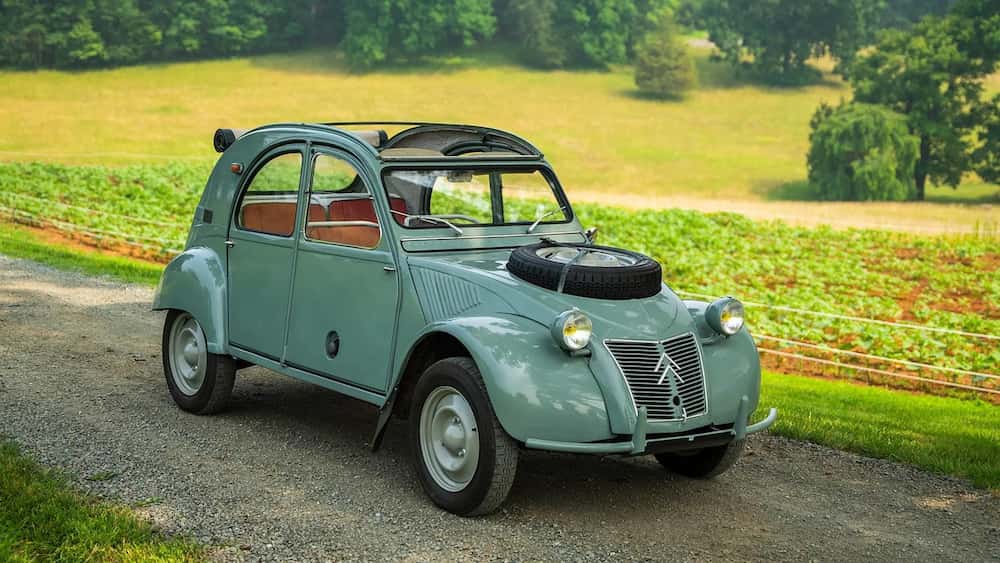
Citroën had to make several body changes to accommodate the new hardware, making the 2CV look even more peculiar. The wheel arches are cut differently and there are louvres in the rear wings to cool the engine. It also has bespoke rear lights flanking the cooling fan needed for the extra engine. At the front, the Sahara 4×4 came with a redesigned bonnet featuring a cut-out for the spare wheel.
The front bonnet with the spare wheel cut-out was the most immediate visual sign that this was not an ordinary 2CV. From the rear, the ventilation grilles in the wings and the rear lights split in two by the engine fan completed the picture of a car carrying more technology than its size suggested.
The chassis was completely different from the production 2CV. It featured not one but two 425 cc, 12 hp flat-twin engines, a special chassis, reinforced suspension, wider wheels, two individual 15-litre fuel tanks under each front seat, and numerous other modifications to enable the car to handle difficult terrain and climates.
The suspension was a reinforced version of the 2CV's interconnected torsion bar system — the same one that made the car "almost impossible to roll over" according to Citroën's official description. In the Sahara, that suspension had to bear the additional weight of the rear engine, its mounting brackets and its auxiliary systems, without sacrificing the characteristic articulation of the 2CV that made it capable off-road.
```label The customers ```
Oil prospectors, the Swiss Post Office and those who could not afford it
From 1960 to 1967, Citroën built just 694 examples of the 2CV 4×4 Sahara, at a time when approximately 200,000 2CVs were sold every year, in both passenger and commercial configurations.
The double price was the first obstacle. The car entered production in late 1960 at double the price of a standard 2CV. In a market where the 2CV was the cheapest and most austere car available, paying double for a more capable but equally small version was a leap that few buyers were willing to make.
Those who did were very specific customers. The Sahara was built for French oil prospectors in North Africa. In Algeria, in Morocco, in Chad, where the oilfields required vehicles that could reach places no conventional truck could reach without road infrastructure — the 2CV Sahara, with its weight of 710 kilograms and its ability to float over soft sand, made sense.
Many were used by the Swiss Post Office as a delivery vehicle. Switzerland had mountain areas where winter postal routes required four-wheel drive but where the road was so narrow and the terrain so technical that a Land Rover or Jeep was excessive. The Sahara, small, lightweight, with its wide wheels and near-perfect weight distribution, was the Swiss answer to that problem. The Swiss Post Offices bought dozens of units and used them for years on alpine routes.
```label The legacy ```
The world's only production twin-engine car — and worth twenty times more than when it was new
Given its novelty, value and rarity, it will probably not surprise veteran 2CV enthusiasts that the 4×4 version is highly prized by collectors seeking the world's only mass-production car with two engines.
Today, a Citroën 2CV Sahara in good condition can fetch between €100,000 and €200,000 at auction — twenty times the price of a restored standard 2CV of the same era. The rarity of 694 units, combined with the uniqueness of being the only twin-engine production car that has ever existed, has made the Sahara one of the most sought-after collector objects in French automotive history.
Due to its light weight of 1,600 pounds and 50/50 weight distribution, it has great off-road capabilities. At its core, the Sahara was a 2CV — with the hammock seats hung from the roof, the spartan cabin and the roll-back canvas roof. What set it apart from the ordinary 2CV was not any luxury technology. It was the same philosophy applied twice: when you do not have enough of something good, put it in twice.
No manufacturer has produced a production car with two independent engines since Citroën stopped doing so in 1971. The Lancia Trevi Bimotore was a one-off prototype. The Citroën M35 was a rolling laboratory sold under special conditions. The Sahara was a catalogue car that anyone could walk into a dealership and buy — for double the price of a normal one.
You just had to fill two tanks. Through two different holes. In the doors.