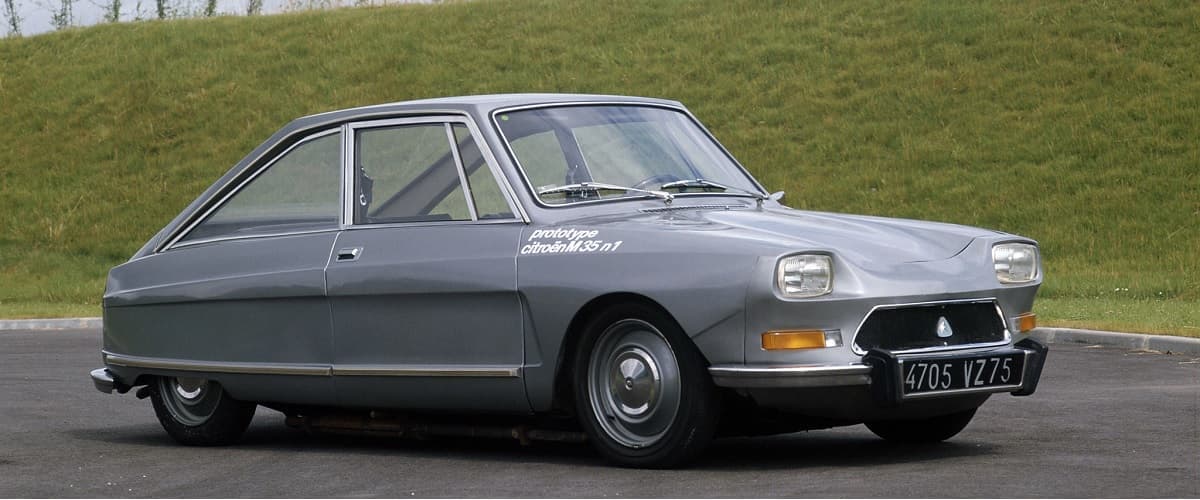
Imagine receiving a letter from Citroën telling you that you have been selected from among their best customers to buy a unique prototype with hydropneumatic suspension and a rotary engine, on the condition that you drive it a great deal and report all problems. And that on the rear window there is a sticker reading: 'This M35 prototype with rotary piston engine is undergoing extended testing in the hands of a Citroën customer'.
The bet nobody else made
Comotor: the company that made surfboards instead of Wankel engines
Pierre Bercot, Citroën's managing director and chairman from 1958 to 1970, thought the Wankel looked like the future and signed a joint venture called Comobile with NSU in 1964. A manufacturing joint venture, called Comotor, followed in 1967, with a factory in Altforweiler, near the Luxembourg border. Initially 25 rotary engines were to be produced there each day and, after a planned expansion, up to 500. To put it briefly: this never happened. On occasion, surfboards were manufactured at that plant.
Comotor's failure as a full-scale factory was not due to lack of will. It was because between 1967 and 1969, Citroën's engineers worked at NSU to learn rotary engine technology. And what they learned was not reassuring. The rotor apex seals — the same problem that sank the NSU Ro 80 — remained a challenge without a definitive solution. The engine consumed oil like a two-stroke. The spark plugs fouled easily.
In 1969, NSU went bankrupt and was bought by Volkswagen. Citroën found itself forced to continue the Wankel adventure alone.
The decision Pierre Bercot took in that scenario was extraordinary: rather than waiting to solve the problems in the laboratory, he would solve them on the road. With real customers. In their daily-use cars. And with sufficient honesty to admit it on the rear window sticker.
¿Cómo se ve en la
vida real?Ver en TikTok▶❤️💬🔗TV@LlantaPinchadaTVThe Citroën M35: the car Citroën sold to its best customers to use them as guinea pigs — then destroyed 🇫🇷🔧 #Citroen #M35 #Wankel #Engineering
Disponible en nuestra comunidad vertical
"Ce prototype M35 à moteur à piston rotatif est en essai longue durée entre les mains d'un client Citroën." — Sticker on the rear window of every M35: "This M35 prototype with rotary piston engine is undergoing extended testing in the hands of a Citroën customer"
The engine
A Wankel that spun so smoothly the driver did not notice the limit — until the alarm sounded
The engine was calibrated to have a displacement of 497.5 cc — equivalent to 995 cc under the rules for rotary engines — to qualify for the advantageous French tax classification of 6CV. It was a fiscal optimisation as much as a technical one: a rotary engine equivalent to 995 cc of a conventional engine paid the same tax as a small utility car.
The bodies were manufactured by Heuliez between 1969 and 1971. The longitudinally mounted rotary engine had a nominal displacement of 498 cc and delivered 49 hp and 68 Nm of torque. First driving impressions highlighted the extreme silence of the Wankel engine, quite good acceleration, and excellent flexibility, with a top speed of 150 km/h.
The rotary engine proved very free-revving, spinning so easily that an alarm had to be installed when engine speed exceeded 7,000 rpm. It was the same problem that afflicted the NSU Ro 80: with no vibrations or noise to warn the driver, the Wankel climbed through the rev range without the driver's right foot being able to feel it. Drivers passed the limit without realising. The alarm was not a luxury — it was an engine safety necessity.
Operation M35
500 cars promised, 267 built, 30,000 km minimum per year
Comotor wanted to use this model to introduce rotary engine technology in France and identify potential problems before the start of mass production at the new factory. Therefore, 500 units were to be sold to regular Citroën customers whose driving profile showed high annual mileage.
Only 267 units were built of the 500 planned, sold exclusively in France to private customers who were required to drive at least 30,000 km annually for the endurance testing.
The price of the M35 was equivalent to that of the ID19 — Citroën's large mid-to-upper-range saloon. It was a very high price for a compact two-door coupé based on an Ami 8, but the customers were not buying a pleasure car. They were buying the privilege of being part of an experiment. Every M35 left the Heuliez factory painted in metallic grey. The interior was in black synthetic leather. No colour options, no personalisation. It was a rolling laboratory with number plates.
Inscriptions on the wings are found on all M35 models, along with the rear window sticker indicating "This Citroën M35 prototype with rotary engine is undergoing extended testing in the hands of a Citroën customer."
The design
The smallest hydropneumatic suspension in Citroën history — and the seats that ended up in the SM
It is the smallest car with hydropneumatic suspension ever built by Citroën. Also the first of a very short line of rotary-powered Citroëns. And being based on the Ami 8, it can trace its structural lineage back to the 2CV.
The body was designed by Heuliez starting from the Ami 8 platform, but with very few components in common with the production car. The M35 shared only the front wings with the Ami 8 — practically everything else was exclusive to the model.
The result was a smooth-lined two-door fastback coupé with a futuristic appearance, with a single circular central headlight as its most distinctive frontal feature. The silhouette was low and aerodynamic by 1969 standards — something no production Ami 8 could ever have suggested.
The rotary engine was deemed satisfactory and in 1974 a twin-rotor version was used in the GS Birotor. The gearbox used in the M35 was that of the GS 1015. Certain suspension parts made their way to the GS line when it was introduced in 1970, and the seats that reclined just above waist level were used in the SM.
The M35 was not just a prototype consuming itself — it was a generator of components that ended up in the cars that followed it. Its seats in the SM. Its suspension in the GS. Its engine in the GS Birotor. It was a car that dissolved into useful parts for others.
The end
Generous buyback, mass scrapping, signing away the right to spare parts
When Citroën's experiment came to an end in 1971, the company did not want to bear the cost of supporting the cars, so it offered owners generous compensation towards a new alternative, which most accepted — unsurprisingly, given that few of the rotary engines went beyond 40,000 miles without needing a rebuild.
Tragically, the returned M35s were scrapped, although around 100 are estimated to have escaped the crusher. Those who kept their car had to sign an agreement that Citroën would not be required to stock spare parts for them. They had been brave to buy them, and were even braver to keep them.
Of the 500 M35s that Citroën claimed to have built (each car had a number written on the wing to validate this figure), it appears only 267 were actually built. And only around thirty of them are thought to have survived to the present day, having miraculously escaped the scrapyard.
One of those survivors has a particularly dramatic story: M35 chassis number 00 EA 0061 was offered to a Mr H., a very loyal customer of the brand, in the early 1970s, perhaps at the very moment the cars were being called in for destruction, as he received it at Citroën's factory in Aulnay, and was given it... without registration documentation. He was even stopped by the gendarmerie, more intrigued by the vehicle than by his papers, when returning to his native Maine-et-Loire. On arriving at his destination, Mr H. stored the M35 in a shed, from which it did not emerge until May 2021, after fifty years of sleep.
The legacy
What the M35 gave Citroën — and what it cost
The experience gained from the M35 was incorporated into the GS Birotor, of which 847 units were built.
The technical lessons were concrete: the apex seals needed better materials. Fuel control needed greater precision to avoid fouled spark plugs. The oil cooling system needed greater capacity. The Wankel's narrow power band in road applications needed to be compensated for with more specific gearbox calibration.
But the cost of those lessons was enormous. Those costs also contributed to Citroën's acquisition by Peugeot in 1974. Comotor, the joint venture whose factory had once made surfboards instead of engines, had consumed resources that Citroën could not afford to waste.
Citroën pressed on. A compact family saloon with hydro suspension and a rotary engine certainly sounded attractive, and the Ro 80 had demonstrated how well the Wankel suited a larger, more luxurious car. The CX would have had a triple-rotor engine if the initial plans had prospered. But Peugeot arrived, the oil crisis arrived, and Citroën's rotary programme closed for good.
Mazda continued where Citroën stopped. Its triple-rotor Renesis engine powered the RX-8 until 2012, and won the International Engine of the Year award in 2003, after Mazda's engineers conquered the Wankel's problematic low-speed operation and the notorious rotor seal problems.
The same problems that the M35 documented in 267 cars, in the hands of 267 French drivers covering at least 30,000 km per year. The same problems that Citroën recorded, analysed and then buried alongside the cars in the scrapyard.