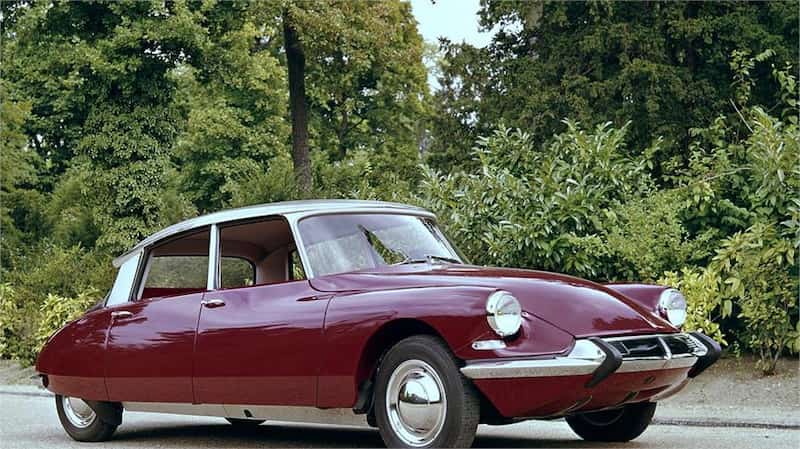
Imagine a car that can freely change its height — from 9 to 28 centimetres — while driving. That brakes with a mushroom-shaped button instead of a pedal. That cannot be stranded by a puncture because the hydraulic system keeps the car level even with a burst tyre. And that is built with panels that simply bolt onto an inner skeleton, like aircraft components.
The two men and the wartime employee
André Lefèvre, Flaminio Bertoni — and Paul Magès, who was not an engineer
This wonder of automotive design was created by two men and their teams. Both were originally recruited by André Citroën and designed the Traction in 1934. André Lefèvre was an engineer, while Flaminio Bertoni was a draughtsman and sculptor.
Lefèvre was the technical brain — the same one who had conceived the front-wheel drive and monocoque body of the Traction Avant at a time when no other mass-production manufacturer offered them. Bertoni was the Italian artist who had given the Traction Avant its flowing lines and who now, twenty years later, was again proving that the shape of a car can be a work of art without ceasing to be pure function.
But the most revolutionary element of the DS came from neither of them. It came from a man almost nobody has heard of.
During the Second World War, Paul Magès, a Citroën employee with no formal engineering training, secretly developed the concept of an oil-and-air suspension to combine a new level of smoothness with vehicle control and self-levelling.
Magès was not a trained engineer. He was a Citroën employee with an obsessive idea: replace steel springs with pressurised spheres filled with gas and hydraulic fluid. He worked on the concept during the years of the Nazi occupation, in secret, with whatever resources he could find. What he delivered when the war ended was the system that in 1955 would make the DS incomprehensible to anyone seeing it for the first time.
¿Cómo se ve en la
vida real?Ver en TikTok▶❤️💬🔗TV@LlantaPinchadaTVThe 1955 Citroën DS: 12,000 orders on the first day, De Gaulle survived an assassination attempt, and Rolls-Royce copied its suspension. The story of the most advanced car of the twentieth century 🇫🇷🚗 #CitroenDS #Engineering #History
Disponible en nuestra comunidad vertical
"Even today, if a manufacturer made a car as advanced as the DS was in 1955, it would be from another world. No company has ever put so much technology into a mass-production car." — Reader at AteUpWithMotor, DS owner
The suspension
Nitrogen, oil at 165 bar and spheres that replaced the spring and the damper
The DS used the fundamental scientific principle that a gas is much easier to compress than a hydraulic fluid, applying it through the use of spheres that replaced the traditional assembly of steel spring and damper. Each sphere was pressurised, with the upper half filled with nitrogen gas and the lower half filled with hydraulic fluid, separated by a rubber membrane. The DS used one sphere per wheel, along with an accumulator sphere that held an additional reserve of hydraulic fluid and helped equalise pressure across each sphere. A piston connected each sphere to the wheel.
The physics of the system was elegant: when the wheel hits a bump, it rises. That movement pushes fluid into the sphere. The fluid compresses the nitrogen gas. The gas, compressed, returns the force — but progressively, continuously, without the sharp rebound of a metal spring. The bump's energy is absorbed in gas, not steel.
In the DS, a 7-piston hydraulic pump driven by the engine's belt provided pressure to the specially developed LHS fluid, which not only actuated the suspension but also the power steering, the brakes and the gearbox and clutch assembly.
A single hydraulic system at 165 bar — like an aircraft — governed everything: the suspension, the brakes, the steering, the clutch. If the pump failed, the car lost everything simultaneously. But when it worked, it worked like nothing any driver in 1955 had experienced before.
The DS could have a ground clearance of between 9 and 28 centimetres. The driver could raise the car to cross a dirt track, lower it to reduce aerodynamic drag on the motorway, or use the minimum position to change a wheel without needing a jack. Its self-levelling capability meant the DS was also one of the first cars that did not require a jack to change a punctured tyre.
The brakes, the steering and the steering wheel
A rubber button on the floor, a single-spoke wheel and a transmission with no pedal
Rather than a conventional lever-type brake pedal, the DS's brakes were actuated by a mushroom-shaped button that could be pressed. The greater the pressure applied, the greater the braking force. However, adjustment was required on the part of drivers due to the slightly different response compared to a regular pedal.
The "mushroom button" was a direct consequence of the hydraulic system: the brakes responded to applied pressure with such sensitivity that a conventional pedal would have been excessively abrupt. With the button, braking force was perfectly proportional to foot pressure. So sensitive was the system that the DS's brakes stopped the car in distances that astonished drivers of the era — the DS 19 braked so effectively that even some experienced drivers were confused when they first encountered the new model.
The DS's steering wheel is famous for its single spoke, which rather than being different for its own sake also provided a safety benefit. Typical steering wheels of the era used a straight central column which, in a frontal impact, risked impaling the driver. The DS design used a hollow spoke that curved away from the driver, so that in a collision it would be more likely to slide over the body.
The transmission used a hydraulic clutch and a gear change that created a semi-automatic transmission, practically unheard of in 1955. In practice, this meant that although the driver had to change gears manually and slightly ease the accelerator when doing so, there was no heavy separate clutch pedal and the car could not stall.
The assassination attempt
August 1962: over 100 bullets, four burst tyres — and De Gaulle reached the airport
The DS proved its worth as a divine omen of good fortune when it helped French president Charles De Gaulle survive an assassination attempt in August 1962. Despite a rain of over 100 bullets that burst all four tyres, the DS was able to speed away to safety thanks to its innovative suspension system.
The Petit-Clamart assassination attempt was the most elaborate of the conspiracies against De Gaulle — a group of OAS members opened fire on the presidential DS with automatic weapons from the roadside. The driver, Francis Marroux, floored the accelerator. With four deflated tyres, the DS did not lose control. The hydropneumatic suspension kept the car level and stable. They reached Villacoublay airport.
Roland Barthes had written in 1957 about the DS in his book Mythologies, comparing it to the great Gothic cathedrals — objects consumed with the eyes by an entire nation. The 1962 assassination attempt turned that metaphor into literal fact: the DS had physically saved the Republic.
The body
Bolt-on panels, fibreglass roof and aluminium bonnet — in 1955
The DS was innovative in every aspect of its design, from its aerodynamic body to its unusual construction, with exterior panels bolted to an inner "skeleton"-type base unit. The hydropneumatics were the key technical feature, but other novelties included inboard front disc brakes, a special front suspension designed to improve stability, and the extensive use of many different types of plastic.
The DS also used cutting-edge materials in its construction, including aluminium for the bonnet and plastic for the roof. The fibreglass roof — lighter than steel, no risk of rusting, with better thermal properties — was an engineer's choice applied to a family saloon. The aluminium bonnet reduced weight over the front axle, improving balance. And the construction by panels bolted to the skeleton simplified body repairs: instead of replacing welded sections, the damaged panel was unbolted and a new one installed.
The DS has a "crab-feet" stance — the rear track (distance between right and left wheels) is considerably narrower than the front, in the interest of aerodynamics. This configuration also allows the turning radius to be much smaller than that of the Traction.
The legacy
Rolls-Royce licensed it. Roland Barthes analysed it. Time confirms it.
In 1965, Rolls-Royce licensed Citroën's technology for the new Silver Shadow's suspension. It was the most elegant validation possible: the manufacturer of the world's most expensive and most conservative cars acknowledging that the engineering of a French manufacturer of popular cars was good enough for its customers.
The direct line from the DS reaches the present day. The hydropneumatic suspension was used under licence by other manufacturers — Rolls-Royce (Silver Shadow), BMW 5 Series (E34 Touring), Maserati (Quattroporte II) and Peugeot. The Mercedes-Benz Active Body Control found today in Stuttgart's luxury models applies hydraulic principles very similar to those that Paul Magès developed in secret during the German occupation of France.
In the first 15 minutes of the presentation, 743 orders were placed, and by the end of the first day they had reached 12,000 — a record that stood for over 60 years, until it was surpassed by the Tesla Model 3, which received 180,000 orders on the first day of its presentation in March 2016.
The DS was built in 1,455,746 units between 1955 and 1975. It was voted "most beautiful car of all time" in an international survey of automotive journalists in 1999 and "the second most influential car in history" by Classic & Sports Car magazine. Bertoni, the Italian sculptor, designed it with plasticine — modelling in three dimensions before design computers existed. Lefèvre, the engineer, built beneath that skin the most ambitious hydraulic system any mass-production manufacturer had ever attempted. And Magès, the employee without a university degree who thought during the war about spheres filled with nitrogen, proved them both right.