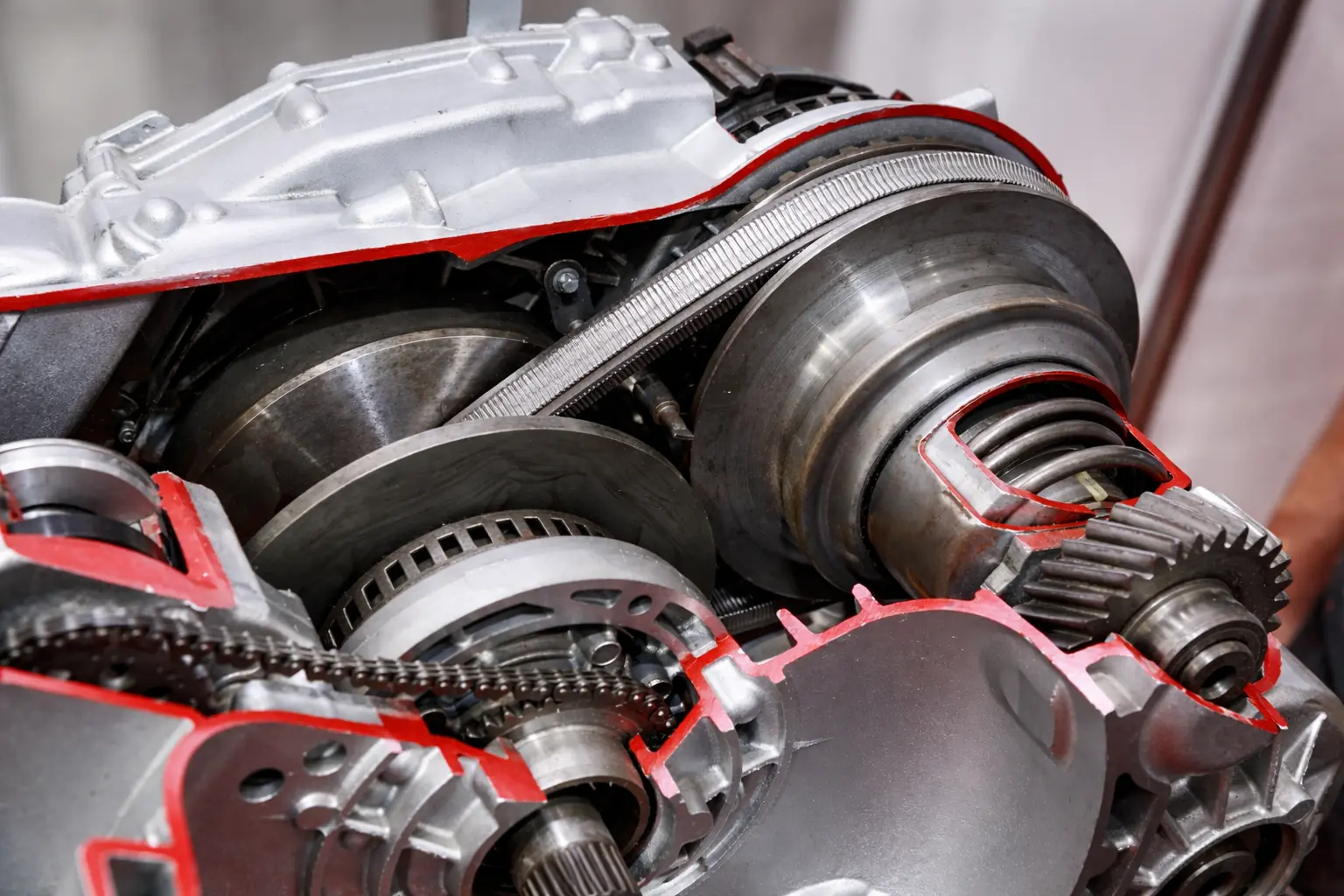
The Truth About CVT Transmissions: Engineering vs. Reputation
If you have purchased a vehicle in the United States over the last decade—whether it's a Nissan Rogue, a Honda CR-V, or a Subaru Forester—chances are it's equipped with a Continuously Variable Transmission (CVT). Manufacturers have pivoted to this technology to meet increasingly stringent EPA fuel economy standards, but for many American drivers, the "CVT" label remains a source of anxiety.
In this comprehensive guide, we strip away the marketing jargon to explain how these transmissions actually work, why some brands are legendary for reliability while others face class-action lawsuits, and exactly how to prevent a $7,000 replacement bill.
1. How a CVT Works: The Infinite Gear Ratio
Unlike a traditional Automatic Transmission (AT) that uses a complex set of planetary gears to create fixed steps (1st gear, 2nd gear, etc.), a CVT uses a variable geometry concept.
The Pulley and Steel Belt System
At its core, a CVT consists of two V-shaped pulleys connected by a heavy-duty steel belt or chain. By hydraulically squeezing or widening the pulleys, the diameter where the belt rides changes.
- Low Speeds/Hills: The drive pulley is small, and the driven pulley is large (high torque).
- Highway Cruising: The drive pulley expands, and the driven pulley shrinks (high speed, low RPM).
This seamless transition allows the engine to stay exactly in its optimum power band at all times. In 2026, many "Next-Gen" CVTs now include a physical Launch Gear for the initial takeoff, which significantly reduces the mechanical stress on the belt—the primary failure point in older units.
2. The Three Types of CVTs in the U.S. Market
Not all CVTs are built the same. Understanding which type is in your vehicle is the first step in predicting its lifespan.
- Push-Belt CVTs (Jatco/Nissan): The most common design, using a belt made of hundreds of steel elements. While Nissan has drastically improved these since the 2013-2017 "meltdown" era, they remain the most sensitive to heat and aggressive driving.
- Chain-Driven CVTs (Subaru Lineartronic): These use a heavy-duty chain instead of a belt. Chains can handle much higher torque loads, which is why Subaru uses them in the turbocharged WRX and the heavy Ascent SUV. These are generally considered more robust for American towing and terrain.
- eCVT (Toyota/Lexus Hybrid): Do not let the name fool you. An eCVT has zero belts and zero pulleys. It uses a planetary gearset and two electric motors to manage power. Mechanically, these are the most reliable transmissions in the world, often surpassing 300,000 miles in high-mileage taxi fleets.
3. The Warning Signs: Diagnostic "Red Flags"
CVT failure is rarely instant. It usually gives subtle hints that are often ignored until the vehicle enters "Limp Mode."
- The High-Pitched "Whine": If your car starts whistling or whining after 30 minutes of highway driving, your transmission fluid is overheating. The fluid is losing its ability to protect the metal, and the pump is struggling.
- The "Judder" or Shudder: Feeling a vibration when accelerating from a stop is a sign that the steel belt is physically slipping on the pulleys. This creates metal shavings that clog the internal filter.
- RPM "Hunting": If you notice your RPM needle bouncing up and down while maintaining a steady speed, the internal hydraulic pressure is fluctuating, likely due to a failing valve body.
4. The "Lifetime Fluid" Myth: A $7,000 Mistake
American dealerships often tell customers that CVT fluid is "Lifetime." In the engineering world, "Lifetime" usually means "until the warranty expires."
In a CVT, the fluid serves a dual purpose: it must lubricate bearings while providing enough friction to keep a steel belt from slipping on a steel pulley. Over time, the friction modifiers in the oil shear down.
- The Golden Rule: Change your CVT fluid (and external filters) every 30,000 to 45,000 miles.
- The Cost Logic: A professional fluid exchange costs roughly $280 - $400. A new transmission from the dealer starts at $6,000. The ROI on maintenance is undeniable.
5. 2026 Reliability & Cost Comparison (USA Data)
Current market averages for parts and labor in the U.S.:
| Manufacturer | Reliability Rating | Service Cost | Full Replacement Cost |
|---|---|---|---|
| Toyota (eCVT/Direct Shift) | 5/5 (Excellent) | $220 - $350 | $4,500 - $6,500 |
| Honda (H-CVT) | 4/5 (Very Good) | $190 - $300 | $5,000 - $7,000 |
| Subaru (Lineartronic) | 4/5 (Good) | $280 - $450 | $6,500 - $8,500 |
| Nissan (Jatco CVT8/Xtronic) | 3/5 (Average) | $180 - $320 | $4,800 - $6,500 |
Note: Prices reflect 2026 labor rates. Expect a 25% premium for Luxury/Performance models (e.g., Infiniti or Lexus).
6. Buying Used: The "CVT Health Check"
If you are at a used car lot in the U.S., perform these three tests before signing:
- The Incline Test: Stop the car on a steep hill and release the brake. The car should hold for a second (if equipped with hill-start assist) and move forward smoothly with light throttle. Any rolling back followed by a "clunk" is a major red flag.
- Fluid Inspection: Ask for the service records. If the car has 80,000 miles and the CVT fluid has never been touched, factor a transmission failure into your negotiation—or walk away.
- The "Slow Crawl" Test: Drive the car at 5-10 MPH in a quiet parking lot. Listen for any rhythmic clicking or grinding. A healthy CVT should be virtually silent at low speeds.
7. Frequently Asked Questions (FAQ)
Q: Can I tow with my CVT? A: Most CVTs are not built for heavy towing. If you must tow, ensure you stay well under the vehicle's rated capacity and consider installing an External Oil Cooler. Heat is the #1 killer of CVT belts.
Q: Why does my car "shift" if it has no gears? A: This is called "Step-Shift" programming. Engineers programmed the computer to mimic gear shifts because American drivers found the constant, high-RPM drone of a true CVT unnerving. It’s purely for your ears, not for performance.
Q: Can a CVT be rebuilt? A: For years, they were "replace only." However, in 2026, specialized shops can now replace the belt and pulleys. However, the labor is still high, and a factory-remanufactured unit is often the better value due to the included warranty.
Do you drive a Nissan, Honda, or Subaru and feel a slight "hiccup" when cruising? Tell me your Year and Mileage, and I can tell you if there is an active Recall or Warranty Extension for your specific transmission before you pay out of pocket!