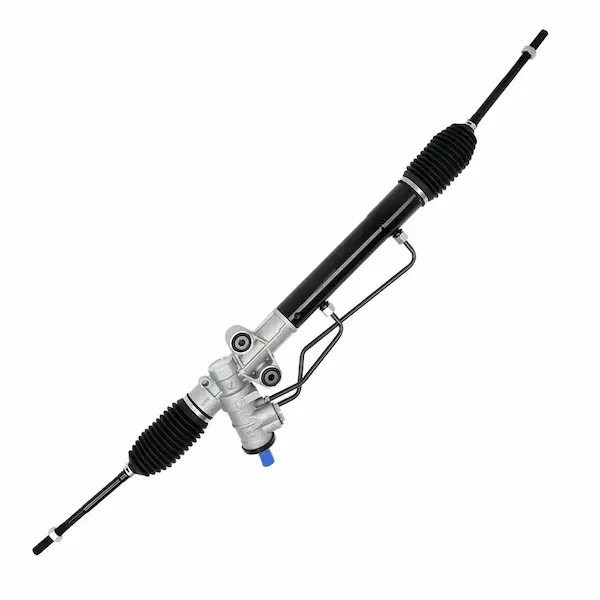
Steering Rack & Pinion: Engineering Precision and Failure Prevention
The steering rack is the critical link between your hands and the pavement. While often tucked away beneath the engine cradle, this component manages thousands of pounds of lateral force every time you navigate a freeway off-ramp or pull into a parking spot. In today’s automotive landscape, where heavy SUVs and trucks dominate the roads, the steering rack is under more stress than ever before.
Understanding how this system evolves—from the classic hydraulic setups to the sophisticated Electronic Power Steering (EPS) found in 2026 models—is the difference between a simple maintenance task and a catastrophic mechanical failure.
🧭 The Shift to Digital Direction: Understanding Your System
For decades, steering was a messy, fluid-based affair. Today, the industry has undergone a massive shift toward efficiency and driver-assist integration.
Hydraulic Power Steering (HPS)
Common in older work trucks and classic sports cars, HPS relies on a belt-driven pump and high-pressure lines. While it provides excellent road feedback, it is prone to leaks at the high-pressure seals. In 2026, these systems are increasingly rare, primarily found in heavy-duty applications where cooling the steering fluid is a priority during towing.
Electronic Power Steering (EPS)
Standard on almost every vehicle produced in the last five years, EPS replaces the pump and hoses with a high-torque electric motor mounted directly to the rack. This eliminates the risk of oil leaks but introduces complex electronic failure points. EPS is what enables your vehicle’s Active Lane Centering and Automatic Emergency Steering—features that rely on the rack’s internal sensors to calculate torque and angle in milliseconds.
⚠️ Critical Failure Symptoms: Beyond the "Clunk"
A failing steering rack doesn't just make noise; it changes how your vehicle behaves at speed. If you experience any of the following, your rack's internal geometry or electronics are likely compromised.
1. The "Morning Sickness" Effect
In hydraulic systems, you might notice that the steering is incredibly stiff when you first start the car but loosens up once the engine warms. This is often caused by internal wear in the rack's aluminum housing, where the seals have "scored" the metal. As the metal expands with heat, the seals finally catch, but this is a definitive sign that a replacement is imminent.
2. Excessive "Play" or Vague Center-Feel
If you can move your steering wheel two inches in either direction before the tires actually react, you have significant internal wear. This usually stems from a worn pinion gear or degraded internal bushings. On the highway, this creates a dangerous "wandering" sensation where the vehicle won't stay in its lane without constant correction.
3. Electronic "Dead Zones" (EPS Only)
For modern electric racks, a common failure is a loss of assistance in only one direction. You might find it easy to turn left but significantly harder to turn right. This typically indicates a failing torque sensor within the rack assembly. Because these sensors are often integrated into the unit, the entire rack usually requires replacement.
🛠️ The $20 Part That Saves a $1,500 Rack: The Bellows
The number one cause of premature rack failure isn't mileage—it's contamination. The steering bellows (the accordion-style rubber boots) protect the inner tie rods and the rack's polished chrome bar.
When these boots crack due to age or road debris, they allow road salt, moisture, and grime to enter the housing. Once moisture touches that internal bar, it begins to pit and rust. As that rusted bar slides back and forth through the precision seals, it shreds them from the inside out. Inspecting these boots during every oil change is the single most effective way to prevent a total steering overhaul.
💰 2026 Repair and Replacement Cost Analysis
Repair costs vary significantly based on vehicle segment and whether the system is hydraulic or fully electric. Below are the current market averages for parts and labor.
| Service Category | Compact/Sedan | Full-Size Truck / SUV | Luxury / Performance |
|---|---|---|---|
| Bellows/Boot Replacement | $180 - $300 | $250 - $400 | $350 - $550 |
| Outer Tie Rod Ends | $200 - $350 | $300 - $500 | $450 - $700 |
| Remanufactured Rack (Installed) | $750 - $1,100 | $900 - $1,400 | $1,600 - $2,400 |
| New OEM Electric Rack (Installed) | $1,200 - $1,800 | $1,500 - $2,500 | $3,000 - $5,000+ |
Note: All steering rack replacements require a professional four-wheel alignment immediately following the repair to ensure the steering angle sensor (SAS) is properly calibrated.
❓ Frequently Asked Questions (FAQ)
Can I drive with a leaking steering rack? If it's a slow "seep," you can manage it by topping off the fluid, but you are playing a dangerous game. If the fluid hits a hot exhaust manifold, it can cause an engine fire. If the leak is internal, you could experience a sudden loss of assistance while cornering.
Why does my steering wheel vibrate at 65+ MPH? While often caused by unbalanced tires, a vibration that only occurs during slight turns or under braking can point to worn internal rack bushings or "inner" tie rod ends that have developed excessive play.
Do I need a "Flash" or "Programming" for a new rack? Yes. In almost all 2020+ vehicles with EPS, the new steering rack must be "married" to the vehicle’s VIN using a factory-grade scan tool. Without this programming, the power assistance may not activate, and the dashboard will remain lit with error codes.
Does your vehicle feel like it's "pulling" to one side even after an alignment? Drop your Year, Make, and Model below—I can check for specific Technical Service Bulletins (TSBs) regarding steering rack recalls or software updates that might fix your issue without a hardware replacement.